The triumph of his tired eyes
February 28th, 2010 § 1 Comment
I am overjoyed (yes, I am capable of it) to write that my colleague, friend and co-conspirator Ryan Van Winkle has been awarded the Crashaw Prize by Salt Publishing.
I will let you know when you can purchase his debut collection.
Now he will be buying me drinks.
Inherent Vice, Chapter 19
February 27th, 2010 § Leave a Comment
PLOT-Doc meets Crocker Fenway and arranges to trade the heroin in return for an assurance that Coy Harlingen and family wont be harmed. The trade takes place without any double cross.
p. 343
Whilst waiting for Fenway, Doc inspects a mural depicting the arrival of the Portola expedition in 1769. In terms of local karma, this is as close as one gets to original sin. The mural, however, is clearly not to be trusted as historical record.
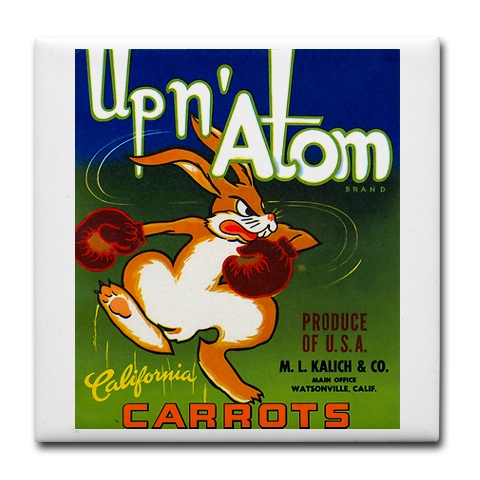
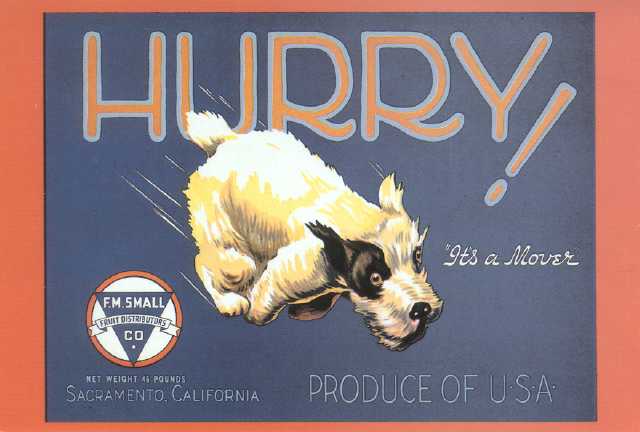
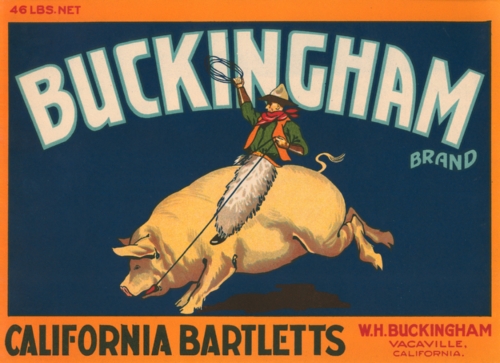
The pictorial style reminded Doc of labels on fruit and vegetable crates when he was a kid. Lots of color, atmosphere, attention to detail… Everybody in the scene looked like a movie star.
It’s style is that of advertising and commerce; the people are substitutes; the details it pays attention to are not those of history. However, the labels are worth a look:
Pynchon then produces a piece of imperial rhetoric to describe one of the expressions of the men in the mural:
There was an expression of wonder, like, What’s this, what unsuspected paradise? Did God with his finger trace out and and bless this perfect little valley, intending it only for us?
This perfectly reproduces the sense of divinely ordained entitlement that lies behind exploration and conquest, with the notion of God ‘intending it only for us’ being especially sharp in its denial of the rights of any indiginous people. However the mural, for all its flaws, is still a reminder of the past, which thus allows for some debate about the nature of that past. Crocker (who is shortly to give one of the most villainous speeches of the book) says ‘Never noticed it really.’
p. 346-347
feature some of the harshest, most political exchanges of the book, in which Doc sounds far more world-weary than when he began.
Crocker Fenway chuckled without mirth. “A bit late for that, Mr Sportello. People like you lose all claim to respect the first time they pay anybody rent.
“And when the first landlord decided to stiff the first tenant for his security deposit, your whole fucking class lost eveybody’s respect.”
Doc continues:
“Every time one of you gets greedy like that, the bad-karma level gets jacked up one more little two-hundred-dollar notch. After a while that starts to add up. For years now under everybody’s nose there’s been all this class hatred, slowly building. Where do you think that’s headed?
I think this is the first time that the karmic equation has been invoked to explain something other than a present ill; it is here being used in a predictive fashion, and aimed at a specfic group of people, as opposed to all of ‘us’.
The lines are then drawn even more clearly:
“We’ve been in place forever. Look around. Real estate, water rights, oil, cheap labor- all that’s ours, it’s always been ours. And you, at the end of the day what are you? one more unit in this swarm of transients who come and go without pause here in the sunny Southland, eager to be bought off with a car of a certain make, model, and year, a blonde in a bikini, thirty seconds on some excuse for a wave- a chili dog, for Christ’s sake.” He shrugged. “We will never run out of you people. The supply is inexhaustible.”
A pretty fair summary of the capitalist system.
p. 349
Doc continues to sound jaded.
“What, I should only trust good people? man, good people get bought and sold every day. Might as well trust somebody evil once in a while, it makes no more or less sense. I mean I wouldn’t give odds either way.”
Denis’ response is to say ‘That’s heavy,’ then, after a toke, ‘What does that mean?’- the pattern of pronouncement/avoidance/humour that is common in Pynchon.
p. 350
Even Bigfoot has ‘weird twisted cop karma’.
This and that
February 26th, 2010 § Leave a Comment
A few things worth a look-
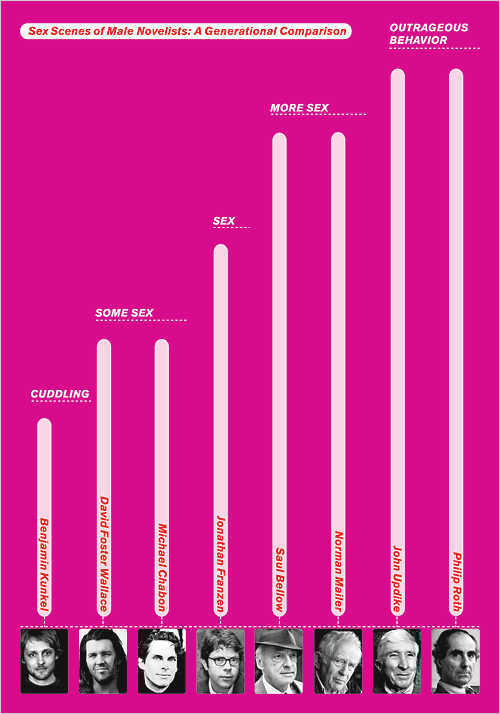
William Vollmann’s review of Ted Conover’s ‘The Routes of Man’; a new take on Salinger’s ‘A Perfect Day for Bananafish‘; the Great Male Novelists compared; why it isn’t worth being on Amazon sometimes; clip from the new Walker Percy documentary; and Zadie Smith’s rules for writers.
Inherent Vice, Chapter 18
February 25th, 2010 § Leave a Comment
PLOT-Doc goes to visit Adrian Prussia, where he is drugged by Puck Beaverton. After this he wakes up, handcuffed to the bed, and can do nothing but summarise the plot. Doc then escapes, killing Puck and Adrian, only to find that Bigfoot has set him up and is now stealing the Golden Fang’s heroin. Though he and Bigfoot appear to come to an understanding, this is only cover for a further set up, as the heroin is planted in Doc’s car. After some bait and switch, he stashes it in Denis’, then gets a call from Crocker Fenway, asking to meet so that Doc can return the drugs.
p. 315
He recalled that somewhere behind him, back at the beach, it was still another classic day of California sunshine.
This feels like a historical reference, only it is Doc who feels that things were better in the past (his present).
He thought about Sortilege’s sunken continent, returning, surfacing this way in the lost heart of L.A., and wondered who’d notice if it did. People in this town only saw what they’d all agreed to see, they believed what was on the tube or in the morning papers half of them read while they were driving to work on the freeway, and it was all their dream about being wised up, about the truth setting them free. What good would Lemuria do them? Especially when it turned out to be a place they’d been exiled from too long ago to remember.
Here is the depressing answer to the idea that we might be ‘saved’- even if our lost (and imagined) utopia was restored to us, it wouldn’t help. The reason being that the consensus we operate under isn’t open to that- in Pynchon, the truth never sets anyone free, but instead enmeshes them in a series of conflicting impulses that lack easy resolution.
p. 316
In Prussia’s office, the light itself has been compromised (see Against the Day for more of this light/knowledge/harm/guilt stuff).
Heated downtown smoglight filtered in from the window behind him, light that could not have sprung from any steady or pure scheme of daybreak, more appropriate to ends or conditions settled for, too often after only token negotiation.
There is also another stopped clock, that Prussia affects to read the time from. This is continued on p. 317
“So who sent you here? Who you working for today?”
“All on spec,” Doc said. “All on my own time.”
“Wrong answer. How much of your own time you think you got lef,t kid?” He checked the dead wristwatch again.
‘Time’ here can also be read in a broader fashion, in terms of the period and its supposed freedoms.
p. 318
This being a novel with genre elements, the villain does need to show up, and this being a Pynchon novel, it is only in a drug-induced hallucination.
p. 321
Linking of a sex ring to Governor Reagan’s administration. This is the most specfiic reference to a future ill thus far- previously it has all been shadows and vague threats.
Adrian Prussia is also told
“The Governor has some great momentum right now, the future of America belongs to him, somebody can be doing American history a big favour here, Adrian.”
Whilst the first and second propositions may be true, there is an ironical slant to the third- arguably, the big favour to history would have been not to help him.
p. 322
A highly sexualised death, with plenty of S & M, not a new thing in Pynchon’s work, but one that I miss the point of here. Maybe its the ugliness of having someone like Prussia- a hired killer -take the moral highground with a pornographer.
p. 326
Doc has a flashback, possibly from the PCP, and possibly not, in which he understands that
he belonged to a single and ancient martial tradition in which resisting authority, subduing hired guns, defending your old lady’s honor all amounted to the same thing.
What this thing is isn’t specified- it could easily be ‘nothing’. Heroism has no place, and no chance, perhaps.
**General observation- is all this being drugged and shooting and killing actually happening? It’s so genre appropriate that I can’t help but wonder.
p. 329
General ominousness-
The sun was just down, a sinister glow fading out above the edge of the world.
p. 334
Bigfoot issues a little wisdom:
“What goes around may come around, but it never ends up in exactly the same place, you ever notice? Like a record on turntable, all it takes is one groove’s difference and the universe can be on into a whole n’other song.”
On the one hand, this is an affirmation in the power of change; on the other, it’s still the same record, still the same turntable.
This metaphor has already appeared, on page 262 (“as if some stereo needle had been lifted and set back down on some other sentimental oldie on the compilation LP of history.”).
p. 339
Doc hides the heroin in a TV container in Denis’ place- when he comes back Denis is
sitting, to all appearances serious and attentive, in front of the professionally packaged heroin, now out of its box, and staring at it, as it turned out he’d been doing for some time.
Whilst this is a final, non-too subtle twist on the TV-as-narcotic theme that has run throughout the book, it may be doing more than critiquing TV. Perhaps TV is only one of many narcotics- it is then more about the psychological needs that each of these meet, rather than some… (ahem)… inherent vice of the drug.
p. 341
Dream in which the Golden Fang ship has been redeemed and ‘dezombified’. Sauncho gives a ‘kind of courtroom summary’ which is both sentence and grounds for optimism.
“… yet there is no avoiding time, the sea of time, the sea of memory and forgetfulness, the years of promise, gone and unrecoverable, of the land almost allowed to claim its better destiny, only to have the claim jumped by evildoers known all too well, and taken instead and held hostage to the future we must live in now forever. May we trust that this blessed ship is bound for some better shore, some undrowned Lemuria, risen and redeemed, where the American fate, mercifully, failed to transpire…”
Is this, then, a verdict on people’s attempt to avoid and deny the politically hopeless state they find themselves in? Or is the book in many ways a resounding contradiction to this? Which has primacy?
The claim is ‘jumped’ as with a record (see page 334), which brings to mind a passage from Against the Day:
“Most people have a wheel riding up on a wire, or some rails in the street, some kind of guide or groove, to keep them moving in the direction of their destiny.” (AD, 46)
Though the notion of a ‘future we must live in now forever’ doesn’t sound optimistic, it could also mean that we have to abandon our laments for what we (imagine?) we have lost, and focus on constructing the best world we can. Also, the ‘we’ in the sentence is clearly far from all-inclusive- there is still those on the blessed ship, for whom the entirety of US history is no more than a cautionary tale. Unless they are just the fond imaginings, a futher escape, of people who feel themselves doomed.
Inherent Vice, Chapter 17
February 17th, 2010 § Leave a Comment
PLOT- Coy tells Doc how he ended up being recruited as a snitch. Doc and Shasta reunite. Sort of. She makes him wonder if there’s any difference between he and Coy.
This is a thematically tight chapter, with its references to zombies, enslavement, addiction, being in the service of evil and irresistable powers.
p. 297
“You can’t always blame zombies for their condition,” says Doc, what may be only a joke, or instead a wider comment about our many forms of enslavement.
p. 297
Anybody understand why they call it ‘real’ estate’?” wondered Denis.
Good question.
p.298
Right now Coy had the look of sailor on liberty, willing to live inside the moment till he had to be back in some condition of servitude.
p.299
Further space reference, to Pink Floyd’s ‘Interstellar Overdrive’.
p.300
Coy’s method for kicking heroin is called, ironically, ‘Higher Discipline’. The irony is compounded by the fact that there is the incentive of ‘a once-a-year fix of Percodan, then regarded as the Rolls-Royce of opiates’. There is thus no recovery from addiction- just the substitution of one drug for another.
p.302
Coy makes the ‘karmic error of faking his own death’.
p.303
Nice mix of contradictory, yet truthful attributes in Doc’s self-description
He was back to his old wised-up self, short on optimism, ready to be played for a patsy again. Normal.
p. 305
Shasta tells Doc about the way Mickey treated her, how it was ‘so nice to be made feel invisible that way sometimes’. Here is a non-drug based method of dissociation- being treated so badly you cease to feel like a person. Even this, she suggests, can be a relief.
p. 312
has some karmic advice- ‘the best way to pay for any luck, however temporary, was just to be helpful when you could.’
p. 313
Shasta describes Coy and Doc as
cops who never wanted to be cops. Rather be surfing or smoking or fucking or anything but what you’re doing. You guys must’ve thought you’d be chasing criminals and instead here you’re both working for them.
Though it might seem that there is a difference between them, Doc is not sure. There is then, on p. 314, this passage.
Doc followed the prints of her bare feet already collapsing into rain and shadow, as if in a fool’s attempt to find his way back into a past that despite them both had gone on into the future it did.
At first this seemed hard to decipher- if the past had gone on into the future, that makes it seem like it hasn’t changed, so why need he try and find his way back to it? On third reading, I think it’s just a lament for a past (perhaps an imagined one) that led to a negative future. Which perhaps raises the question- how idyllic could such a past have been if it led to a present ruin? By imagining our past utopia, we must also undermine it, else there cannot be the Fall that leads to the present.
Inherent Vice, Chapter 16
February 15th, 2010 § Leave a Comment
PLOT- Doc and Penny hook up again. The detective killed by Adrian Prussia turns out to be Bjornson’s old partner. Doc also finds a photo of Prussia in front of the Golden Fang. When he returns his office he finds Clancy Charlock and Tariq Khalil going at it on the floor. Tariq tells Doc about the arms deal Glen Charlock did with the WAMBAM. Later, Doc has a stoned conversation with Thomas Jefferson.
p. 278
When Doc needs to look at someone’s file, he says,
Ancient history, but it’s still under seal. Like till 2000?
There something disorientating about having a reference to the distant past with a projected event in the narrative future, which is actually our recent past. I’m not sure that we, as readers, can reconcile these different time periods, since one is imagined and the other is history, and maybe that’s the point. Whatever we take to be history, it isn’t a cohesive, continuous narrrative, but one of conflicting, contradictory accounts.
p.280
Further temporal distortion: when Doc and Penny are having sex, ‘for an untimably short moment Doc believed it was somehow never going to be over, though he managed not to get panicked about that.’
p.282
Further differentiation of the FBI and local cops, with the idea that the FBI are beyond the law. Then a long passage about ways of pereceiving and understanding from a supposedly addled state.
The clock up on the wall, which reminded Doc of elementary school back in San Joaquin, read some hour that it could not possibly be.
What matters here, I think, is disbelief- it is not that the situation (1970s America, or that of the present) was impossible, or even implausible, more that ‘we’ told ourselves it was. Such denial of the we-did-not-think-it -could-ever-possibly-get-this-bad variety is of course a contributory factor.
The passage continues:
Doc waited for the hands to move, but they didn’t, from which he deduced that the clock was broken and maybe had been for years.
Another interpretation would be that that time (as a index of change) has stopped. If the hands are not moving, it is thus not because the clock is broken, just that there is nothing for it to measure. This ties in with the whole idea (which I don’t have much use for) that there is a ‘crisis of historicity’.
Yet another interpretation is that it is ‘the time’ (i.e. society) which is broken. However, there is still the possibility of learning something from what seems to be broken (as there is from a paranoid supposing).
Which was groovy however because long ago Sortliege had taught him the esoteric skill of telling time from a broken clock. The first thing you had to do was light a joint… After inhaling potsmoke for a while, he glanced up at the clock, and sure enough, it showed a different time now, though this could also be from Doc having forgotten where the hands were to begin with.
Thus the means by which this knowledge is gained contaminate the answer.
p.283 Further reference to ‘ancient history’ (at least the third- the other being a reference to The Flinstones’ theme song).
p.286 In the photo of Adrian Prussia, the Golden Fang is described as ‘riding calmly at anchor in some nameless harbour, slightly out of focus as if through the veils of the next world’. This latter reference may refer to the future, and also our present.
Sauncho freaks out when he watches The Wizard of Oz on a colour TV, what is partly a stoner over-reaction, but also a commentary on the distorting effect of TV.
-the world we see Dorothy living in at the beginning of the picture is black, actually brown, and white, only she thinks she’s seeingit all in colour- the same normal everyday color we see our lives in. Then the cyclone picks her up, dumps her in Munchkin Land, and she walks out the door, and suddenly we see the brown and white shift into Technicolor. But if that’s what we see, what’s happening with Dorothy? What’s her ‘normal’ Kansas colour changing into? Huh? What very weird hypercolor?
p.288
In the previous chapter I wrote that Pynchon is rarely cynical about love. However, when Petunia says ‘Oh, Doc. Love is the only thing that will ever save us’, his only response is ‘Who?’ It is not love that is the problem- more the notion of ‘us’- and the questions of who can we trust, and what constitutes a bond.
p.293
The commodification of resistance and murder.
I been seein these T-shirts and shit? Like Manson’s mug shots with Afros airbrushed onto them, that’s real popular.
There is thus the suggestion that these are equivalent, in their status as icons, and that this matters more than what they stand for. This is certainly true of the variations of Che Guerava seen on T-shirts.
p.293 also has a too long to type out passage of paranoia (or dead on commentary) which, after a long list of paranoid supposings, asks
And would this be multiple choice?
It is thus not necessarily a question of only one of these terrible supposings being true. That could even be the best we can hope for.
p.294
Thomas Jefferson (also appears in Mason & Dixon, p.385) speaks to Doc:
So! The Golden Fang not only traffick in Enslavement, they peddle the implements of Liberation as well.
Though this is a reference to guns, it can also be a reference to drugs- the depressing thing being that both of those, whatever their revolutionary potential, are just further commodties.
Beheaded by a laser beam
February 5th, 2010 § Leave a Comment
I haven’t been able to watch TV news in years, mostly due to the sterling efforts of Mr Chris Morris on programs such as The Day Today and Brass Eye.
But we all need booster shots, and here is one courtesy of Mr Charlie Brooker.
‘Non-buyers of carrots and turnips’
February 4th, 2010 § Leave a Comment

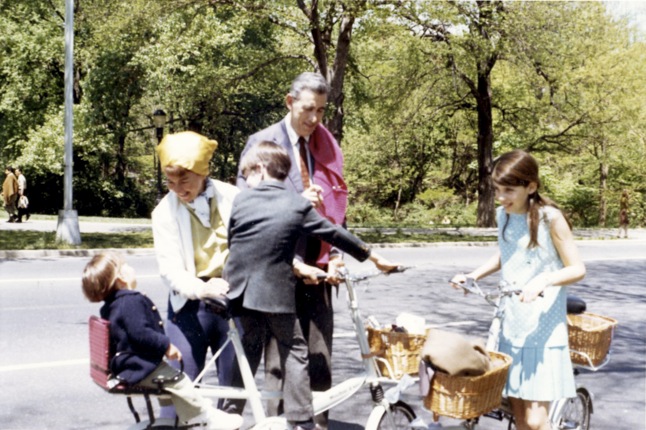
From left: Erik Ross, Lillian Ross, Matthew Salinger, J. D. Salinger, and Peggy Salinger, in Central Park.
The first rash of obituaries for J.D. Salinger seemed to add little to what we had known for years. That he had removed himself from the world (at least, the literary one) for decades, only emerging to defend his privacy, albeit sometimes at the cost of it. That he had been writing… something during this time, but what this was, and whether we might dare to hope to see it, was no more certain than it had been for the last four decades.
However, now that the news cycle has moved on slightly (and perhaps also now that it is clear that this is not a hoax), people who had known Salinger are starting to come forward. Some of these are fairly minor, as one might expect from people who only had glancing, professional contact with Salinger (such as Tim Bates, who corresponded with Salinger whilst working at Penguin, in the far distant days before he was my agent for a brief time. About this, let it merely be said that, like Salinger, I too remember him in my nightly prayers) whilst others are from people with a deeper connection, such as Lilian Ross of the New Yorker, who talks of his love for Emerson’s dictum that
“A man must have aunts and cousins, must buy carrots and turnips, must have barn and woodshed, must go to market and to the blacksmith’s shop, must saunter and sleep and be inferior and silly.” Writers, he thought, had trouble abiding by that, and he referred to Flaubert and Kafka as “two other born non-buyers of carrots and turnips.”
Ross’ piece is the first one to make me recall what I prize most in Salinger- not the talk of phonies and fakes, but the unswerving belief in innocence. What I would like to be able to call Goodness. There are whole clusters of feelings we spend most of our adult lives avoiding, because of the risks they involve, because we lack the opportunity, or courage- these are what Salinger gives voice to. These are why it is worth reading (and re-reading) Franny & Zooey, Seymour: an introduction, and For Esme with Love and Squalor.