The photos of Lu Guang

I used to live in Shaoyang, a small town in Hunan province, in the south of China. When I told strangers where I was living they said, ‘There are many criminals there’ or ‘They have many oranges’. But the most frequent response was ‘That is a dirty place’. In many respects they were right. There were always piles of litter on the street, some of which were never swept up. The water in the Shao Shui river was a dubious green, like that of a jade milkshake (a colour some attributed to the presence of a dragon that slept in there). Even the people of the town said they disliked it being for dirty, though there was often a double standard at work- those who wiped the seat of a bus or chair in a restaurant, or who insisted on sitting on newspaper, were also the same people I saw throw cans and tissues out of train and bus windows.

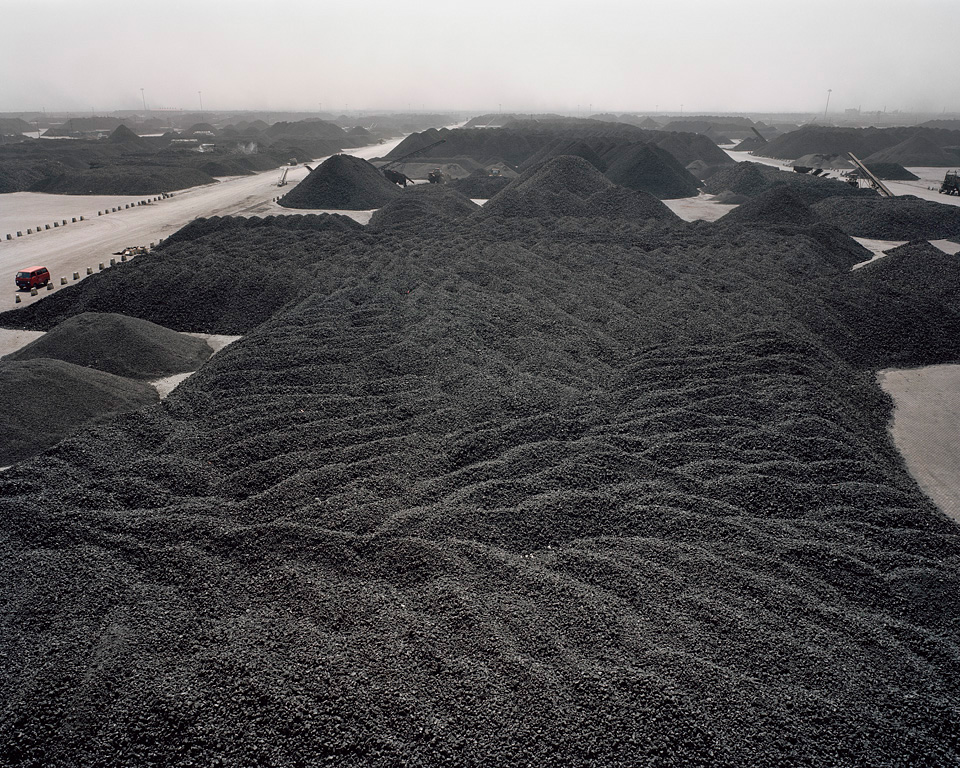
But Shaoyang was in an agricultural region. Whilst I often saw rubbish caught in the sluice gates of the dam- and once the burst body of a pig -there were few signs of industrial pollution, nor of the alterations of landscape depicted in Edward Burtynsky’s photos (click on them to enlarge).
CHNA_STE_TAN_10_05

Tanggu Port, Tianjin 2005

TGD_FJ_04_02

Feng Jie #4

TGD_WZ_04_02

Wang Zhou #4

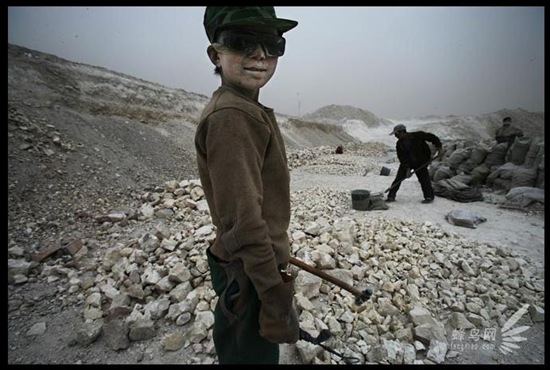
Though it is clear from watching Manufactured Landscapes (the documentary about his work) that Burtynsky has a strong environmental stance, his pictures often have a neutrality about them- the sense of judgement witheld. The same cannot be said of Lu Guang’s photos which make plain the environemntal costs of China’s reliance on coal-fired power stations (approximately 80% of their energy).
20091020luguang23

15-year-old boy from Tianshui, Gansu Province

20091020luguang17

Longmen town in Hanchen city, Shaanxi Province

20091020luguang16

Tianjin Steel Plant, She County, Hebei Province, March 18, 2008
An army with no uniforms

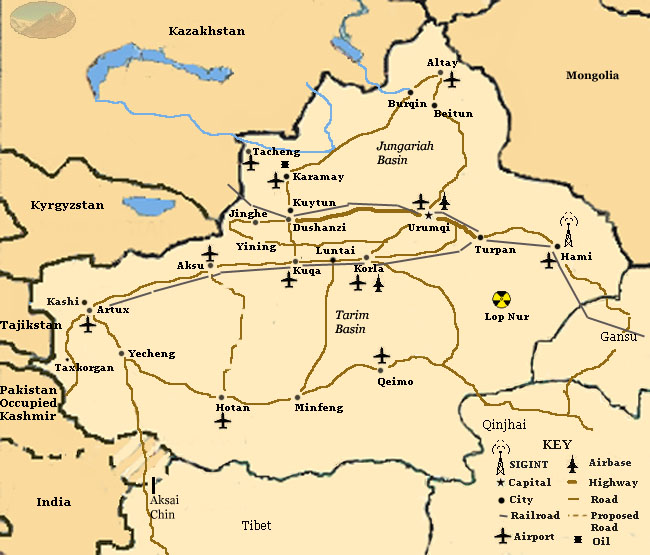
I have a letter in the new LRB (dated September 24) which expands on one of the major causes of unrest in Xinjiang: the massive resettlement of Han Chinese in the province, many of whom are part of the Xinjiang Production and Construction Corps, a paramilitary organisation that has a controlling presence in both agriculture and industry in the region. I also respond to the claim (made in a letter responding to my piece) that the reports of atrocities during the riots in Urumqi in early July were in all liklihood true.

When I lived in Xinjiang I thought I understood how pervasive the XPCC presence was. In the process of doing only mild research, I have come to realise that I still underestimated the extent of their influence- they have their own TV station, they have built their own cities, and even have a parallel education system, from primary schools all the way up to university. Although parallels are often drawn between Xinjiang and Tibet, perhaps an equally instructive one could be drawn between the Israeli settler movement and the activities of the XPCC.

Sale of stuff

In a rearguard action to gain some shelf-space (and to support various legal ‘habits’) I’m selling some magazines and anthologies I’ve been in. I only have a few copies of each, so fortune will favour the bold.

For £6 (+£1 postage, UK only) you can get a copy of The Southern Review, which my story ‘The Ballad of Lucy Miller’ appeared in. Here’s a short Review of it.

tsr_spring2009

For the same price, there’s the Edinburgh Review special issue on China that has a non-fiction piece about Xinjiang.

124

For £7 ((+£1 postage, UK only) you can buy a copy of the Willesden Herald Anthology that features my story ‘Amy’, and a fine story by Jo Lloyd entitled ‘Work’. There’s a review here.


41dOHV+K4fL._SS500_

Payments only accepted by PayPal. Send the £7 or £8 to nholdstock@hotmail.com

‘A profound lesson in blood’

_46015541_007602849-1

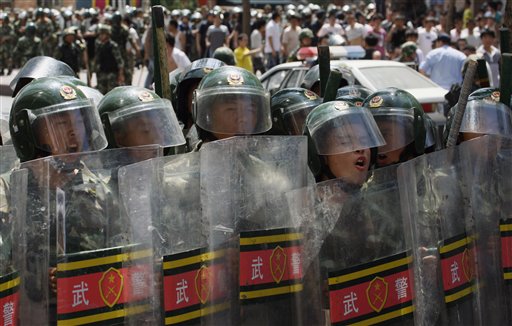
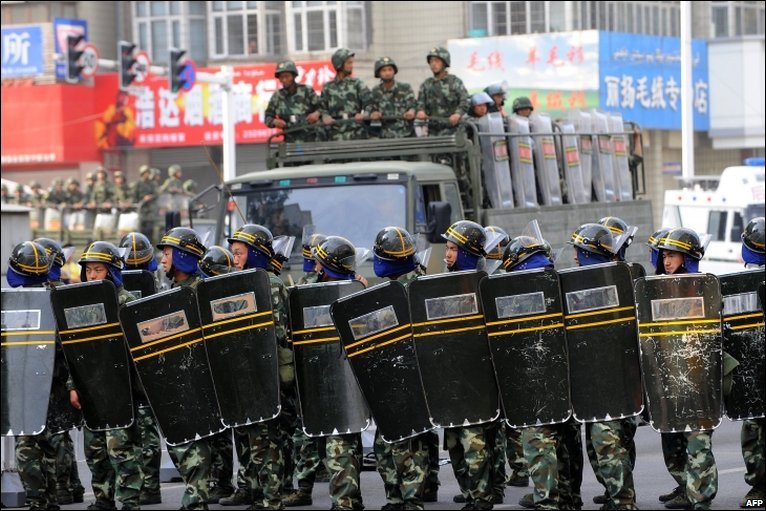
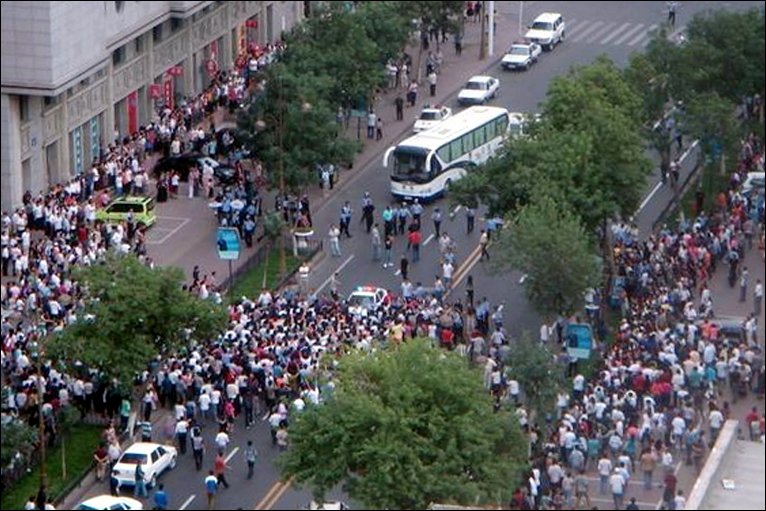
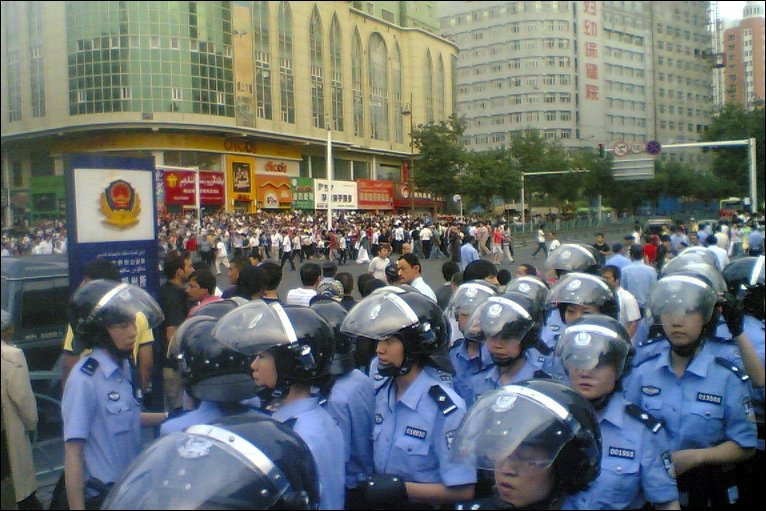
Police in central Urumqi

I have a new piece about Xinjiang at Eurozine, which is a bit more speculative than my piece in the London Review of Books. It also fills in some of the gaps of the last few years, between the time I left Yining (2002) and the Urumqi riots in July.

The Tree That Bleeds

img045

Luath Press are going to publish The Tree That Bleeds, my book about living in western China, in early 2010.

For more information, click on the tab above.

Yeah, I’m pretty pleased.

An opinion

_46025777_007618209-1

Though there is a long history of protest in Xinjiang (most notably in Baren, in 1990, and Yining, in 1997) the recent unrest in Urumqi differs from previous clashes in two important respects.

The first is that however the events of July 5th started (whether it was intended as a peaceful protest or not), it definitely ended in violence. Usually this violence has been between Uighur protesters and the army or police (with the protesters on the receiving end). On this occasion, judging by scores of interviews (and the casualty figures, of whom two-thirds were Han) the violence was mostly aimed at Han residents. This, then, is violence on purely ethnic grounds, aimed at other citizens rather than representatives of the government.

The second is the Han response to Sunday’s riots, when they purposefully set out to attack Uighur neighborhoods.This has reinforced the purely ethnic side of the conflict. The role of the police, unusually, has thus been to actually keep the peace.

Whilst the authorities represent a clearly defined entity, about which specific (and verifiable) grievances can be expressed, the same logic cannot apply to other ethnic groups. The fact that most of the police and army (and government) are Han Chinese naturally leads people to conflate the two, but does not, I think, necessitate an automatic hatred for people as individuals. When I lived in Yining in 2001-2, Han and Uighurs were able to co-exist, albeit often in separation (separate schools, neighborhoods, shops and restaurants). Though there was prejudice in abundance, there was rarely any sense that it would escalate to violence.

But even uneasy co-existence seems far off in Urumqi. There will probably be soldiers on the streets for a long time.

‘Martial law in all but name’

_46025780_007618231-1

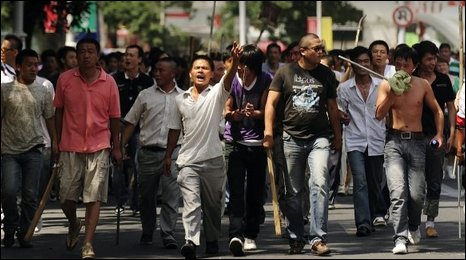
Yesterday a mob (I think this is a fair way to describe a crowd of people armed with iron bars, meat cleavers and shovels who are shouting angry slogans) of Han Chinese attacked Uighur neighborhoods in Urumqi, in apparent retaliation for Sunday’s violence. Though there were reports of beatings, no casualties have been confirmed (which did not stop the World Uyghur Congress from reporting a long list of atrocities:

A Uighur woman who was carrying a baby in her arms was mutilated along with her infant baby… over 1,000 ethnic Han Chinese armed with knives and machetes marched into Xinjiang Medical University and engaged in a mass killing of the Uighurs… two Uighur female students were beheaded… their heads were placed on a stake on the middle of the street.

This post seems to have since been removed from their site (and it is important to stress that there has been absolutely no indication of any such horrific events), in favour of reports that rely more on the major news providers.

Today, the BBC are reporting a massive troop influx into the city (some estimate 20, 000). They show footage of soldiers marching through the streets; there is talk of it being ‘martial law in all but name’.

Interesting, their footage (which looks to be in a central, Han area) shows people going about their daily business. No doubt the increased troop presence has reassured them there will not be a repeat of Sunday’s violence (a retaliation for their retaliation).

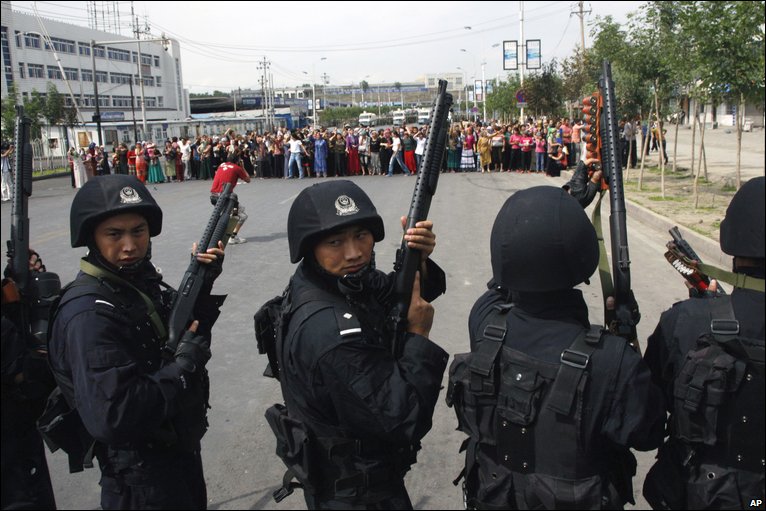
The BBC also have this photo of a Uighur neighborhood, where residents are apparently blocking off a street. Perhaps they are less reassured by the massive influx of troops.

Uighur residents blocking off street

Uighur residents blocking off street

“Ethnic confrontation should be definitely prohibited”

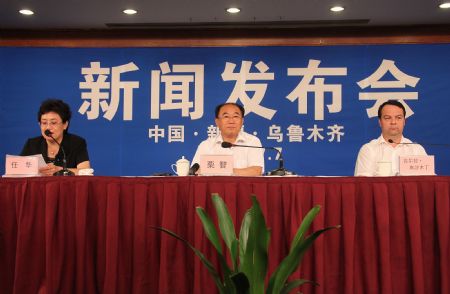
Local government officials hold a press conference

Local government officials hold a press conference

This was the message of Wang Lequan, secretary of the Xinjiang Uygur Autonomous Region Committee of the Communist Party of China (CPC) earlier today, who sounded increasingly worried, and unusually conciliatory.

“Neither the people of Han nor Uygur ethnicalities (sic) are willing to see the Han people being attacked. It is the same the other way around. If the Han people attack the innocent Uygur people, it is also heart-breaking. The family members of those who were involved in the violence are innocent. We should be cool-headed and do not be fooled by the enemies…Our targets should be the hostile forces at both home and abroad and criminals, rather than our own brothers and sisters of different ethnic backgrounds.”

He also announced there will be a curfew in Urumqi (and probably elsewhere).

A less conciliatory note was struck by Foreign Ministry spokesman Qin Gang, who denied that the original protest on Sunday had been intended to be peaceful. He described it as “an evil killing, fire setting and looting… Anybody calling the violence a peaceful protest is to turn black into white in an attempt to mislead the public,” Qin told a press conference.

At present, an estimated 1,400 people have been arrested across the province in connection with Sunday’s protest.

“Now we are going to their area to beat them”

_46019971_hi007610426

Chinese official sources are reporting what appears to be a counter-protest in Urumqi, this time by Han Chinese. They report that several thousand people

“armed with clubs and knives.. marched along the Youhao Street and Guangming Street toward Erdaoqiao Roadin downtown Urumqi Tuesday afternoon. The protesters, mostly Han Chinese, were shouting “protecting our home, protect our family members”. Police armed with guns and shields guarded intersections. A Xinhua reporter saw a police officer crying while he followed the march.Many of the protesters gathered at the Urumqi South Railway Station, Changjiang Road, Yangzijiang Road and some other places. People ran in panic and roadside shops were shut down. Residents of some community compounds were holding bats for self-defense.”We will not hide up anymore. We will fight back if they (the rioters) come,” said a man standing in front of a building in Shihezi. Crowds of people rushed to the municipal people’s hospital to take shelter. Many nurses were trying to call their relatives to make sure they are safe. An adult who was coughing up blood and a young man whose head was covered in blood were rushed to the hospital for emergency treatment… Someone drove a car into a police wagon during a standoff with police at Tuanjie Road at about 1:30 p.m.. Police have arrested a number of people. The number of arrests in the latest outburst is unknown at this time.

I’m not sure what to make of the tone of the Chinese report. It’s unusual for the Han to be portrayed as being so aggressive. It doesn’t read like a threat, or an act of self-defense. If anything, the report seems almost bewildered by the way in which things seem to be slipping out of the government’s control.

_46020533_-54

The BBC have since confirmed that a demonstration by Han Chinese took place. Hundreds of Han Chinese marched through the streets of Urumqi smashing shops and stalls belonging to Uighurs. Reuters reported that some Chinese protesters shouted “attack Uighurs” as both sides threw stones at each other. One Chinese protester, clutching a metal bar, told the AFP news agency: “The Uighurs came to our area to smash things, now we are going to their area to beat them.”

Further protests in Urumqi

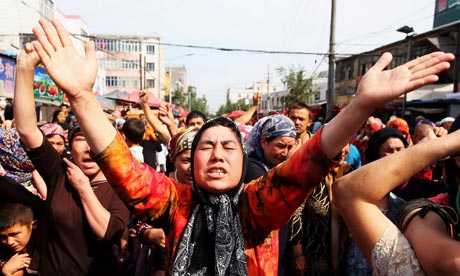
Uighur people take to the streets in Urumqi. Photograph: Guang Niu/Getty Images

Uighur people take to the streets in Urumqi. Photograph: Guang Niu/Getty Images

The BBC and The Guardian report that there have been further protests in Urumqi, this time without violence. Incredible footage at http://news.bbc.co.uk/1/hi/world/asia-pacific/8137519.stm

Uighur residents erupted into protests during an official media tour of the riot zone in the face of hundreds of officers… Women in the market place burst into wailing and chanting as foreign reporters arrived, complaining that police had taken away Uighur men. Authorities have arrested 1,434 people in connection with Sunday’s unrest. As they streamed out on to the main street, the crowd swelled to about 200, with Uighur men and more women joining them, shouting and waving their fists… And then a single old woman, propped on a crutch, forced armoured personnel carriers and massed paramilitary ranks into a slow – if temporary – retreat. No one noticed her at first. She emerged from the crowd and moved slowly down the street. A Uighur police officer came forward to escort her away. She could not be persuaded. As older residents stepped forward and attempted to calm the crowd, she advanced steadily towards the line of armoured vehicles. She halted inches in front of one. The driver started its engine. For a long moment they faced each other. Then the carrier slowly began to roll backwards and the line of officers inched away, back down the road. Suddenly, the massed might of the Chinese authorities looked very much like one scared and vulnerable man – like many of the young officers stationed around the city. Officials attempted to remove reporters – telling them that it was not safe and did not fit in with media arrangements – as the stand-off continued. “You see old women and children now. But on Sunday night it was men – you should go to the hospital and see the victims,” said one.

One wonders what the situation would be like if the international media was not present. It could be like after the riots in Yining in 1997, where arrests continued for weeks, followed by executions.

Or perhaps the Chinese authorities have decided that such crackdowns are ultimately counter-productive. That they only exacerbate tensions between Han and Uighurs.

The test is what happens when the media’s attention inevitably shifts.

Unrest spreads to Kashgar

Further pictures of Urumqi from the BBC, who also report that the unrest has spread to Kashgar, in the south of Xinjiang, which has been the focus of many protests in the past. The authorities claim that about 200 people were “trying to gather” at the Id Kah mosque in the centre of Kashgar. They also claimed to have information about plans to organise unrest in Aksu and in Yili prefecture (which was the site of the largest riots to date, in 1997). Given that all of the police and paramailitary troops are likely to be on full alert, it seems unlikely there will be any more large scale disturbances like the one in Urumqi. It is not just the sheer number of police and troops that make this likely- they are also organised in rings that encircle most of the major towns in the province.

_46015540_007602848-2

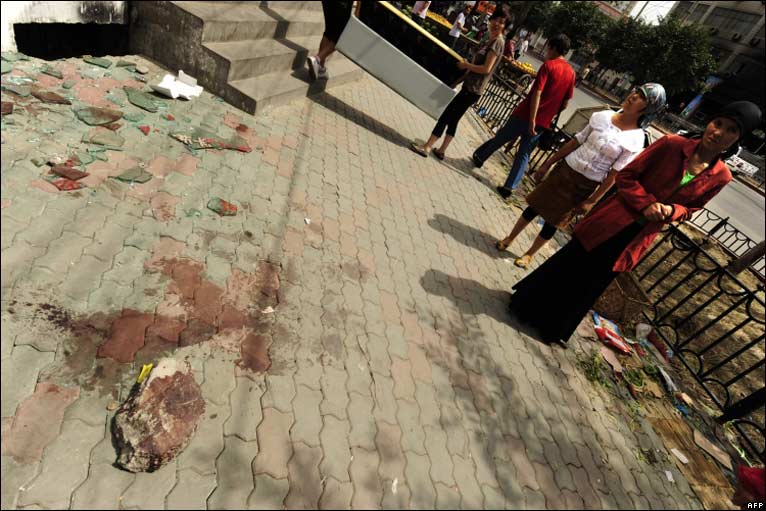
_46017788_stains_afp

_46015541_007602849-1

Update

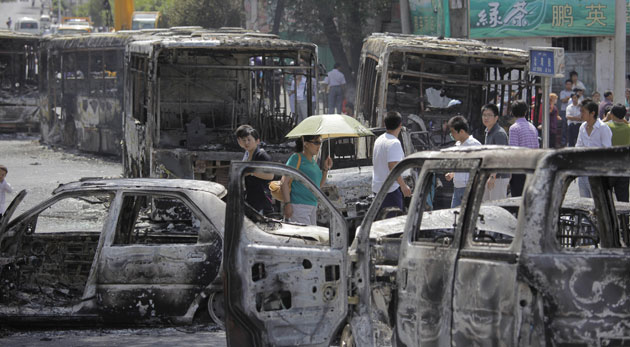
Burned-out-buses-after-ye-002

The BBC are reporting that the clash in Guangdong province last month (n the city of Shaoguan) was caused by a man who posted a message on a local website claiming six boys from Xinjiang had “raped two innocent girls”.

Police said the false claim sparked a vicious brawl between Han and Uighur ethnic groups at a factory. Two Uighurs were killed and 118 other people were injured.

As for the riots in Urumqi, Uighur groups are insisting that their protest was peaceful and had fallen victim to state violence, with police firing indiscriminately on protesters in Urumqi.

Dolkun Isa, a spokesman for the World Uyghur Congress (WUC) in Munich, disputed the official figures, saying the protest was 10,000 strong and that 600 people were killed. He rejected official reports on Xinhua that it had instigated the protests.

Riot in Urumqi

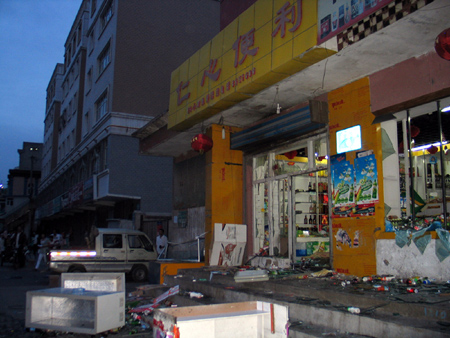
A shop smashed on Tianchi Street in Urumqi

A shop smashed on Tianchi Street in Urumqi

The Guardian reports that there has been widespread violence in Urumqi, the provinical capital of Xinjiang. Official reports place casualties at 140 so far (though this is impossible to verify). The protests were said to have started when several thousand people rallied in the grand bazaar to protest at the death of two Uighur migrants, and injuries suffered by hundreds of others, during an ethnic conflict between workers in a factory in Guangdong, southern China, last month. If this is the case, then it marks a shift from previous protests, most of which have have been at the provincial level (see my article at Eurozine for background and the history of such protests). One would predict an even more intense crackdown than usual from the authorities- nothing disturbs them more than nationally-organised protest.

xin_0620706061121500275224

The official explanation is that “the violence was masterminded by the separatist World Uyghur Congress led by Rebiya Kadeer, according to the regional government. Rebiya Kadeer, a former businesswoman in China, was detained in1999 on charges of harming national security. She was released on bail on March 17, 2005 to seek medical treatment in the United States.”

Whilst there is no evidence of Kadeer ever having done much more than send a few newspapers to her husband (let alone instigating a riot via the internet), it is interesting that the government refuses to mention the political aspect of the riots, so as (in the case of the riots in Yining in 1997) to portray the rioters as apolitical criminals intent on looting and destruction.

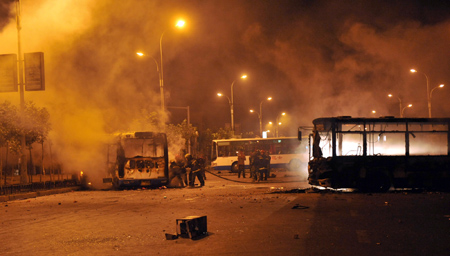
Firemen put out a fire in Dawannanlu Street in Urumqi

Firemen put out a fire in Dawannanlu Street in Urumqi

As for the events in Guandong, the government said “that three forces of terrorism, separatism and extremism made use of a fight between Uygur and Han ethnic workers in a toy factory in Guangdong Province on June 26, in which two Uygur workers died, to creat (sic) chaos.

“Nur Bekri said the bodies of the two Uygur workers in the factory fight have been sent back by plane to Xinjiang for burial. Police in Xinjiang and Guangdong are jointly investigating the incident.

“The government of Shaoguan City, where the toy factory is located, and the factory are trying their best to help Uygur workers go back to work as soon as possible, he added.

“The fight was triggered by the sexual (sic) of a female Han worker assault by a Uygur coworker, he said.”

More on this to follow (not least the dubious implication (as I read it) that it all stems from an attempted rape by a Uighur male.

China article

img0161

My Edinburgh Review piece on the riots in Xinjiang has been picked up by Eurozine, a site that brings together social and political articles from various magazines and journals.

http://www.eurozine.com/articles/2008-08-12-holdstock-en.html

At the end of the piece I wrote that there have been ‘few [recent] reported incidents of protest, violent or otherwise’.

This is no longer the case:

http://www.guardian.co.uk/world/2008/aug/11/terrorism.china

http://news.yahoo.com/s/ap/20080812/ap_on_re_as/china_violence

As far I can tell, it is unclear who is committing these acts. Whilst they are probably motivated by separatism, the extent to which (if any) they are Islamist, remains to be determined.