Vineland 91-140

p. 92 Ralph Wayvone’s momentary escape:

[He] could take another of what he’d come to think of as microvacations on an island of time fragile and precious as any Tahiti or one of them.

This is perhaps the only kind of escape that is accessible and unproblematic. Grace, but only for an instant. Later, in Mason & Dixon, Pynchon will explore the way in which many different temporal experiences can be embedded in a single perceptual/narrative moment.

p.97 A little joke for postmodern theroists. The band consult The Italian Wedding Fake Book by Deleuze and Guattari. Who also authored Capitalism and Schizophrenia, which consists of A Thousand Plateaus and Anti-Oedipus.

p.117 Whilst Wayvone’s escape is a solitary moment of peace, for Frenesi ‘the best chances of light’ are to be found in action. The final sentence, however, may possibly undermine the sacrifices described.

Frenesi dreamed of a mysterious people’s oneness, drawing together toward the best chances of light, achieved once or twice that she’d seen in the street, in short, timeless bursts, all paths, human and projectile, true, the people in a single presence, the police likewise simple as a moving blade- and individuals who in meetings might only bore or be pains in the ass here suddenly being seen to transcend, almost beyond will to move smoothly between baton and victime to take the blow instead, to lie down on the tracks as the iron rolled in or look into the gun muzzle and maintain the power of speech- there was no telling, in those days, who might change unexpectedly, or when. Some were in it, in fact, secretly for the possibilities of finding just such moments.

The first thing to say is that all this is only a dream of Frenesi’s, how she would like things to be. Does that mean this cannot exist? Not necessarily, but the fact that the people are ‘a single presence’,  and the police are ‘likewise simple’ almost seems to echo the accusations of childishness levelled by Hector at Zoyd earlier in the novel. And again, there is this notion of an altered temporal sense.

p. 127 DL’s sensei offers advice that addresses a rather different notion of grace and election- one which does not deny our Fallen status, and our own limitations.

This was what he felt he had to pass on- not the brave hard-won grace of any warrior, but the cheaper brutality of an assassin. When DL finally tumbled, she brought it to his attention.

“Sure,” he told her, “this is for all the rest of us down here with the insects, the ones who don’t quite get to make warrior, who with two tenths of a second to decide fail to get it right and live it with the rest of our lives”

When DL protests that ‘everybody’s a hero at least once’ he tells her she is ‘seeing too many movies, maybe’.

p.131 Wayvone tells DL

“We know your history, it’s all on the computer.”

p 133-134 A long passage where DL tells Frenesi about how “Superman could change back into Clark Kent”.

“Don’t underestimate it. Workin’ at the Daily Planet was the Man o’ Steel’s Hawaiian vacation, his Saturday night in town, his marijuana and his opium smoke, and oh what I wouldn’t give…”

What’s interesting is that it is Frenesi, not DL, who tries to live this fantasy, that of giving up on anything remotely heroic. By throwing in her lot with Brock Vond, and then becoming an informer, Frenesi ends up living a perverted version of this, one where all the solid normality is bought at other’s expense. Which makes her objection to DL’s daydreaming (and DL has arguably had to deal with far worse than Frenesi, which in some ways would make any such escape, however it was bought, more understandable) all the more ironic.

Why should anybody want to be only mortal? Better to stay an angel, angel.”

If DL did go on to try and escape, in a literal sense, by moving to Columbus and compiling an ‘invisibility wardrobe’ it was for good reason. If Frenesi thinks of DL as an ‘angel’, it is because she doesn’t grasp what DL has had to do.

p. 139 Ralph says to DL (in flashback)

“All that great gift? You wanted to just escape it?”

She doesn’t even bother to address this when she answers him, so obviously is her situation not a ‘great gift’.

Vineland 68-90

p.71 Frenesi on remembering the Sixties:

Sure, she knew folks who had no problem at all with the past. A lot of it they just didn’t remember. Many told her, one way and another, that it was enough for them to get by in real time without diverting precious energy to what, face it, was fifteen or twenty years dead and gone.

The idea of having no problem with the past is reminiscent of the mentions of being blessed with Doper’s Memory in Inherent Vice– the best thing, even better than nostalgia, is to forget. Nostalgia whilst being a crutch, is also a distraction.

Frenesi goes on to consider the strange form of ‘freedom’ she hoped to gain at the end of the 60s by collaborating with the authorities. In an inversion of the usual liberal view of the period, she sees the ‘Nixonian repression’ as ‘her Woodstock, her Revolution’ (which echoes Hector’s comments on p. 27).

She understood her particular servitude as the freedom, granted to a few, to act outside warrants and charters, to ignore history and the dead, to imagine no future, no yet-to-be-born, to be able simply to go on defining moments only, purely, by the action that filled them.

But even this escape (which is not really an escape) is going to be taken away by the economic forces of the Reagan era.

p.76-77 has a different kind of nostalgia, one that perhaps isn’t even that, if by this we mean something sentimental, and somewhat selective in a self-serving way.

[Eula] discovererd what she really wanted- the road, his road, his bindlestiff life, his dangerous indenture to an idea, a dream of One Big Union, what Joe Hill was calling “the commonwealth of toil that is to be”.

This has a markedly straigher tone than all the talk of the Magic Sixities- and is an interesting contrast to the nostalgia for, or denial of, the past in the novel thus far.

Growing up, Frenesi heard stories of those prewar times, the strike at the Stockton cannery, strikes over Ventura sugar beets, Venice lettuce, San Joaquin cotton… of the anticonscription movement in Berkeley, where, as Sasha was careful to remind her, demonstrations had been going on before Mario Sava was born.

Sasha continues in this vein on p. 82

After a while her thoughts started falling into place. The injustices she had seen in the streets and fields, so many times, too many times unanswered- she began to see them more directly, not as world history or anything theoretical, but as humans, usually male, living here on the planet, often well within reach, commiting these crimes, major and petty, one by one against other living humans. Maybe we all had to submit to History, she figured, maybe not- but refusing to take shit from some named and specified source- well, it might be a different story.

Though Sasha herself is immediately undercut by Hub saying how he wasn’t really listening, this does not necessarily refute what she has said. And there is something refreshing about bringing it all down to a very human level- where it is not some ‘distant others’ or some abstract force like Capital or Technology, but a ‘named and specified source’, which is for the most part where most of the ills of the world come from (please supply your own list of these). It is far from the defeated tone one often gets from Pynchon’s characters.

p. 81 has a passage that almost seems to be against the metahistorical (the idea that there are can only be Histories)

“History in this town,” Sasha muttered, “is no more worthy of respect than the average movie script, and it comes about in the same way- soon as there’s one version of a story, suddenly it’s anybody’s pigeon. Parties you never heard of get to come in and change it. Characters and deeds get shifted around, heartfelt language gets pounded flat when it isn’t just removed forever.

It is as if she is lamenting that there are these multiple histories, which is unusual, as the idea of plurality is commonly thought to be a beneficial corrective to the homogenising, and usually deeply compromised, narrative that is presented as History.

p. 83 Magical properties are ironically imputed to the TV.

Believing that the rays coming out of the TV screen would act as a broom to sweep the room clear of all spirits, Frenesi now popped the Tube on.

While watching a motorcycle cop show, she gets aroused, which is offered as part of the explanation for why she ends up with Brock.

Since her very first Rose Parade up till the present, she’d felt in herself a fatality, a helpless turn towards images of authority, especially uniformed men.

Sasha (who suffers from the same fetish) is obliged to face ‘the dismal possibility that all her oppositions, however just and good, to forms of power were really acts of denying that dangerous swoon’. Though this unsurprisingly angers Frenesi (it seems incredibly sexist and patronising to argue that women have this kind of uncontrollable, almost hysterical weakness), she eventually more or less accepts it. ‘Let the grim feminist rave’ she thinks (or at least we are encouraged to think that she does) and then, unexpectedly, Pynchon does not undercut this idea. One possibility is that mother and daughter would rather believe it was due to some uncontrollable urge, instead of a series of decisions, or choices ignored, that has led to the submission (sexual and otherwise) to authority.

p. 87 Frenesi’s son goes to find his parents, the ‘cartoons having ended and his parents now become the least objectionable programming around here’. Reality is thus just another show that one sometimes must unhappily turn over to.

p. 90 on how we will be executed:

It would all be done with keys on alphanumeric keyboards that stood for weightless, invisible chains of electronic presence or absence.

Vineland 35-67

p. 37  A possibly wishful affinity between surfers and drivers.

Beer riders of the valleys having found strange affinities with surfers and their music. Besides a common interest in beer, members of both subcultures, whether up on a board or beind a 409, shared the terrors and ecstacies of the passive, taken rider, as if a car engine held encapsulated something likewise oceanic and mighty- a technowave, belonging to distant others as surf belonged to the sea, bought into by the riders strictly as is, on the other party’s terms.

The interesting thing about this is that we might expect Pynchon to place these groups at odds with one another- mainstream vs counterculture. Both, however, are ‘subcultures’, not least in the sense that they are beneath, and subservient to, the ‘distant others’, who dictate the ‘terms’. Both share ‘the terrors and ecstacies of the passive, taken rider’, one via technology, the other via the sea. Pynchon may intend to suggest that there is also political common ground between these (and other) groups, because whether one is driving a car, or riding a board, one is still far from being in control of the forces (natural, financial) that shape one’s environment. It is questionable whether Pynchon really intends the description of the car engine as encapsulating ‘something likewise oceanic and mighty’ as a simile- it can also be taken as synedoche of the whole socio-economic system of consumption. Another effect of pairing surfers and drivers in this fashion is to reduce the extent to which the surfers can really be said to be an alternative lifestyle. They, too, are no less in thrall to the ‘distant others’.

p.38 has what begins as a piece of nostalgia for the unhurried, ‘Mellow Sixities’, one where people’s sense of time, as a continuous flow, has not yet been disrupted (see all the stuff about temporal distortion (Currie, Huehls et al) in the Inherent Vice posts).

It may have taken hours or been over in half a minute, there were few if any timepieces among those assembled, and nobody seemed restless, this after all being the Mellow Sixties, a slower moving time, predigital, not yet so cut into pieces, not even by television.

However, this is not being shown, it is being remembered (like so much else in the book).

It would be easy to remember the day as a soft focus shot, the kind to be seen on ‘sensitivity’ greeting cards in another few years.

The fact that this is remembered as ‘a soft focus shot’ is telling- it suggests that our vocabulary (lexical, visual, memorial) has been changed by film and TV. Even if the actual moment was experienced as a temporally uncertain event, it is not recalled this way. And perhaps, to return to an earlier thought, this pre-digital ‘timelessness’ is no more socially beneficial than the ‘crisis of historicity’ that many new media are said to have produced. The paragraph continues in a supposedly rosy tone:

Everything in nature, every living being on the hillside that day, strange as it sounded later whenever Zoyd tried to tell about it, was gentle, at peace- the visible world was a sunlit sheep farm. War in Vietnam, murder as an instrument of American politics, black neighborhoods torched to ashes and death, all must have been off on some other planet.

But they weren’t (and aren’t) ‘on some other planet’. These horrors were happening concurrently. Though at the time, and also in memory, they have escaped into the fantasy of everything being a ‘sunlit sheep farm’, such a view is only possible if one ignores, or forgets, what else was happening. However, this is probably the only way that we can live on a daily basis- by denying what we know to be happening, while telling ourselves that we care. This is a delicate balancing act, this satisfying of one’s (inevitably) selfish urges, while trying to maintain the self-image of being a ‘good’ person (which brings us back to Weber’s ideas of ‘the elect’ seeking reassurance that they were in fact so).

The description, and the erasure of evil, has been said to be reminiscent of Emerson’s passage in Experience:

When I converse with a profound mind, or if at any time being alone I have good thoughts, I do not at once arrive at satisfactions, as when, being thirsty, I drink water, or go to the fire, being cold: no! but I am at first apprised of my vicinity to a new and excellent region of life. By persisting to read or to think, this region gives further sign of itself, as it were in flashes of light, in sudden discoveries of its profound beauty and repose, as if the clouds that covered it parted at intervals, and showed the approaching traveller the inland mountains, with the tranquil eternal meadows spread at their base, whereon flocks graze, and shepherds pipe and dance. (41).

As Dickson(1998) argues, Emersonian ‘transcendence takes place through a removal not of the self from the realm of ordinary activity, but through a removal of ordinary reality away from the self.’

Emerson is directly referenced at the end of the novel, on page 369.

p. 41 has a reference to karma:

He wrote her a postdated check he’d still have to scramble, this day already so advanced, to cover.

p. 51 Hector wants to make a movie of the whole Zoyd, Frenesi, and Brock Vond story.

Ernie’s been waitin years for the big Nostalgia Wave to move along to the sixties, which according to his demographics is the best time most people from back then are ever goin to have in their life

In a sense, this is what we are watching for most of the book, given how much of it is flashback, and only rarely in the voice of the person telling/remembering what happened.

And it is worth asking what good nostalgia does, in a political sense? is there any real difference between being nostalgic for the ‘Mellow Sixties’ or a (possible equally) imaginary past like Lemuria in Inherent Vice? Are either an impetus to an action which might lead to change?

p. 58 Frenesi as portayed as a habitual escapist.

Sasha was as angry as she’d ever been at Frenesi’s habit, developed early in life, of repeatedly ankling every situation that it should have been her responsibility to keep with and set straight. Far as Sasha could make out, this eagerness to flee hadn’t faded any over the years, with its latest victim being Zoyd.

In her case, the question is not only what she is fleeing from, but also what she is fleeing to- why does she flee  Zoyd (as an exemplar of the counter culture of which, she herself, via her role in guerilla film making, is a part) and end up with with his opposite (Brock Vond) and even as the opposite of herself (from documenting the ills of the powerful, to being an informer who conspires with them). What does her narrative suggest about our need to Fall?

p. 60 Death, the greatest form of escape, is also commodified. Hawaii is said to be ‘where men from California bring their broken hearts’. Zoyd is offered ‘several travel agents who offer Suicide Fantasy packages.’
Vineland 1-34

After the feral success of my posts on Inherent Vice– we’re talking about daily hits sometimes in double digits -I thought I’d do the same for Vineland because a) it’s an obvious point of comparison, in terms of setting (California), time period (the 70s and 80s)  and preoccupations (the many ways that the counter culture has been, um, countered) and b) because it’s my ‘job’ to (in terms of being a doctoral student, though let’s face it, it’s a pretty strange job where you have to pay your employer for the right to work, and then still find yourself slacking off).

Anyway, my reading of Vineland is going to be based around two interests- its similarities with Inherent Vice, and how the characters in the novel use different strategies to escape/deny/avoid various mental and emotional states, with a particular emphasis on ideas of Redemption, Transcendence etc. (which is starting to sound dangerously like I might have some notion of what this PhD is about).

Given that the book doesn’t have numbered sections, I’ll just be doing it in as large a chunks as I can. And forgive me if I don’t provide much in the way of plot summaries- life, I am given to understand, is really very short. All page numbers from the Vintage UK 1990 edition.

Pages 1-14

Introduces Zoyd Wheeler, his daughter Prairie and Hector Zuniga, DEA field agent. The novel opens with Zoyd waking to hear blue jays, which reminds him of his dream where carrier pigeons have a special message for him that he can never receive. He understands this as ‘another deep nudge from forces unseen, almost surely connected with the letter that had come along with his latest mental-disability check.’

Of course, there’s no necessary connection between the real and dream birds and the letter, and Pynchon quickly undermines Zoyd’s reliability with the reveal of mental-disability. One reading of this is to satirise people’s tendency to see significance and pattern (not to say conspiracy) where there is mostly randomness. (As Sortilege says in Inherent Vice, “That’s because you think everything is connected”).

As in Inherent Vice, there is also the start of a thread about going over to the other side by becoming a snitch.

Hector had been trying over and over for years to develop him as a resource, and so far- technically -Zoyd had hung onto his virginity.

That ‘technically’ is pretty damning- and maybe also softens the realisation that ‘one day, just to have some peace, he’d say forget it, and go over.’

14-21

Zoyd watches himself on the TV (‘in Tubal form’) jumping through a window, ‘in midair with time to rotate into a number of positions he didn’t remember being in’

TV thus distorts memory, either by showing us what didn’t happen, or what did but we have forgotten. Memory is thus as rewritable a medium as any other technology.

p.19 has a bit on the commodification of violence

Isaiah’s business idea was to set up first one, eventually a chain, of violence centres, each on the scale, perhaps, of a small theme park.

p.27

“This ain’t tweakin around no more with no short-term maneuvers here, this is a real revolution, not that little fantasy hand-job you people was into, is it’s a groundswell, Zoyd, the wave of History, and you can catch it, or scratch it.”

The Right (as personified by Hector- an equivalence that will blur as the novel goes on) is here appropriating the terminology of the left- a revolution that is not Progressive, but is actually the opposite, in that it solidifies the exisiting structures of power and wealth.

p.28 In the same vein, Hector attacks 60s radicalism

I know you still believe in all that shit. All o’ you are still children inside, livin your real life back then. Still waitin for that magic payoff.

There’s a lot of talk in the novel about ‘innocence’ and other supposedly child-like states, which although is meant by Hector in a derogatory way, can be viewed in a more tolerant fashion. The retreat back into childhood, or nostalgia (the ‘real life back then’) may be the only safe haven (and it’s worth noting that at least half of the novel occurs in flashback, as a tale related). But even this innocence must be questioned

Impossible to tell with you, Zoyd. Never could figure out how innocent you thought you were.

Hector then asks a difficult question.

I won’t asks you to grow up, but just sometime, please, asks yourself, OK, ‘Who was saved?’ That’s all, rill easy, ‘Who was saved?’ “

Of course no one can be ‘saved’ (unless we buy into a non-secular world view) but the idea of personal redemption, of joining some kind of ‘elect’ or at least not being so clearly part of the preterite (yes, I have been reading Weber), is a powerful impulse, one that it is difficult to discount.

p. 29 Already Hector is becoming a deeper character:

It was the closest Hector got to feeling sorry for himself, this suggestion he liked to put out that amongst the fallen, he had fallen further than most

This notion of the Fallen recurs in Inherent Vice, and with it all the talk of karma.

p .31 Further talk from Hector of  youth and innocence being a kind of distortion that needs, by implication, to be rubbed off.

“I used to worry about you, Zoyd, but I see I can rest easy now the Vaseline of youth has been cleared from your life’s lens by the mild detergent solution of time, in its passing….”

There seems like a extra level of disingenuity in this use of the language of advertising- a consequence of Hector being a TV addict. The changes wrought by time (especially in historical terms) are not usually ‘mild’.

Hector then refers to the counterculture as

“A certain kind of world that civilians up on the surface, out in the sun thinkin’ em happy thotz, got no idea it’s even there”

Rather than it being a place to escape to, for Hector it is more like a dark sercet, a Welles-ian subterranean nightmare. This seems like an inversion of how we like to think of the 60s- rather than a happy, carefree time, with a dark undercurrent (Manson, riots, Nixon, Vietnam) it is here the counterculture that is the corrosive force.

Of course, the loss of innocence (or rather the belief in one’s own innocence), and the ensuing inability to escape into nostalgia, leads to bitterness. At the end of Inherent Vice Doc talks about how hippies ‘don’t know nuthin’. And as Zoyd says to Hector on p. 31

“Nothin’ meaner than a old hippie that’s gone sour, Hector, lot of it around.”

To which Hector answers, “You pussies set yourself up for it”.

p. 33 TV equated with any other harmful substance. There’s the ‘National Endowment for Video Education and Rehabilitation’ whose acronym is ‘NEVER’. Maybe this stands for the possibility of us ever recognising and being willing to actually confront this aspect of TV.

There’s also talk of ‘Tubal abuse’ and ‘A dryin’-out place for Tubefreeks.’

Which raises the question- how much of Hector’s worldview is supposed to be attributable to watching too much TV? And isn’t it also perhaps his partial salvation, in terms of how he acts at the end of the book, when trying to make the film?

‘A conjuror of high magic to low puns’

It’s definitely more fun to write about being an academic than to actually do academic stuff.

As proof, I cite this piece of mine in n + 1 and Elif Batuman’s The Possessed.

***Thanks to The New Yorker, American Fiction Notes, The Millions, Longform.org, The New York Observer and other places for linking to the piece.

Festival readings

A patas monkey

I’ll be reading on the shoulders of a few distinguished folk- first with Ron Butlin, the Edinburgh Makar, and author of The Sound of My Voice and many other acclaimed books, at Wordpower at 1pm on Thursday August 12th.

Then I’ll be reading at the Golden Hour at the Forest cafe on Wednesday 25th Wednesday 18th from 8pm. Also on the bill is AL Kennedy, whose novel Day won the Costa award, and more importantly, is amazing. As in a great book that actually deserved to win. She, like Ron, is also a wonderful reader, so this should appeal to my enemies as well as my few allies: come and see my literary ass get kicked by these people.

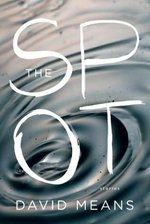
The Spot

David Means has a new collection out. It is called The Spot. It is probably awesome. I came across his previous collection, The Secret Goldfish (a Salinger reference) whilst in a bookstore in Ireland (Rep. of) and decided to check out ‘A visit from Jesus’. It is the only time I have ever stood and read an entire short story in a bookstore, and also the only time my parasympathetic nervous system reacted so strongly to a bunch of marks on a page that I staggered so much I had to grab hold of the shelf to keep balance.

Here’s a recent story of his from  The New Yorker.

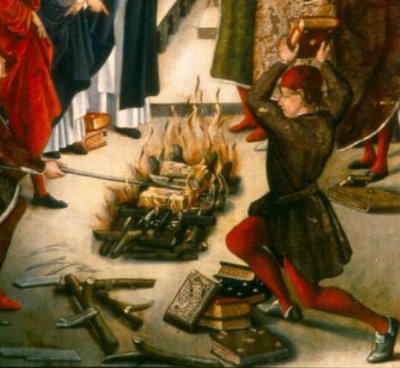
Burning Books

I have a piece in the latest London Review of Books. This is how it begins:

I began burning books during my third year in China. The first book I burned was called A Swedish Gospel Singer. On the cover there was a drawing of a blonde girl wearing a crucifix with her mouth wide open and musical notes floating out of it. Inside was a story, written in simple English, about a Swedish girl who loved to sing. One day, passing a church, she heard a wonderful sound. When she went in, the congregation welcomed her and asked her to join their gospel choir. Through these songs she learned about Jesus, his compassion, his sacrifice, the love he feels for all.

It was originally longer, and took in all kinds of other personal stuff, but I think they kept the core. There’s no better cure for one’s tendency to be precious than having a thousand words just cut.

Suspicious Timing

Policeman on a side street in Urumqi

I have a brief piece on the London Review of Books blog about the recent arrest of a ‘terror cell’ in Xinjiang, conveniently just in time for the one year anniversary of the Urumqi riots.

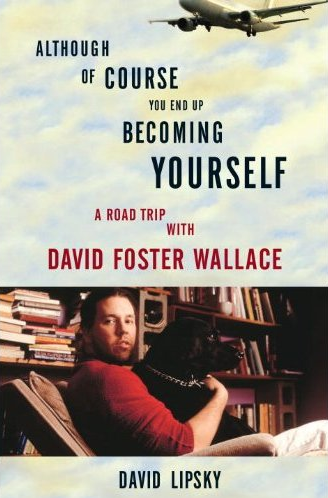
Although of Course You End Up Becoming Yourself

The wonderful Wyatt Mason has a review of Although of Course You End Up Becoming Yourself: A Road Trip with David Foster Wallace by David Lipsky in the latest New York Review of Books. WM makes some good points about DFW’s willingness to explore the various sofas, couches, ottomans, divans, chaise lounges and footstools that constitute our mental furniture. He argues that there was nothing ‘un-edited’ about DFW’s stories and novels (if memory serves, Infinite Jest had about 500 pages cut from it). For my part, I have a copy of Lipsky’s book glaring at me right now. There is a dog on the cover. His name is Drone.

The Year of the Metal Tiger

So I went to the Pynchon conference. In Poland. A marvellous time was had. In addition to being promised a certificate proving that I am now a bona fide scholar, the lovely people at Marie Curie University recorded everyone’s talks. So delete your playlists. Sit in a dark room. You’ll be amazed at what you end up doodling.

Click on the names on the abstract page to hear the talks- My suggestions would be Simon de Bourcier on Aether, David Letzler on character, Sascha Pöhlmann on games, Jeffrey Severs on women and capitalism, and for sheer verbal brio, Douglas Lanark on the year of the metal tiger.

Here is mine which is about 15 minutes long. It’s about how to escape.

Minor update

Looks like my book, The Tree That Bleeds: A Uighur Town on the Edge, will be out in early October, at least according to Amazon. No doubt the thinking is that it will clean up at Xmas, which is of course the time of year when people are desperate to buy books about riots and ethnic tension. On Xmas day, I may recreate that scene from The Doors where Jim Morrison gives the rest of the band presents, which pleases them greatly, till they open them and find that they have each been given a copy of his book of poems. [following sentence deleted out of an attempt to preserve reasonable family relations].

Problems for Adam and Eve

From Jo McMillan’s piece on Chinese sex shops in the current issue of Granta:

Dr Wang opens her eyes. She is ready now to pronounce, to prescribe for my lack of man. She fishes keys from her pocket and unlocks a cabinet. ‘This is what you need,’ she says, and offers me a pink baton, a face moulded into the head, the shaft embossed with rows of nodules that look – here, in this clinic, in this doctor’s hands – like an unusually disciplined rash. She balances the vibrator in the tips of her fingers, showing it off to me. I catch the smell of garage forecourts.

Having stayed in a lot of Chinese hotels over the last few months, I am pleased to report that the quality and range of sexual health products supplied in the rooms has improved immeasurably from 8 years ago. Though there are still the lotions that misleadingly promise genital hygiene (which are dangerous, in that their use dissuades people from using more reliable methods of prevention) there are now always condoms as well, sometimes for free (for instance in Yining, which has a high rate of HIV infection).

The Thorn in the Heart

Trailer for the new Michel Gondry movie, a personal look at the life of Gondry family matriarch, his aunt Suzette Gondry, and her relationship with her son, Jean—Yves. Michel examines Suzette’s years as a schoolteacher and her life in rural France.

Heaven knows when it will be out in the UK, but on the evidence of this it looks worth seeing- assuming you have any interest in the lives of actual people who are not vampires or tycoons with superpowers.

A wooden tongue

The same Noh mask at three inclinations.

From Ian Buruma’s review of the new William Vollman book in the latest NYRB:

If even our deepest desires are no more than delusions, then the objects of our desires are forever beyond our reach. But Vollmann, like most of us, though moved by the performance of Noh, is not ready for Buddhist renunciation. This, he writes, “is not what I wish to believe. I want to kiss the mask, and when I put my lips against its wooden emptiness, I want to feel a woman’s tongue in my mouth.”

798, Beijing

Despite my best efforts to do nothing in Beijing other than sit in a room and type while I wait for the flight that KLM so graciously gave me on May 4th, two weeks after my original flight was cancelled, I still occassionally find myself somewhere that threatens to undermine my dislike of this city. 798 is a district given over to galleries and studios, in the north east corner of the city not far from the airport. It began in the mid-90s, when artists were looking for cheap spaces and found that the closed factories of the district were available.

As in every other place in the world, most of the art was terrible: dull, derivative, overly conceptual. But there were things I liked (pictured below), most of all the sense of being in a Cultural space, which at the risk of making a horribly insulting, not to say idiotic generalisation, is not all that common in China, even in the highly developed cities of the east coast.

How to Bait A Hook

I have a new story in the latest issue of Northwords Now- you can download it here or pick up a copy from a bookstore or library, should you happen to live in the north, as the term applies to Scotland.

I am writing this in Beijing, where I may be for some time…

Sunday in Shanghai

Before this I was in Beijing. Perhaps, without crippling jet lag, it might have been fine. But with this, and the dust storm, it was pretty dreadful.

Shockingly, I only have good things to say about Shanghai. It is clean and modern without being antiseptic. Behind East Nanjing Road (pictured below) there are still smaller, older streets without the hysteria of consumerism. As posters on every surface tell us: only 4o days till EXPO! This is a huge international gathering of ideas about architecture and design- the stills look very promising.

Next stop: Huizhou, about which I know nothing other than that my old colleauge Mr Ma (who used to be a spy) is now teaching there.

Horrible news

Barry Hannah, a writer who could make a sentence twist and kick and still make sense, has died aged 67. It would be incorrect to say that his books have influenced me greatly- it is something they still, and will, continue to do. High Lonesome is as good as any place to start. I hope that some of the stories’ titles put a hook in you:

‘Ned Maxy, He watching you.’

‘Snerd and Niggero’

‘Through Sunset into the Racoon Night’

‘Taste like a sword’

‘Get some young’

He had this to say about his writing:

“There’s a ghost in every story. Something haunts the story and you’re turning those pages to find out what it is. And it better be good. I’d better be good, or just shut up.”

An old interview with Hannah, from 1993: Barry Hannah Interview with Don Swaim


Inherent Vice, Chapter 20

PLOT- Doc’s parents try to score weed off him… Sauncho and Doc go to watch the Golden Fang being repossessed… Coy is finally freed of his obligations.

p.351

While gazing at photos Doc sees their details become little blobs of colour.

It was as if whatever had happened had reached some kind of limit. It was like finding the gateway to the past unguarded, unforbidden because it didn’t have to be. Built into the act of return finally was this glittering mosaic of doubt. Something like what Sauncho’s colleagues in marine insurance liked to call inherent vice.

“Is that like original sin?” Doc wondered.

“It’s what you can’t avoid.”

This is about the problem of knowing the past (history), and with the added spin being what seems to underline last chapter’s conclusion- it really is what you can’t avoid. But maybe this is a step sideways from the karmic equation- there isn’t the suggestion of wrongdoing.

p.353

Doc’s parents complain that after smoking weed the soap they watch becomes hard to understand- identities and faces shift, either because they are befuddled, or because some veil has been stripped away.

p. 354

I think there’s a joke in the fact that Doc is still only wearing one shoe here, long after his escape from Prussia’s place. I’d like it to be suggesting that he’s waiting for the other shoe to drop- which would tie in nicely with the whole this-is-a-mystery-but-everyone’s-avoiding-answers theme.

p. 355

Doc imagines, then perhaps shifts to remembering, Bigfoot when he first came to Gordita.

“This place has been cursed from the jump” he told anybody who’d listen. “Indians lived here long ago. they had a drug cult, smoked tolache which is jimsonweed, gave themselves hallucinations, deluded themselves they were visiting other realities- why come to think of it, not unlike the hippie freaks of our present day. Their graveyards were sacred portals of access to the spirit world, not to be misued. And Gordita beach is built right on top of one.”

The jump seems part of the record/groove image set- and Bigfoot is of course missing the point. There’s no need to make a supernatural explanation up- the reality of disposession is bad enough.

They were hard to see and hard to catch hold of, these Indian spirits. You plodded along in pursuit, maybe only wanting to apologize, and they flew like the wind, and waited their moment…

“What’re you looking at?” Saunco said.

“Where I live.”

There is a sense of complicity in Doc’s reply.

p.363

At the end of the chapter, when Coy is thanking Doc, what should be a happy moment instead has a sour tone.

“Yeah, yeah, some hippie made that up.” These people, man. Don’t know nothin.

It is as if, after all Doc has seen and heard, he can no longer count himself among the ranks of the happily unenlightened. This is an old theme, that of the hero-becoming-an-exile-from-the-community-he-has-fought-to-protect. Like John Wayne in The Searchers (1956).

The triumph of his tired eyes

I am overjoyed (yes, I am capable of it) to write that my colleague, friend and co-conspirator Ryan Van Winkle has been awarded the Crashaw Prize by Salt Publishing.

I will let you know when you can purchase his debut collection.

Now he will be buying me drinks.

Inherent Vice, Chapter 19

PLOT-Doc meets Crocker Fenway and arranges to trade the heroin in return for an assurance that Coy Harlingen and family wont be harmed. The trade takes place without any double cross.

p. 343

Whilst waiting for Fenway, Doc inspects a mural depicting the arrival of the Portola expedition in 1769. In terms of local karma, this is as close as one gets to original sin. The mural, however, is clearly not to be trusted as historical record.

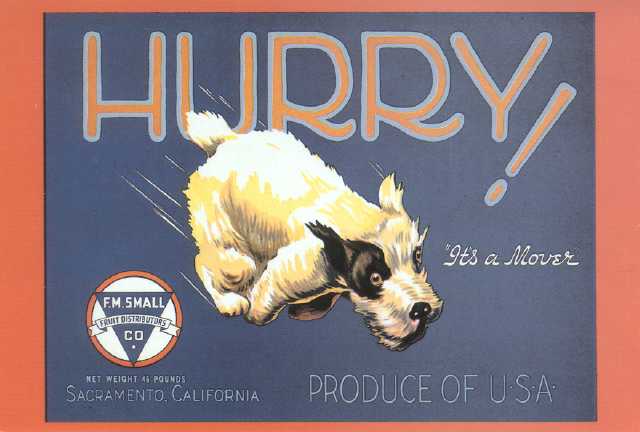
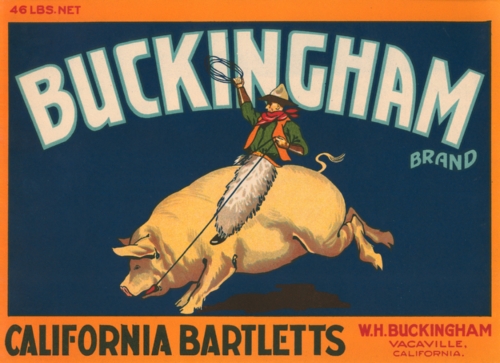
The pictorial style reminded Doc of labels on fruit and vegetable crates when he was a kid. Lots of color, atmosphere, attention to detail… Everybody in the scene looked like a movie star.

It’s style is that of advertising and commerce; the people are substitutes; the details it pays attention to are not those of history. However, the labels are worth a look:

Pynchon then produces a piece of imperial rhetoric to describe one of the expressions of the men in the mural:

There was an expression of wonder, like, What’s this, what unsuspected paradise? Did God with his finger trace out and and bless this perfect little valley, intending it only for us?

This perfectly reproduces the sense of divinely ordained entitlement that lies behind exploration and conquest, with the notion of God ‘intending it only for us’ being especially sharp in its denial of the rights of any indiginous people. However the mural, for all its flaws, is still a reminder of the past, which thus allows for some debate about the nature of that past. Crocker (who is shortly to give one of the most villainous speeches of the book) says ‘Never noticed it really.’

p. 346-347

feature some of the harshest, most political exchanges of the book, in which Doc sounds far more world-weary than when he began.

Crocker Fenway chuckled without mirth. “A bit late for that, Mr Sportello. People like you lose all claim to respect the first time they pay anybody rent.

“And when the first landlord decided to stiff the first tenant for his security deposit, your whole fucking class lost eveybody’s respect.”

Doc continues:

“Every time one of you gets greedy like that, the bad-karma level gets jacked up one more little two-hundred-dollar notch. After a while that starts to add up. For years now under everybody’s nose there’s been all this class hatred, slowly building. Where do you think that’s headed?

I think this is the first time that the karmic equation has been invoked to explain something other than a present ill; it is here being used in a predictive fashion, and aimed at a specfic group of people, as opposed to all of ‘us’.

The lines are then drawn even more clearly:

“We’ve been in place forever. Look around. Real estate, water rights, oil, cheap labor- all that’s ours, it’s always been ours. And you, at the end of the day what are you? one more unit in this swarm of transients who come and go without pause here in the sunny Southland, eager to be bought off with a car of a certain make, model, and year, a blonde in a bikini, thirty seconds on some excuse for a wave- a chili dog, for Christ’s sake.” He shrugged. “We will never run out of you people. The supply is inexhaustible.”

A pretty fair summary of the capitalist system.

p. 349

Doc continues to sound jaded.

“What, I should only trust good people? man, good people get bought and sold every day. Might as well trust somebody evil once in a while, it makes no more or less sense. I mean I wouldn’t give odds either way.”

Denis’ response is to say ‘That’s heavy,’ then, after a toke, ‘What does that mean?’- the pattern of pronouncement/avoidance/humour that is common in Pynchon.

p. 350

Even Bigfoot has ‘weird twisted cop karma’.

This and that

A few things worth a look-

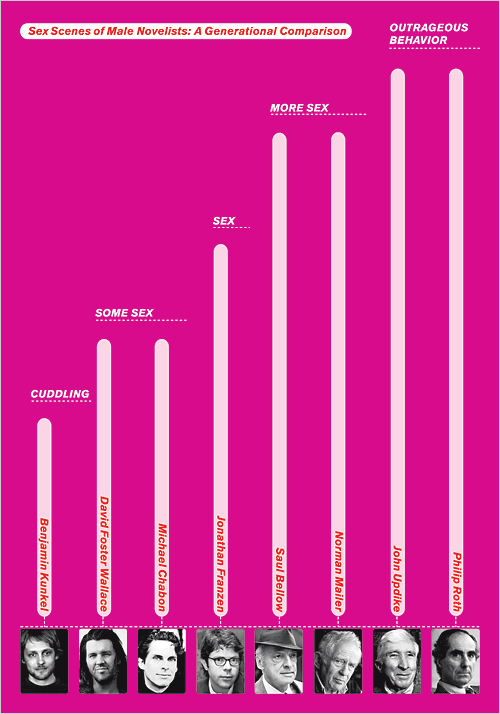
William Vollmann’s review of Ted Conover’s ‘The Routes of Man’; a new take on Salinger’s ‘A Perfect Day for Bananafish‘; the Great Male Novelists compared; why it isn’t worth being on Amazon sometimes; clip from the new Walker Percy documentary; and Zadie Smith’s rules for writers.

Inherent Vice, Chapter 18

PLOT-Doc goes to visit Adrian Prussia, where he is drugged by Puck Beaverton. After this he wakes up, handcuffed to the bed, and can do nothing but summarise the plot. Doc then escapes, killing Puck and Adrian, only to find that Bigfoot has set him up and is now stealing the Golden Fang’s heroin. Though he and Bigfoot appear to come to an understanding, this is only cover for a further set up, as the heroin is planted in Doc’s car. After some bait and switch, he stashes it in Denis’, then gets a call from Crocker Fenway, asking to meet so that Doc can return the drugs.

p. 315

He recalled that somewhere behind him, back at the beach, it was still another classic day of California sunshine.

This feels like a historical reference, only it is Doc who feels that things were better in the past (his present).

He thought about Sortilege’s sunken continent, returning, surfacing this way in the lost heart of L.A., and wondered who’d notice if it did. People in this town only saw what they’d all agreed to see, they believed what was on the tube or in the morning papers half of them read while they were driving to work on the freeway, and it was all their dream about being wised up, about the truth setting them free. What good would Lemuria do them? Especially when it turned out to be a place they’d been exiled from too long ago to remember.

Here is the depressing answer to the idea that we might be ‘saved’- even if our lost (and imagined) utopia was restored to us, it wouldn’t help. The reason being that the consensus we operate under isn’t open to that- in Pynchon, the truth never sets anyone free, but instead enmeshes them in a series of conflicting impulses that lack easy resolution.

p. 316

In Prussia’s office, the light itself has been compromised (see Against the Day for more of this light/knowledge/harm/guilt stuff).

Heated downtown smoglight filtered in from the window behind him, light that could not have sprung from any steady or pure scheme of daybreak, more appropriate to ends or conditions settled for, too often after only token negotiation.

There is also another stopped clock, that Prussia affects to read the time from. This is continued on p. 317

“So who sent you here? Who you working for today?”

“All on spec,” Doc said. “All on my own time.”

“Wrong answer. How much of your own time you think you got lef,t kid?” He checked the dead wristwatch again.

‘Time’ here can also be read in a broader fashion, in terms of the period and its supposed freedoms.

p. 318

This being a novel with genre elements, the villain does need to show up, and this being a Pynchon novel, it is only in a drug-induced hallucination.

p. 321

Linking of a sex ring to Governor Reagan’s administration. This is the most specfiic reference to a future ill thus far- previously it has all been shadows and vague threats.

Adrian Prussia is also told

“The Governor has some great momentum right now, the future of America belongs to him, somebody can be doing American history a big favour here, Adrian.”

Whilst the first and second propositions may be true, there is an ironical slant to the third- arguably, the big favour to history would have been not to help him.

p. 322

A highly sexualised death, with plenty of S & M, not a new thing in Pynchon’s work, but one that I miss the point of here. Maybe its the ugliness of having someone like Prussia- a hired killer -take the moral highground with a pornographer.

p. 326

Doc has a flashback, possibly from the PCP, and possibly not, in which he understands that

he belonged to a single and ancient martial tradition in which resisting authority, subduing hired guns, defending your old lady’s honor all amounted to the same thing.

What this  thing is isn’t specified- it could easily be ‘nothing’. Heroism has no place, and no chance, perhaps.

**General observation- is all this being drugged and shooting and killing actually happening? It’s so genre appropriate that I can’t help but wonder.

p. 329

General ominousness-

The sun was just down, a sinister glow fading out above the edge of the world.

p. 334

Bigfoot issues a little wisdom:

“What goes around may come around, but it never ends up in exactly the same place, you ever notice? Like a record on turntable, all it takes is one groove’s difference and the universe can be on into a whole n’other song.”

On the one hand, this is an affirmation in the power of change; on the other, it’s still the same record, still the same turntable.

This metaphor has already appeared, on page 262 (“as if some stereo needle had been lifted and set back down on some other sentimental oldie on the compilation LP of history.”).

p. 339

Doc hides the heroin in a TV container in Denis’ place- when he comes back Denis is

sitting, to all appearances serious and attentive, in front of the professionally packaged heroin, now out of its box, and staring at it, as it turned out he’d been doing for some time.

Whilst this is a final, non-too subtle twist on the TV-as-narcotic theme that has run throughout the book, it may be doing more than critiquing TV. Perhaps TV is only one of many narcotics- it is then more about the psychological needs that each of these meet, rather than some… (ahem)… inherent vice of the drug.

p. 341

Dream in which the Golden Fang ship has been redeemed and ‘dezombified’. Sauncho gives a ‘kind of courtroom summary’ which is both sentence and grounds for optimism.

“… yet there is no avoiding time, the sea of time, the sea of memory and forgetfulness, the years of promise, gone and unrecoverable, of the land almost allowed to claim its better destiny, only to have the claim jumped by evildoers known all too well, and taken instead and held hostage to the future we must live in now forever. May we trust that this blessed ship is bound for some better shore, some undrowned Lemuria, risen and redeemed, where the American fate, mercifully, failed to transpire…”

Is this, then, a verdict on people’s attempt to avoid and deny the politically hopeless state they find themselves in? Or is the book in many ways a resounding contradiction to this? Which has primacy?

The claim is ‘jumped’ as with a record (see page 334), which brings to mind a passage from Against the Day:

“Most people have a wheel riding up on a wire, or some rails in the street, some kind of guide or groove, to keep them moving in the direction of their destiny.” (AD, 46)

Though the notion of a ‘future we must live in now forever’ doesn’t sound optimistic, it could also mean that we have to abandon our laments for what we (imagine?) we have lost, and focus on constructing the best world we can. Also, the ‘we’ in the sentence is clearly far from all-inclusive- there is still those on the blessed ship, for whom the entirety of US history is no more than a cautionary tale. Unless they are just the fond imaginings, a futher escape, of people who feel themselves doomed.

Recycle

During the 2008 US Presidential Election, The Onion ran a series of blog pieces purporting to be by Don Delillo (whose new novel Point Omega is just out), commenting on the political conventions in Minneapolis. There were several reasons why this seemed unlikely. The first was that The Onion is a satirical newspaper, famous for having articles whose headlines are punchlines in themselves (‘Massive Earthquake Reveals Entire Civilisation Called “Haiti”‘; ‘Man Who Enjoys Thing Informed He Is Wrong’), whereas Don De Lillo— one of the most lauded authors of his generation —has rarely been associated with either comic writing or direct political comment. The second was that the tagline for the author read ‘Master of Postmodern Literature’- surely too immodest a title to be taken seriously. Though an entirely accurate (and respectful) bio accompanied each piece (‘Don DeLillo is considered one of America’s greatest living novelists. His works explore themes of consumerism, alienation, and decontextualization, and include such towering postmodernist classics as White Noise, Mao II, and Underworld’), and though I wanted to believe that Don Delillo was writing for The Onion (The British equivalent of J.G. Ballard writing for Private Eye), in the end what convinced me that this could only be a fond parody was that one of the pieces began ‘He speaks in your voice, American’. This is the opening phrase of Underworld,  Delillo’s best-selling (and most praised) novel to date,  and thus not a phrase he seemed likely to re-use.  However, after reading through the pieces again, I had to conclude that they were at the very least a fair imitation of Delillo’s style:

In the air, invisible information. Uploads, downloads. Waves and radiation. Surrounding us both, on every side of the lobby, dozens more do exactly the same, typing with their thumbs into tiny silver death machines.

Whilst I hoped that this was a piece of self-parody, a wink at the notion that in postmodernity every text is a pastiche, even if it is only of your own work, I and most other commentators concluded that it had to be a hoax. The only indication to the contrary was an item in the New Yorker, said ‘to be from the writer himself.

Yes, I posted a blog for The Onion, but this was four years ago at the Republican Convention in New York. Evidently the report has been orbiting the blogosphere all this time. Note the prophetic reference to Sarah Palin.

All this did was muddy the waters, albeit of a debate that was somewhat less pressing than the questions being asked of the US electorate. Even if Delillo had written those pieces, and thus reused his opening phrase, did it really matter? The answer, I decided, was that it did not. And then Obama won.

But yesterday, whislt reading a collection of tributes to the late David Foster Wallace, I came across a piece by Delillo. At the end of his moving and appreciative eulogy (the pieces were first read out on 23 October, 2008 at New York University) there is a familiar phrase.

The words won’t stop coming. Youth and loss. This is Dave’s voice, American.

The idea that one should always avoid repetition in one’s work may be helpful for begining writers (‘the big dog chased the big man into the big field’ is probably not a good sentence) but done deliberately, as for example, throughout Faulkner’s work, repetition can be a very effective device.  Whilst there is an argument that a writer should always be looking for new ways to test the language, it is also true that sometimes the best way to express something has been said before, not only by others, but also oneself.