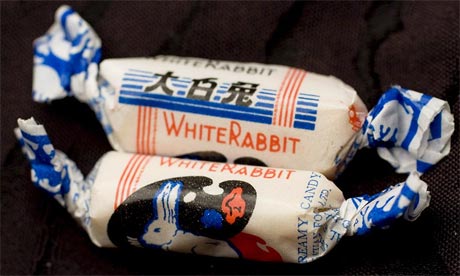
I have a new piece on the London Review of Books Blog about a vicious South Park-style cartoon that has been banned in China. WARNING: some animated rabbits get hurt.
I have a new piece on the London Review of Books Blog about a vicious South Park-style cartoon that has been banned in China. WARNING: some animated rabbits get hurt.

Right wing of the diptych Virgin and Child Surrounded by Angels by Jean Fouquet, c.1450. Wood, 93 x 85 cm Royal Museum of Fine Arts, Antwerp.
Yukio Mishima once wrote about a picture of St. Sebastian whose ‘only purpose had been to lie in wait for him’. Whilst I disagree with Mr Mishima about many things- for example, the irrelevance of women, the need for emperor worship, the advisability of staging a coup -I did feel ambushed when I saw this on the cover of a book about 15th Century European painting. The angels’ faces are sullen, threatening. I don’t know if the angels are red and blue because they represent different types, or if this is just for visual impact. As for the enthroned Virgin, she is said to be modelled on Agnès Sorel, mistress of Charles VII, who died of mercury poisoning aged 28, and whose cousin took her place after her death.
As for Mr Fouquet (1420–1481), he is thought to have been the inventor of the portrait miniature.

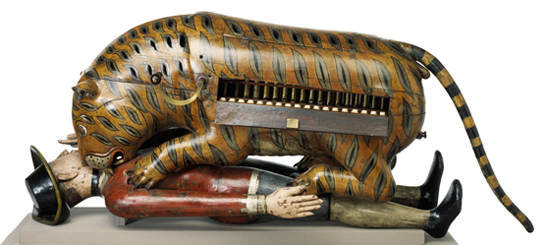
‘Tippoo’s Tiger’ is a life-size tiger of carved and painted wood, seen in the act of devouring a prostrate man in the costume of the 1790s. Concealed in the bodywork is a mechanical pipe-organ with several parts, all operated simultaneously by a crank-handle emerging from the tiger’s shoulder. Inside the tiger and the man are weighted bellows with pipes attached. Turning the handle pumps the bellows and controls the air-flow to simulate the growls of the tiger and cries of the victim.
Tipu (Tippoo Sahib to his European contemporaries) was Sultan of Mysore in South India from 1782-99. He was the implacable enemy of the East India Company, a commercial enterprise with its own armies and civil administration, which during the late 18th century was engaged in extending British dominion in India. Tigers and tiger symbols adorned most of his possessions, from his magnificent throne to the uniforms of his guards.His armoury included mortars shaped like sitting tigers, cannon with tiger muzzles, and hand weapons decorated with gold tiger heads, or inlaid in gold with tiger masks formed by an arrangement of Arabic letters meaning The Lion of God is the Conqueror.
The tiger is currently in the V & A in London, and if you don’t think it’s scary enough, listen to them play the organ inside it.
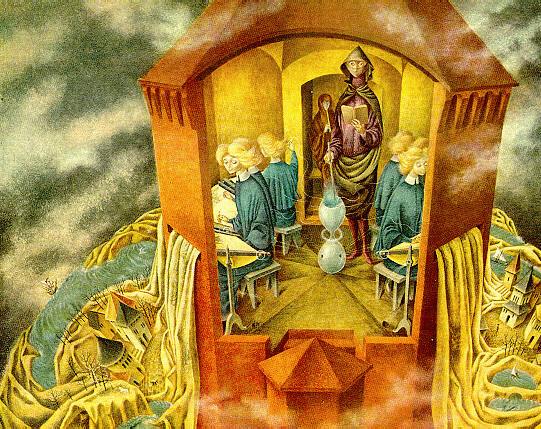
At the end of the first chapter of Thomas Pynchon’s The Crying of Lot 49, Oedipa Maas looks at a painting and cries. The painting is by the exiled Spanish artist Remedios Varo and depicts
a number of frail girls with heart-shaped faces, huge eyes, spun-gold hair, prisoners in the top room of a circular tower, embroidering a kind of tapestry which spilled out the slit windows and into a void, seeking hopelessly to fill the void. (CL 13).
What upsets Oedipa is that she identifies with these girls, not only their sense of captivity, but also their impotence. It is with terror she thinks that
what really keeps her where she is magic, anonymous and malignant, visited on her from outside and for no reason at all… if the tower is everywhere and the proof of deliverance no proof against its magic, what else? (CL 13)
But when I look the painting above, I don’t see anything to justify this kind of fear or paranoia. It’s something Oedipa brings to the painting. The rest of Varo’s work doesn’t have this tone either. It’s more playful, more interested in the surreal than in being allegorical.
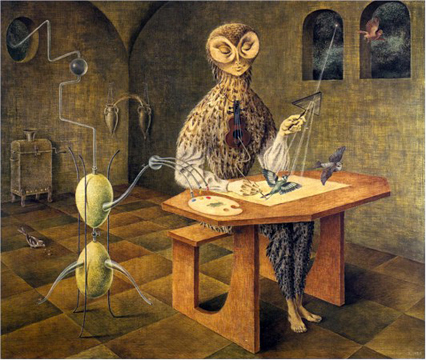

Please note the cat in the floor.

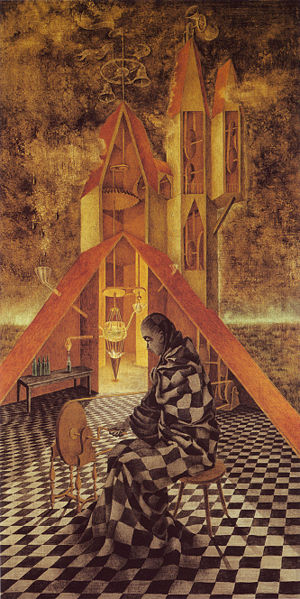
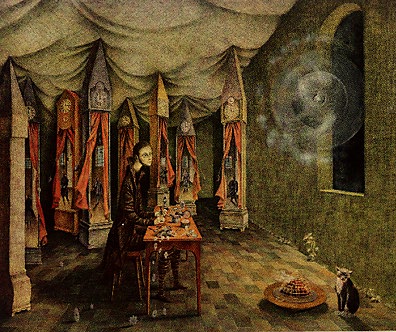
Remedios Varo (1908-1963) was born in Spain and educated in Spanish convent schools. Her father was a hydraulic engineer, which had a recurring influence in her work. Her artistic training was strict and academic, from which she fled into Barcelona’s bohemian artistic circle. She was married to the poet Benjamin Peret, and her widower, publisher Walter Gruen. She moved to Paris where she became involved within the Surrealist movement. Forced into exile by the Nazis, she settled in Mexico City where she died of a heart attack at 55. There only seems to be one biography of her in English, Unexpected Journeys: The Art and Life of Remedios Varo (1988) by Janet Kaplan, and I have a feeling she isn’t that well critically thought of (there’s a lot of snobbishness about ‘fantasy’ art, sometimes with good reason). But to me there’s something distinctive about these pictures that elevates them from a lot of stuff that’s come since. The trouble is that the waters have been muddied so much.

A few obscure Wes Anderson clips, the first from the 1999 MTV Movie Awards, where the Max Fischer players from Rushmore stage some popular films.
This second is a 2004 American Express commercial that’s a homage to Truffaut’s Day for Night. My advice: click on the YouTube bit on the right hand corner of the screen, and it will get bigger.

After my conversation with the organisers of the July 2009 Urumqi protests, I’ve been thinking a lot about protest, in all its forms. Slavoj Zizek’s In Defense of Lost Causes is a book that aims to convince the reader that the ills of the world will not be solved peacefully. What is needed, he argues, is revolutionary terror. The book is a sustained attack on the idea that tolerance and democratic debate are going to effect meaningful change (which for Zizek means the end of capitalism). It’s a complicated book whose argument wanders at times, and occasionally gets lost in score-settling, or Hegelian nitpicking, but it is always readable, provocative and entertaining, not least because for Zizek everything- whether it be Shakespeare or a Jennifer Anniston film -can be illustrative. As a Pynchon scholar I was particularly interested in how he deals with alternative communities, whether or not these are genuinely subversive, or just a form of escape which does nothing to threaten that which they are fleeing from. If I rely heavily on Zizek’s quotes to summarise some of the book’s main arguments, it’s because it seems a safer way to avoid any ‘violence’ to his ideas.
The book’s aim “is not to defend Stalinist terror, and so on, as such, but to render problematic the all-too-easy liberal-democratic alternative… the misfortunes of the fate of revolutionary terror confront us with the need- not to reject terror in toto, but- to reinvent it” (6-7).
In terms of the accepted ideas about which to put a human face to capitalism, he argues that “When one confronts a world which presents itself as tolerant and pluralist, disseminated, with no center, one has to attack the underlying structuring principle which sustains this atonality- say, the secret qualifications of “tolerance” which excludes as “intolerant” certain critical questions, or the secret qualifications which exclude as a “threat to freedom” questions about the limits of the existing freedoms. (30)
He goes on to critique the idea of opting out of the system:
“Postmodernity” as the “end of grand narratives” is one of the names for this predicament in which the multitude of local fictions thrives against the background of scientific discourse as the only remaining universality deprived of sense. Which is why the politics advocated by many a leftist today, that of countering the devastating world-dissolving effect of capitalism modernization by inventing new fictions, imagining “new worlds”… is inadequate or, at least, profoundly ambiguous: it all depends on how these fictions relate to the underlying Real of capitalism- do they just supplement it with the imaginary multitude, as the postmodern local narratives do, or do they disturb its functioning? (33)
Zizek is withering about the way in which many of our ‘ethical’ choices involve choosing how we consume:
True freedom is not a freedom of choice made from a safe distance, like choosing between a strawberry cake and a chocolate cake; true freedom overlaps with necessity, one makes a truly free choice when one’s chouice puts at stake one’s very existence- one does it because one simply “cannot do otherwise.” When one’s country is under foreign occupation and one is called by a resistance leader to join the fight against the occupiers, the reason given is not “you are free to choose,” but: “Can’t you see this is the only thing you can do if you want to retain your dignity?” (70-71)
At times the worldview he presents veers towards a form of Gnosticism (much like Pynchon’s):
The fact that God created the world does not display His omnipotence and excess of goodness, but rather his debilitating limitations. (153)
Many of the book’s best lines belong to Robespierre. This is his riposte to the moderates who deplored the excesses.
Citizens, did you want a revolution without a revolution? What is this spirit of persecution that has come to revise, so to speak, the one that broke our chains? But what sure judgement can one make of the effects that follow these great commotions? Who can mark, after the event, the exact point at which the waves of popular insurrection should break? (163)
Robespierre addressing those who complained about the innocent victims of revolutionary terror: “Stop shaking the tyrant’s bloody robe in my face, or I will believe that you wish to put Rome in chains”. (471)
On the anti-globalisation movement:
This movement also succumbs to the temptation to transform a critique of capitalism itself (centred on economic mechanisms, forms of work organization, and profit extraction) into a critique of “imperialism”… with the (tacit) idea of mobilizing capitalist mechanisms within another, more “progressive” framework. (181)
On the power of ‘failed’ revolutionary Events:
The ultimate factual result of the [Chinese] Cultural Revolution, its catastrophic failure and reversal into the recent capitalistic transformation, does not exhaust the real of the Cultural Revolution: the eternal Idea of the Cultural Revolution survives its defeat in socio-historical reality, it continues to lead an underground spectral life of the ghosts of the failed utopias which haunt the future generations, patiently awaiting their next resurrection. (207)
With reference to Pynchon and the failed Utopias that appear in his work (such as Lemuria in Inherent Vice), it makes me think that though it can be a form of escape, to posit some form of Utopia is always an essentially hopeful act.
For Zizek, the real problem is what happens after a revolutionary Event, how one keeps revolutionary momentum.
The problem is thus: how to regulate/institutionalize the very violent egalitarian democratic impulse, how to prevent it being drowned in democracy in the second sense of the term (regulated procedure)? If there is no way to do it, then “authentic democracy” remains a momentary utopian outburst which, on the proverbial morning after, has to be normalized. The harsh consequence to be accepted here is that this excess of egalitarian democracy over the democratic procedure can only “instituinalize” itself in the guise of its opposite, as revolutinary democratic terror. (266)
One of Zizek’s main strengths is overturning conventional wisdom about what rhetorical positions we should occupy:
The influx of immigrant workers from the post-Communist countries is not the consequence of multiculturalist tolerance- it is indeed part of the strategy of capital to hold in check workers’ demands… the lesson the Left should learn from it is that one should not… merely oppose populist anti-immigration racism with multiculturalist openness, obliterating its displaced class content (267)
Given how much of Pynchon’s work deals with delusion and escape, I was interested in what Zizek has to say about fetishes:
They can be our inner spiritual experiences (which tell us that our social reality is mere appearance which does not really matter), our children (for whose good we do all the humiliating things in our jobs) and so on and so forth (298)
Fetishists are not dreamers lost in their private worlds, they are thoroughly “realist”, able to accept the ways things effectively are- since they have their fetish to which they can cling in order to canel the fall impact of reality. (296)
Zizek on how democracy has its own constraints:
When Rosa Luxembourg wrote that “dictatorship consists in the way in which democracy is used and not in its abolition” her point was not that democracy is an empty framework which can be used by different political agents (Hitler also came to power through- more or less -free democratic elections), but that there is a “class bias” inscribed into this. (379)
Zizek then goes on to offer what looks like an argument in favour of some kind of revolutionary faith, without which one cannot see the potential for change.
Liberals claim that capitalism is today so global and all encompassing they they cannot “see” any serious alternative to it… The repy to this is that, in so far as this is true, they do not see tout court: the task is not to see the outside, but to see in the first place (to grasp the nature of contemporary capitalism)- the Marxist wager is that, when we “see” this, we see enough, including how to go beyond it. (393)
The following seems to be a fairly clear endorsement of ‘violence’ (though what that means is not yet clear, i.e. is it literal violence or symbolic?)
One should not renounce violence ; one should rather reconceptualise it as defensive violence, a defense of the autonomous space created by subtraction (408)
Zizek also offers a way of evaluating subtraction (e.g. the alternative communities that occur throughout Pynchon, especially in Vineland).
Is it a subtraction/withdrawl which leaves the field from which it withdraws intact (or even functions as its inherent supplement , like the “subtraction” from social reality to one’s true Self proposed by New Age meditation); or does it violently shake up the field from which it withdraws? (412)
It’s only in the afterword that Zizek starts to signal what he might mean by ‘violence’. Unfortunately, this seems to shift, initially from a kind of eye-of-the-beholder definition of violence (that differentiates between “radical emancipatory violence against the ex-oppressors and the violence which serves the continuation and/or establishment of hierarchical relations of exploitation and domination” (471)) to talk of violence that is really non-violence. He calls for
a passive revolution which, rather than directly confronting power , gradually undermines it in the manner of the subterranean digging of a mole, through abstaining from particiapation in the everyday rituals and practices that sustain it. (474)
However, Zizek concludes by arguing that the distinction between literal violence and non-violence is less important than whether the “violence” is “divine violence”.
What is and what is not divine violence?… it can appear in many forms: from “non-violent” protests (strikes, civil disobedience) through individual killings to organized or spontaneous violent rebellions and war proper. (483)
As for evaluating such acts, these are said to be
located ‘beyond good and evil’, in a kind of politico-religious suspension of the ethical. Although we are dealing with what, to an ordinary moral consciousness, cannot but appear as “immoral” acts of killing, one has no right to condemn them, since they are the reply to years, centuries even, of systematic state violence and economic exploitation. (478)… If a class is systematically deprived of their rights, of their very dignity as persons, they are eo ipso also released from their duties toward the social order, since this order is no longer their ethical substance. (479)
This is about as unambiguous as it gets:
Sometimes one has to kill in order to keep one’s hands clean; not as a heroic compromise of dirtying one’s hands for a higher goal. (484)
However, in the final pages, Zizek again muddies the waters by suggesting that no one is able to pass judgement on whether an act of violence is ‘divine’ or not, which if he means it, to some extent undermines many of the judgements he passes on the value of various failed revolutions.
There are no “objective” criteria enabling us to identify an act of violence as divine: the same act, that to an external observer, appears merely as an irrational outburst of violence, can be divine for those engaged in it. (485)
The subtleties of this may be lost on me. But to me this seems dangerously close to denying us the right to condemn the killings by a lynch mob, the suicide bomber in a school, or acts of ethnic cleansing.
I rarely remember my dreams. But I am assured that they still happen. Or at least the same patterns of electrical activity that correlate with waking reports of a dream. Though this is fine for my brain, it leaves me feeling a bit cheated. Thankfully I own a copy of The World Doesn’t End by Charles Simic, which has many fine short pieces I can recite and pass off as my own whenever the conversation during the party/train ride/hostage situation turns the sad corner to ‘Dreams’. This is one of my current mainstays, which you may of course feel free to appropriate, should you also suffer from the same deficit, and are at a different party or bank to myself.
My thumb is embarking on a great adventure.
“Don’t go, please,” say the fingers. They try to hold
him down. Here comes a black limousine with a
veiled woman in the back seat, but no one at the
wheel. When it stops, she takes a pair of gold
scissors out of her purse and snips the thumb off.
We are off to Chicago with her using the bloody
stump of my thumb to paint her lips.
I review some of the main events this year in China at n+1, along with contributions from Yelena Akhtiorskaya, Siddhartha Deb, Eli S. Evans, Keith Gessen, Chris Glazek, Emily Gould, Elizabeth Gumport, Alice Gregory, Charles Petersen, Nikil Saval, Jonathan Watson, and Emily Wit.

Urumqi's Nan-Men (south gate) in 1910
Richard Hughes was a journalist who spent most of his life as a correspondent in Asia for The Times, The Economist, and the Far Eastern Economic Review. During World War 2 he was thought by some to be a spy, and possibly a double agent. Given these suspicions, it is unsurprising that he ended up being fictionalised twice: Ian Fleming based the character of Dikko Henderson in You Only Live Twice on him; in John Le Carre’s The Honourable Schoolboy he appears as Craw. This is his from book Foreign Devil, a memoir. I quote this because a) it suggests how relations (not to say manners) have worsened in the city known as ‘beautiful pastureland’ and b) I have a weakness for this kind of prose.
It happened in ‘The Street of the Grey-Eyed Men’ during the tranquil noontime traffic ‘rush’. The inexpert Chinese driver of a bus loudly tooted his horn and frightened a nervous, highstepping white mare, ridden by a tough Kazakh tribesman. The horse reared, neighing, and fell. The horseman skillfully sprang clear, raised and soothed the mare, handed the reins with a bow to the chairman of a council of dignified nomads seated in converse in the gutter, walked calmly over to the halted bus, and, with deliberation but no visible anger, fetched the apologetic driver a fearful backhand clout over the nose. He then remounted, saluted his quietly approving audience in the gutter, and rode off. The Chinese driver wiped his nose, bowed first to the seated gallery, arose, turned and bowed next to the amused but friendly passengers, and drove off, without tooting.
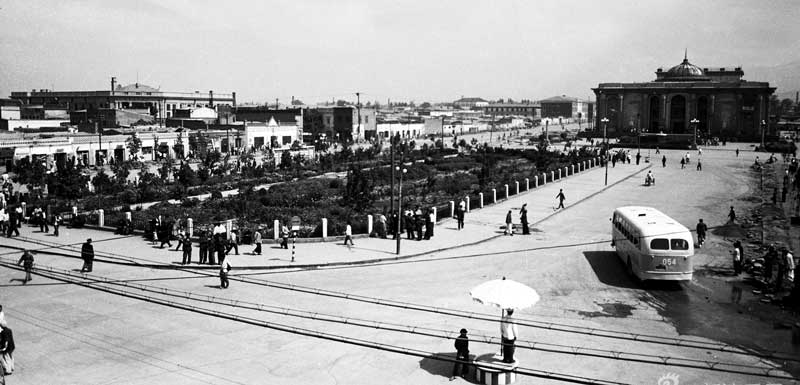
Urumqi's South Gate in the 1960's

Hui shepherd in a Han graveyard
Some photos of the market and back streets in Yining, where I used to live. These were taken in April 2010- there are more up on my Flickr site.
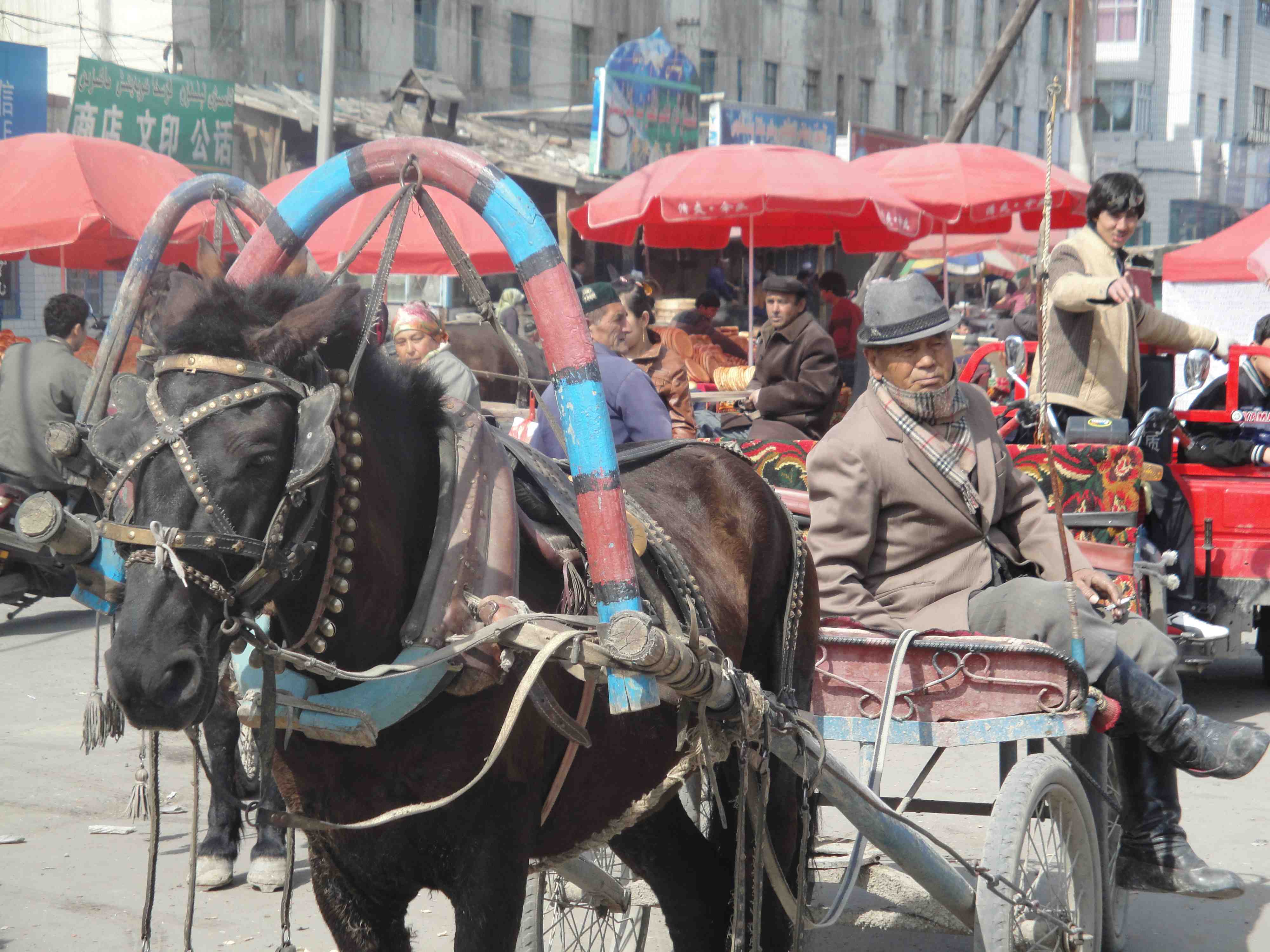
Horse taxi

Traditional Uighur house
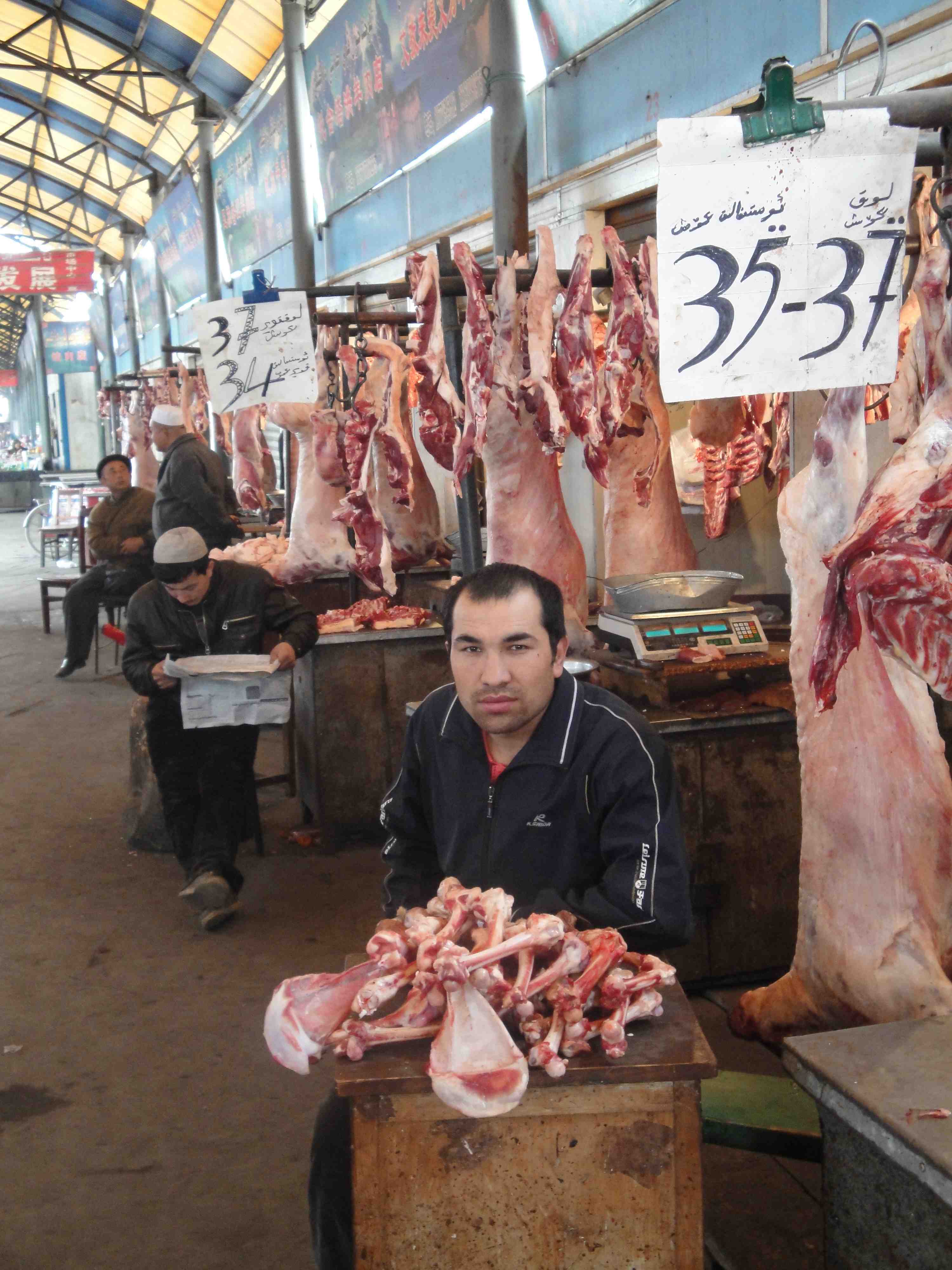
Meat

Snake-oil salesman
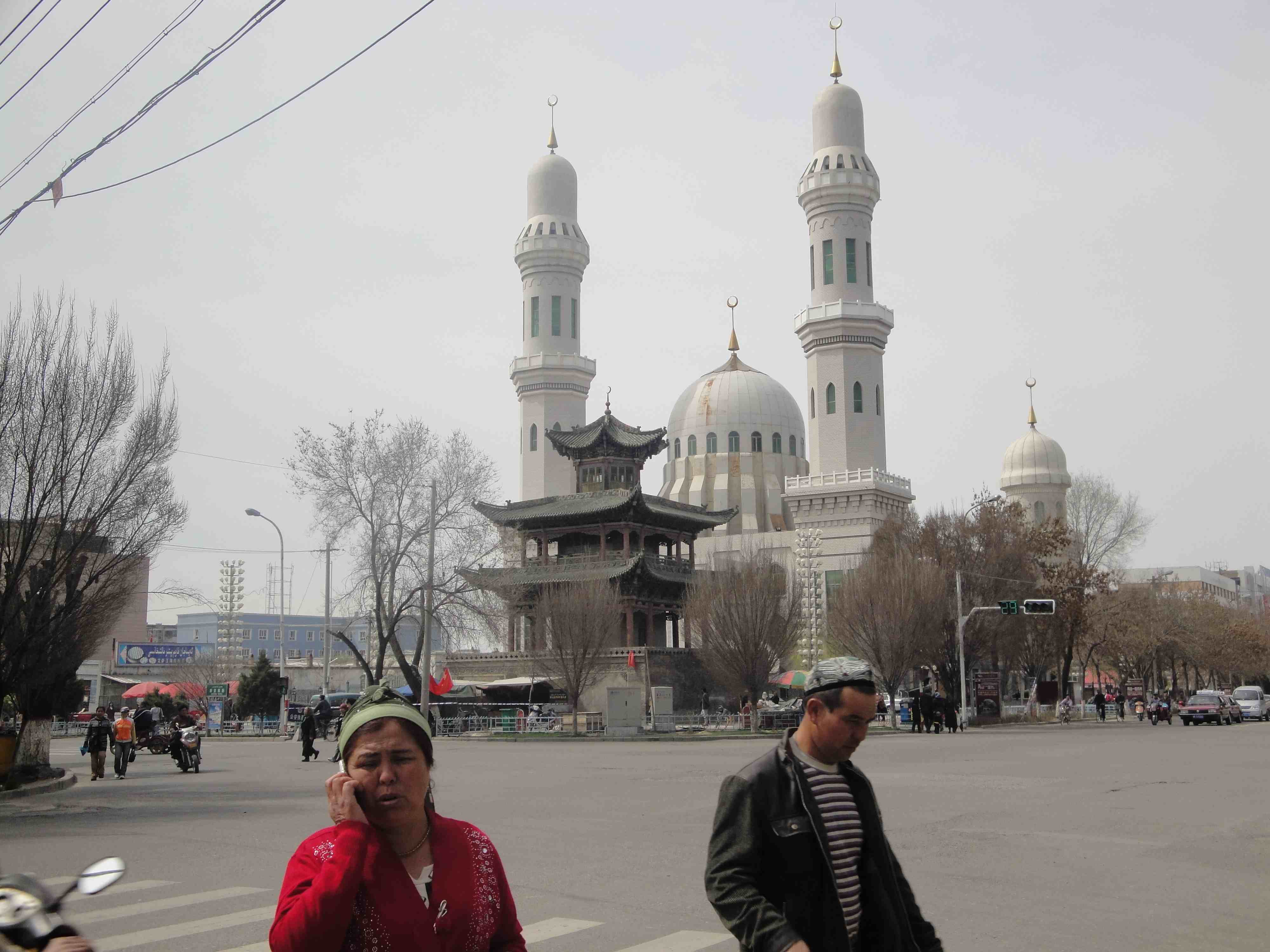
Old Hui mosque, new Uighur mosque
I used to finish every book I began, no matter how bad it seemed. To stop reading would only compound the sense of failure the book had already inspired. I suppose that the failure, on my part, was in thinking that the book was worth reading in the first place; that a scan of its opening pages had not alerted me to the fact that it was misconceived/ cliched/badly plotted/ pretentious/narrated by a rabid dog that thought it was a hippo. There was also the fear that the book was not to blame, especially if it was part of the canon, or even just well-reviewed. Because we should always acknowledge the possibility that the fault lies with us, not the book (or at least that we share blame). We can ruin good books for ourselves by reading them last thing at night, when we are tired, or on a train where someone is talking too loudly, or simply by reading the book too quickly. And there are definitely great books that are very uneven, that have both wonderful and mediocre sections (e.g. Lanark and Ulyssess), and that the latter must be endured. Even with some of the very worst books, there is the increasingly desperate hope that the last 25 pages, when the spaceship lands, will turn out to be a tour de force that contains ‘some of the finest passages written in the English language since the end of the War’ (or some other hyperbole).
But a few years ago, after 120 pages of Memoirs of a Geisha, I decided to stop. The narrative premise was unconvincing, the writing was leaden, and there were hundreds of books in my room. For me, this last point has become increasingly crucial. I will only be able to read a small fraction of the books I would like to read, and so to waste time on something that is less than wonderful seems ridiculous.
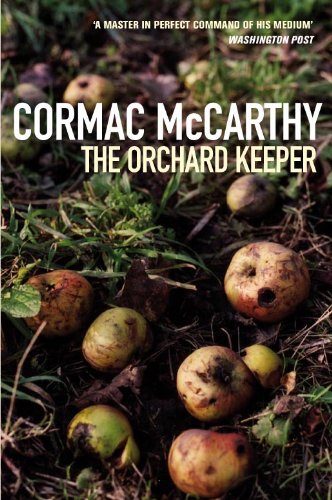
These days the difficulty is in deciding when to stop. I don’t, for example, read 50 pages and think ‘Shall I continue?’ If something is enjoyable, this question never arises. Usually it takes longer, especially if I think that the fault is partly mine, that I am just being obtuse. In the case of the book I most recently stopped- The Orchard Keeper (1965) by Cormac McCarthy -it was because I had read 5 or 6 other books by the author, and felt that I knew what to expect. This passage was decisive.
The boy followed him for a few paces, then quartered off to the creek again and the man watched him go, his legs disappearing in the mist, then the rest of him, so that he seemed to be gliding away toward the line of willows marking its course like some nightwraith fleeing the slow reaching dawn until the man wasn’t sure that he had really been there at all. Then he came back with the pole and handed it to him.
Thanks, the man said.
They moved on across the field, through vapors of fog and wisps of light, to the east, looking like the last survivors of Armageddon.
(103-104 UK Picador edition)
Though this probably doesn’t seem bad (especially out of context), after reading 5 or 6 books written in this style, it now seems incredibly overblown, an attempt to make every event in the book into some portentous event. I’ve managed to deal with this kind of thing before, for example in All the Pretty Horses
The browsing horses jerked their heads up. It was no sound they’d ever heard before. In the gray twilight those retchings seemed to echo like the calls of some rude provisional species loosed upon that waste. Something imperfect and malformed lodged in the heart of being. A thing smirking deep in the eyes of grace itself like a gorgon in an autumn pool.
Why it should be a ‘gorgon’ is beyond me- it doesn’t fit any character’s point of view, not even the authorial voice, with its King James cadences. As a result it seems comical rather than resonant. In terms of the passage from The Orchard Keeper, I could probably have dealt with ‘nightwraith’ on its own, but the subsequent description a paragraph later of them being like ‘survivors of Armageddon’ was too much faux-epic for me.
And the other thing about ceasing to read is that it need not be a judgement on the author- I’ve enjoyed several of McCarthy’s books, and realise this was his first novel. It’s just that I also have 2666, The Man Without Qualities, The Recognitions, In Search of Lost Time, Wolf Hall, and too many others staring at me from the shelf, and I don’t know what they contain.
If you didn’t like The Thin Red Line, Badlands, Days of Heaven, or The New World, judging from this trailer, you won’t like The Tree of Life either.
I happen to like the aforementioned films very much.
This comes out in May.
p.s. If the film runs slow or is pixellated, go here and watch it in HD. Which you probably should do anyway.

Summer in Baden-Baden by Leonid Tsypkin is a novel about what it means to love literature. The novel recreates the life of Dostoevsky, focussing mainly on the summer of 1867 when he and his wife Anna visited Baden-Baden. It is also an account of the narrator’s journey to Moscow, during which he visits places Dostoevsky lived and wrote about. The novel switches between these without warning, but the boundaries between these are quickly blurred, not only because the narrator, in the novel’s present, is so preoccupied with Dostoevsky, but also because both are written in the same style. Each paragraph, whether several lines, or five or six pages, is only a single sentence, full of diversions, qualifications, evasions, and digressions. Here is Dostoevsky’s reaction to Christ in the Sepulchre by Holbein the Younger, a painting that ‘was enough to make you lose your very faith’.

He stared at the picture with renewed intensity- and for a few moments it faded, even seemed to dissolve, and in its place there appeared the familiar faces: the red one with the lynx eyes, the squashed one with the protruding eyes, and then the faces of those performing the round-dance, before positioning themselves in a semi-circle at the summit of the mountain, and begining to point their fingers at him, sniggering and winking at each other, making him want to get down from the chair, but the next moment they all disappeared and he saw clearly once again the face and body of the dead Christ and heard the words about loss of faith spoken by someone else- and this idea was to become the focus of the novel, and then there began to emerge from the mist a few still indistinct objects, scenes and images: a gleaming knife- one peasant stabbing another and raising his eyes to the sky with the words: ‘God, forgive me for the sake of Jesus Christ’; then a soldier selling his pewter cross, pretending it is a silver one; words about God uttered by a simple peasant woman as she sees her baby smile for the first time; an exchange of crosses between the two main characters of the novel; then an unusually deserted Summer Garden with storm clouds thickening over the Petersburg side; a knife gleaming again somewhere in a dark corridor in one of the cheap Petersburg hotels near Liteiny Propsect and the quick glance of tiny, fiery murderous eyes, and a knife gleaming again in the darkness as it is driven in beneath the white breast of the proud and fallen woman.
The effect of these single-sentence paragraphs is to trap the reader within the flights of association that Dostoevsky is portrayed as being subject to, many of which revolve around climbing or descending a mountain, at the summit of which is a Crystal Palace (there is an irony here, in that Dostoevsky frequently mocked this image, which appeared in Chernyshevsky’s 1862 novel What is to be done?, as an idealised communal living space– in Notes from Underground it is likened to a ‘chicken coop’).
The book also raises an interesting question as to why the narrator , who is Jewish, should be so interested in a writer was made no secret of his anti-semitism. This is from A Writer’s Diary:
the whole activity of the Jews in these border regions of ours consisted of rendering the native population as much as possible inescapably dependent on them, taking advantage of the local laws. They have always managed to be on friendly terms with those upon whom the people were dependent. Point to any other tribe from among Russian aliens which could rival the Jew by his dreadful influence in this connection! You will find no such tribe. In this respect the Jew preserves all his originality as compared with other Russian aliens, and of course, the reason therefore is that status of status of his, that spirit of which specifically breathes pitilessness for everything that is not Jew, with disrespect for any people and tribe, for every human creature who is not a Jew…
However, it is more in bafflement, than anger, that the narrator considers this question; at no point does the reader get the sense that it impinges on his love for Dostoevsky’s work.
Two excellent, and very different stories, from the New Yorker, one by George Saunders, the other by David Means. I particularly like the way the Saunders story starts in such an unintelligible manner.
“Drip on?” Abnesti said over the P.A.
“What’s in it?” I said.
“Hilarious,” he said.
“Acknowledge,” I said.
Abnesti used his remote. My MobiPak™ whirred. Soon the Interior Garden looked really nice. Everything seemed super-clear.
I said out loud, as I was supposed to, what I was feeling.
“Garden looks nice,” I said. “Super-clear.”
Abnesti said, “Jeff, how about we pep up those language centers?”
“Sure,” I said.
“Drip on?” he said.
“Acknowledge,” I said.
He added some Verbaluce™ to the drip, and soon I was feeling the same things but saying them better. The garden still looked nice. It was like the bushes were so tight-seeming and the sun made everything stand out? It was like any moment you expected some Victorians to wander in with their cups of tea. It was as if the garden had become a sort of embodiment of the domestic dreams forever intrinsic to human consciousness. It was as if I could suddenly discern, in this contemporary vignette, the ancient corollary through which Plato and some of his contemporaries might have strolled; to wit, I was sensing the eternal in the ephemeral.
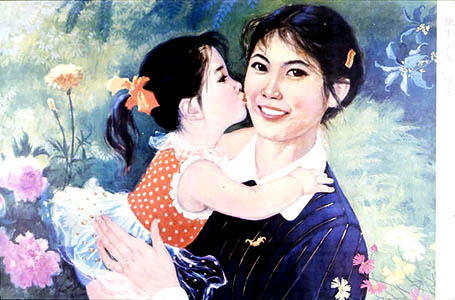
Whether you have a boy or girl, it is still a blossom
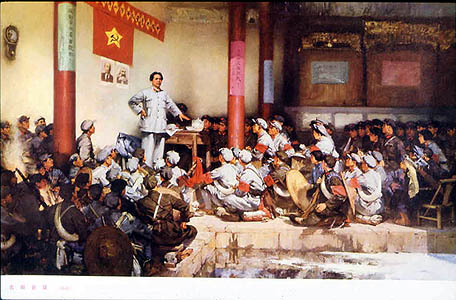
More Chinese Propaganda Posters, this time from the large collection at the University of Westiminster (thanks to Jeff Wasserstrom for making me aware of the collection).
The collection spans the period between the late 1960s and the late 1980s. John Gittings, then Senior Lecturer of the Chinese Section, began the collection in 1979 as the China Visual Arts Project for research and teaching purposes. Over the years it grew, with the contributions of other colleagues, students and friends who studied and travelled in China.There are over 500 images in the collection, which is organised thematically.
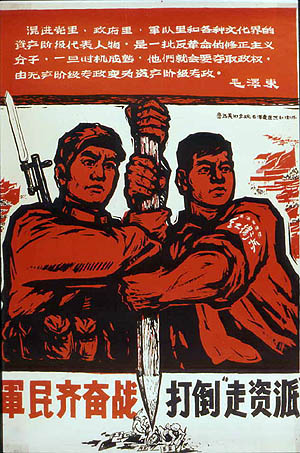
Hold High the Revolutionary Banner of Proleterian Criticism
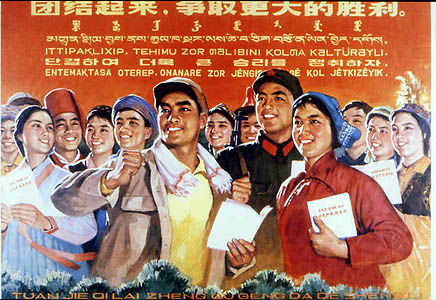
Unite to win still greater victories- April, 1975
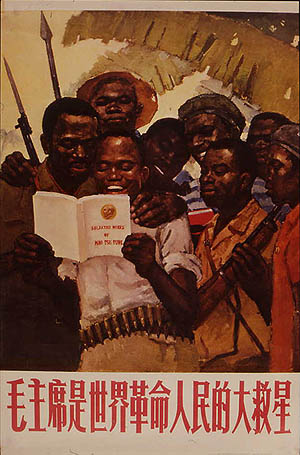
Chairman Mao is the saviour of the world's revolution, 1968

'Man Must Conquer Nature'- Miner with "Tangshan" on his vest, with doctors, soldiers and peasants carrying spades, bringing aid to the July 1976 Tangshan earthquake
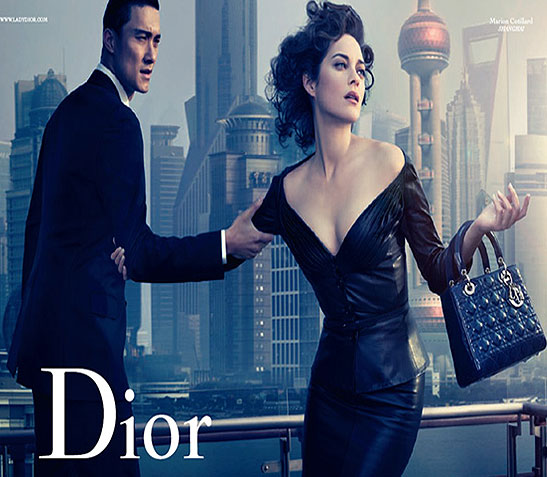
This is David Lynch’s film for the Lady Dior Handbag. It was written, directed, shot, and edited by David Lynch,and stars Marion Cotillard and Gong Tao. I will now make 5 announcements.
FIRST ANNOUNCEMENT: THIS IS A LONG COMMERCIAL, RATHER THAN A SHORT FILM, AND SHOULD BE VIEWED ACCORDINGLY. I.E. WITH SOME DEGREE OF LENIENCY GIVEN THE CONSTRAINTS THAT THIS INVOLVES.
SECOND: I STILL FOUND IT WORTHWHILE.
THIRD: I”M FAIRLY SURE LYNCH ONLY DID THIS FOR THE MONEY. BUT EVEN SAINTS HAVE TO EAT/BUY NEW WHITE SHIRTS/OPEN NEW CENTRES FOR TRANSCENDENTAL MEDITATION.
FOURTH: APOLOGIES FOR IT BEING TWO CLIPS, NOT ONE.
FIFTH: GOOD LUCK.
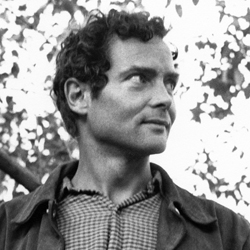
There’s a half hour interview with W.S. Merwin, U.S. Poet Laureate, at the Kenyon Review.
Here’s a poem of his:
| Thanks | ||
Listen with the night falling we are saying thank you we are stopping on the bridges to bow from the railings we are running out of the glass rooms with our mouths full of food to look at the sky and say thank you we are standing by the water thanking it smiling by the windows looking out in our directions back from a series of hospitals back from a mugging after funerals we are saying thank you after the news of the dead whether or not we knew them we are saying thank you over telephones we are saying thank you in doorways and in the backs of cars and in elevators remembering wars and the police at the door and the beatings on stairs we are saying thank you in the banks we are saying thank you in the faces of the officials and the rich and of all who will never change we go on saying thank you thank you with the animals dying around us our lost feelings we are saying thank you with the forests falling faster than the minutes of our lives we are saying thank you with the words going out like cells of a brain with the cities growing over us we are saying thank you faster and faster with nobody listening we are saying thank you we are saying thank you and waving dark though it is |
||
Some propaganda posters from North Korea, more of which can be found here.
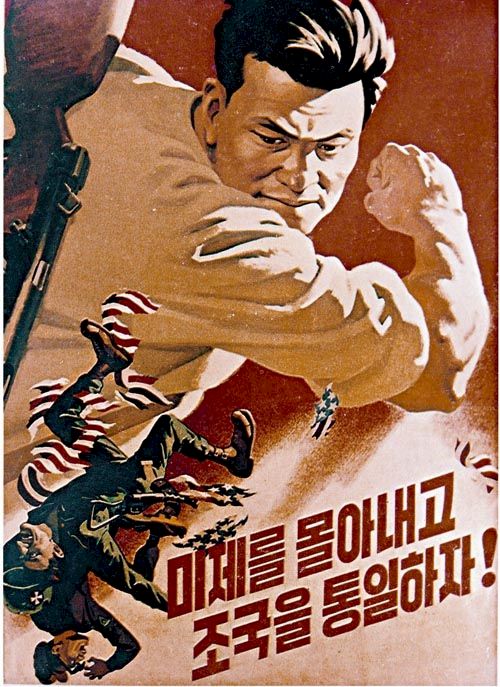
"Let's drive the US imperialists out and reunite the fatherland!"
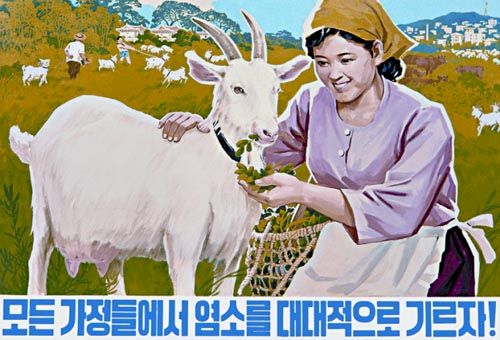
"Let's extensively raise goats in all families!"
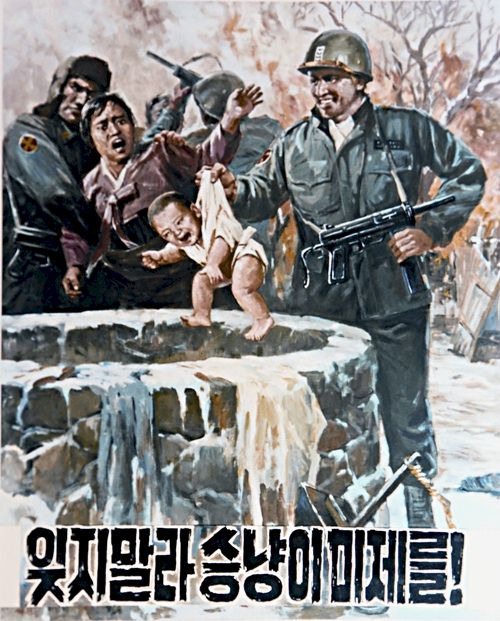
"Do not forget the US imperialist wolves!"

"Though the dog barks, the procession moves on!"

"The US is truly an Axis of Evil."
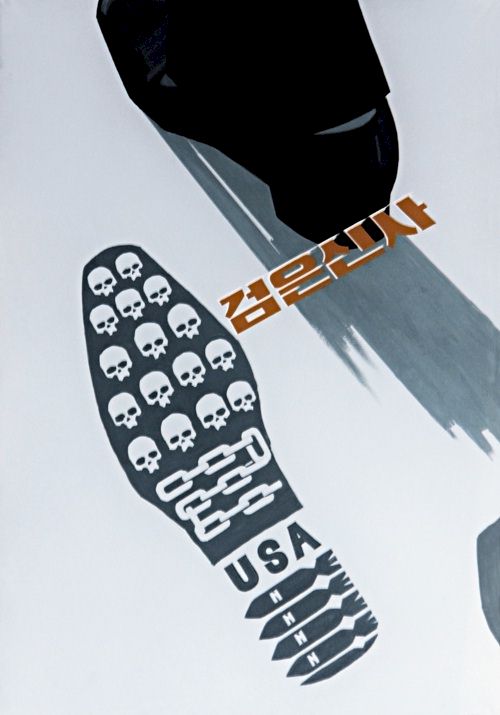
"Wicked Man."

'Love the motherland'
I have some pictures of Chinese propaganda murals on the LRB Blog
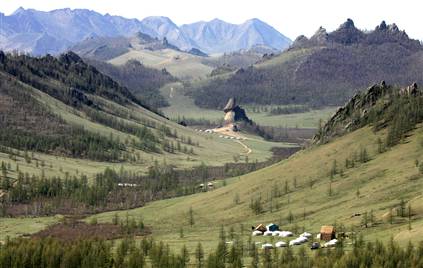
July 12th 2000
The skeletons are flashing me a welcoming white smile. They lie in dried up riverbeds, still waiting for the rains. Above them the sky is cornflower blue, interrupted only by the wings of vulture eagles.
The train flirts with the Gobi’s edges. The train guard asks, in a pleading voice, for us to close the windows. ‘We must keep the sand out,’ he says.
Though it is barely 8 a.m., all the passengers are up, even the song and dance troupe: they were still perfecting their version of “Love Me Tender” at 3 a.m. this morning. They are returning from a two-month tour of China laden with toasters, teddies and microwave ovens. On departure the women stripped down to their underwear whilst shouting and brushing their hair, then donned peach silk dressing gowns which they have been lounging in ever since.
We are still several hours from Ulaan Baatar (‘red hero’) and I know little about this country. I am sans Lonely Planet, speak no Mongolian and have absolutely no plan for the next three weeks. I haven’t really come to see Mongolia, but to visit my friend Theo who is a Peace Corps volunteer in a small town. I last saw him two years ago in Edinburgh, when my last words to him were, “See you in Asia”.
July 13th
Ulaan Baatar is a study in Soviet architecture. The buildings all wear the same grey uniform and radiate an air of unshakeable solidity. There are a few attempts at decoration, some lilac walls and orange shutters, but it is too little against the functional. The main square is a mournful place, lost in memories of previous parades. But this is not an unpleasant town; the streets are tree-lined and the buildings are spaced enough to permit frequent glances of the hills. About 700,000 people live in and around the capital, about a quarter of the total population.
I am staying in the flat of a couple that approached me when I got off the train. In China, I would mistrust any such offer, but for some reason I instantly trusted Ariuna and Enkhbat. They run a semi-legal guesthouse from this flat, which belongs to one of their mothers, currently staying in the countryside. Ariuna is a homeopathic doctor. She studied medicine in Irkutsk for 5 years, and seldom saw her husband during this time. Enkhbat is a quiet man who restricts himself to nods. His moustache is a timid curtain caught between nose and lip. She speaks and he accepts, an arrangement both seem happy with. Though I wonder if he missed being told what to do during those 5 years.
The flat looks as if it was burgled yesterday; an absence of mess that can only be achieved by a lack of content, decor by elimination. There are beds, carpets and an old sofa, nothing more except a set of dusty forks in a kitchen drawer that only sometimes opens.
There are two other travellers in the flat: Steve, a 40-ish American with bottle blond hair and an over travelled air and Marie, a quiet Swedish girl that maybe I’m attracted to.
July 14th
Naadam is the most important festival in Mongolia, a week of horse riding, archery and wrestling, which unfortunately ended yesterday. I must settle for repeats of the wrestling final, which was watched with even greater interest than usual, as the reigning champion of the last eight years had abdicated on reaching the semi-final, thus guaranteeing a new champion.
There is no ring in Mongolian wrestling, the aim is simply to throw one’s opponent to the ground. A hand on the ground is permitted, but only one. Enkhbat told me that they used to wear tunics but this was abandoned after a woman entered in disguise and became champion. So now the competitors only wear a small pair of pants and a sleeved piece of clothing that leaves the chest bare.
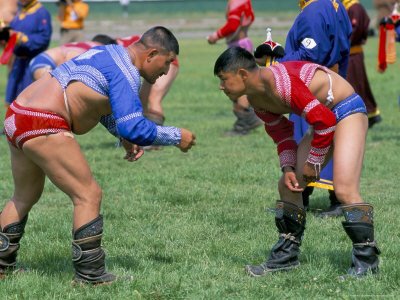

I imagined that the final would be a short and frenzied episode of grunting. It is anything but. The competitiors stood and stared at each other for half an hour, trying not to blink; it was only when I went to the toilet that one lunged for the other. It was over before I flushed.
July 15th
Last night we went to a rock concert. I was even more loath to go than usual, as the flat is hard to get back into. Sometimes the locks just can’t be bothered, and the whole fumbling process isn’t made any easier by the lack of lights on the stairwell. But it was Marie’s last night, so I went.
There were six or seven bands playing various types of soft metal. I was on the point of leaving during the third group when a couple of kids attempted to stage dive. Security took them out before they got a foot on stage. My renewed interest got me through a few more songs, even one whose lyrics were “Sexy sexy lover/ Tell me there’s no other/ You look like your brother/ When we’re under the covers”.
I stood outside and drank a beer too quickly. Portraits of big men in pants ran around the walls. A drunken man came up to me and tried to engage me in conversation with his one word of English.
“John?”
“Pardon?”
“John?”
“No, sorry, I’m not John.”
“John!”
He staggered over to some women, perhaps expecting more success with those who spoke the same language. He put his face towards one of them and said something. She pushed him away, hard, and he fell over. He smiled and then was sick.
July 16th
U-B has some great museums, especially the national museum which also serves as the unofficial headquarters of the Chinggis Khan (Genghis Khan) fan club. Downstairs there is a copy of the friendship treaty of 198 BC between China and Mongolia, when the former was ruled by the Han Dynasty and the latter by the Hunnu, nomadic tribes ruled by kings called Shanui:
“Let the state holding the bows beyond the great wall follow the rules of Shanui and let the Han govern the state of overcoat and hat which lies inside the great wall.”
Upstairs are numerous portraits of Khan and long paeans in praise of his invasion of China in 1211 AD, and of the period of Mongol rule (1271-1368). I was quite confused beforehand, as a number of people in China insisted that Genghis Khan must have been Chinese as he was the ruler of a Chinese dynasty (the Yuan dynasty, which funnily enough also ran from 1271-1368). I suppose this is just historical face-saving, no different to the way that Manchu invasion and rule is known as the Qing Dynasty (the Manchus also controlled Mongolia during roughly the same period).
The other interesting thing was the display of dels, long belted robes that genuinely are national costumes, in that ordinary people still wear them. One of them looked familiar, a long red dress with a pointed collar on a mannequin whose hair was arranged in stiff bunches.

It took me a moment to realise it was the same as the one worn by Queen Amadala in Star Wars Episode 1: The Phantom Menace.
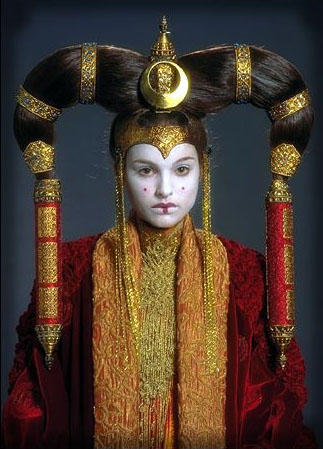
Imagine the dishonesty of the museum for trying to make us think that the garment in question was Mongolian national dress. Someone should be told.
Saw a load of anti-Chinese graffiti this afternoon, which had kindly been written in English.
July 17th
Theo lives in Arvaiheer, a small town in the next aimag (province). The only railway in Mongolia is the Trans-Siberian express, which only stops in U-B. I had to take a minibus, which bumped along slowly for six hours. There was a tub of fermented horse milk between my legs, I was partially deafened by the Aqua songs blasting from the stereo, and the back of my neck was wet. An old, drunk man was sitting behind me with of those spray bottles used for watering plants. After the first few times, I asked him not to. He nodded, smiled, and a few minutes later, squirted me again. After an hour of me asking, him nodding, then squirting, I opened my water bottle, turned round and emptied onto him. It suddenly occurred to me that he was a very large man. That there were several other such men on the bus, and that compared to me, they were giants.
I sat very quietly after that. In five hours we didn’t passed a single town or village, only scattered ger camps. A ger is a large circular tent comprised of canvas and felt draped over a wooden frame. Most gers have a stove in the centre and beds around the walls. Gers are also known as yurts, though not by Mongolians as yurt is a Russian word and thus associated with the long period of Soviet occupation.
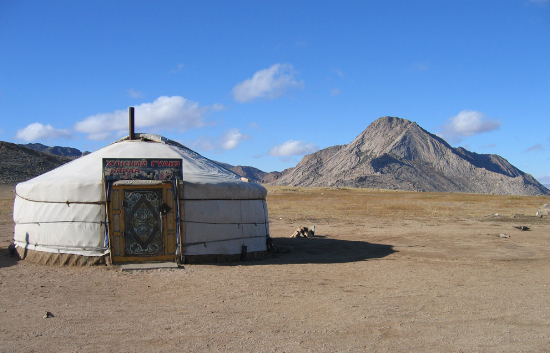
We stopped by a ger camp for lunch. The main dish was tarok, a large charred rodent cooked by having hot stones placed in its stomach. I ate my biscuits and watched the others picking at the carcass. I think it was a marmot. The kind that still carry the Black Death.
We kept passing large stone cairns with bits of bone and bottle, on which blue ribbons fluttered. They are called ovoos, and are sacred sites.


You’re supposed to walk around them three times clockwise saying a prayer. They represent the meeting of Mongolia’s twin traditions of shamanism and Tibetan Buddhism.
July 19th
Arvaiheer is small and isolated. There’s an outdoor market that sells clothes, hats, rope, shoes, bicycles and toys. A line of homemade pool tables stands next to the stalls. The ‘shops’ are converted shipping containers, large metal sheds that mostly sell non-perishable goods. The indoor market has one room for vegetables, one for meat and one for dairy products, or “white food”. There’s a small bakery, a post-office, the odd restaurant, and that’s pretty much it except for the Naadam stadium. In the centre of town, people live in three and four storey flats but away from here people live in gers and small houses. The place has a temporary feel about it, as if one morning the townsfolk might pack it in wagons and head off.
Everyone seems to know Theo, and not just in the “oh look it’s the foreigner” way that most know me in Shaoyang. It takes twice as long as it should to go anywhere because he has to stop and chat to all the people he knows. I suppose I’m jealous.
July 21st
Theo lives in a ground floor flat. Washing is a challenge as there isn’t a bath or shower. You have to stand in a plastic bowl and pour water over yourself. We spent ten minutes today trying to kill some of the flies. No one seems to knock here; people just wander in and sit down. There were five different people this morning and three already this afternoon. Mucqdul has been here three times today. He lives in the next block with his mother. He’s unlike any other man I’ve seen here. Most of them are large, solid and semi-drunk; Mucqdul is a hunched five-foot. His legs are barely thicker than his arms; his head is an inverted triangle. He’s twenty-seven. We sat on the carpet and played a game with sheep’s anklebones whose rules I don’t understand.
July 22nd
A couple of girls came round this morning. I played chess with the older one, who beat me in ten minutes. Chess is one of the better things that the Russians brought to this country. Vodka is not.
The younger girl is called Bagee, which is quite funny as there’s a popular song at the moment whose chorus goes “BAGEE! BAGEE BAGEE BAGEE!” She brought a tiny baby rabbit that she had found. Its eyes were barely open. We tried feeding it some milk, first in a dish, then on our fingers, then on the end of a cotton bud, all to no avail. I don’t hold out much hope for it.
This afternoon we went to the Nadaam stadium. There was no one there and I struggled to imagine the wrestlers and horses that had packed the place the week before. On the way back we passed an old man that Theo knew a little. When he heard I was English he said that he had been there. When? In 1971, for an archery contest in York. What did he remember? That the tea wasn’t milky enough.
July 23rd
Theo is the nicest person that I know. He never minds when hordes of people come to his house. They are always made welcome. He lets people keep meat in his fridge even though he’s vegetarian. He’s so nice that he has agreed to move out of his flat a month early because the woman he rents it from wants to move back in, even though Theo has already paid for August. From tomorrow we will be homeless. Wherever we end up, I hope there are less flies.
July 25th
We have managed to avoid the problem of being homeless by going camping for the last few days. We pitched our tent near the gers of a family that Theo knows. He’s been trying to encourage more people to grow vegetables so that they are not solely dependent on sheep and goats for income. In addition to the difficulties of harsh winters and summer droughts, there is also the problem that animals will eat any crop or shrub if given the chance. The carrots and beetroot have a high fence around them. The idea of a diet that isn’t based purely on meat and dairy products is still quite new to some people here. We had to show the family how to make a salad, and they didn’t really like it until they had put a cup of salt onto it.
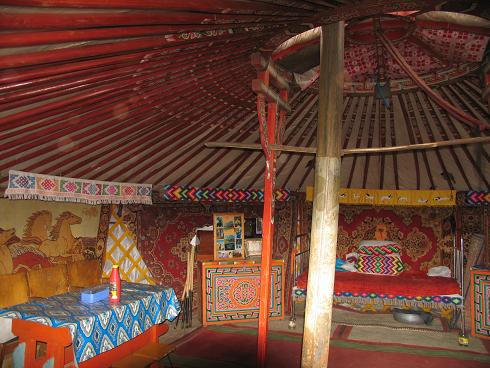
Their ger is the nicest I’ve seen so far. The walls and furniture are painted the same bright orange. The chests of drawers have dark blue lines coiled around their handles. Framed photos of men and horses stand on top of the dresser, crowding around a small altar. Boney M plays from a small tape recorder. Drying meat hangs near the door. A large container of white liquid lurks in the shadows. I worry that it may be airag, fermented horse’s milk, semi-alcoholic and quite frightening to someone who hasn’t had dairy products for over a year.
Theo has been giving me a crash course in Mongolian etiquette, which I am having plenty of opportunity to practice. When you give or receive something, you should always use your right hand; it can then be transferred to your left hand. And if you’re going to trip over the doorstep of a ger, make sure you do so on the way in. This is said to bring luck into the ger. Tripping on the way out takes the luck away.
July 26th
Back in town. Last night we went to the Buddhist temple, as there was a special ceremony taking place. Arvaiheer has even less streetlighting than Shaoyang which makes going anywhere at night rather disorienting. We took a shortcut down a street that Theo called “dog alley”. Dogs with too much wolf blood howled and threw themselves against their gates in frustration. I was ready to offer thanks by the time we got to the temple.
The temple is made from wood and replaces a much older one that had been destroyed (like so many others) during the Soviet occupation. Inside it was crowded. A red line of monks sat chanting in the centre. Om mani padme hum. Banners and flags hung down to head height. A second line of monks sat against the left wall, possibly in reserve. Om mani padme hum. The rest of the space was filled with people from the town, young and old, herders and shopkeepers. Prayer wheels span; incense burned; Om mani padme hum.
Theo saw someone and asked him in a whisper about the ceremony’s purpose. The man replied for several minutes whilst I watched Theo trying to make sense of unfamiliar words. When he had finished I asked him what the man had said.
“He says it is very simple, a very important thing, a small thing… only a single grain of rice.”
“What does that mean?”
“I’m not sure.”
Afterwards we went to Mucqdul’s house, as his mother had kindly offered to let us sleep round there. When we arrived they were watching a video about Jesus. Judas had just taken the thirty pieces of silver. We put our things in the living room, which also doubles as a chapel. It was the first time I’ve seen sanitary towels in a place of worship. When we went back in we found we’d missed the crucifixion. They insisted on rewinding the tape.
When I was laying out my sleeping bag I noticed a lot of small boxes under one of the beds. Mucqdul’s eyes lit up when he saw me looking at the boxes. He crawled under the bed and fished them out. Each one was full of blister packs of pills in various child friendly shades. It turns out that his mother is part of some pyramid sales scheme for selling medicine. I wonder where his father is.
July 27th
Today we went to a waterfall with Mucqdul and his mother. On the way he gave me a badge bearing the words “GOD PEOPLE!”. I thanked him and put it into the black hole of my pocket. I think he was disappointed that I didn’t put it on.
It was nice sitting watching the waterfall, pretending not to notice the goats sneaking up behind me. Later Mucqdul tried to teach me some Mongolian: ot toloh means “don’t bark at me”; bithi hots is “do you want to count some stars?” He also came up with some rude words for Chinese people, which I pretended to write down. One of them was the name of a black bird that makes a fast twittering sound, apparently mocking the way they speak. Another referred to a person who is not honest in business, someone who gives tea in exchange for furs. What surprises me most is the reasons that people give for disliking the Chinese. I could understand if they said things about communism, China pinching Inner Mongolia, or about all the killings during the persecution during the Cultural Revolution but instead they refer to Genghis Khan. What are they cross about? Not being beaten?
On the way back to Arvaiheer we stopped to give a monk a lift. He was the toughest-looking monk I’ve ever seen. He told Theo that he could speak the language of wolves, tried to demonstrate, then laughed for several minutes.
July 28th
I’m not spending another night in that flat. It has no curtains so the sun wakes you up at half past five and there are more flies than in a slaughterhouse. And if I have to watch that Jesus film one more time…
Mercifully, one of Theo’s colleagues has said we can stay in their bungalow. He owes Theo a favour because he still hasn’t returned the video recorder that Peace Corps provide for educational purposes, the one he borrowed three months ago.
The horizon here is clear, the land a green tarpaulin spread into the distance. Blue above and green below.
We ran into Bagee today. I asked about the rabbit. She shook her head.
July 29th
The quest for sleep continues. When we went to the bungalow there was no sign of Theo’s colleague. His 12-year-old daughter was sitting on her own watching an extremely violent film. She barely looked at us for the duration of the film. When it finished (the evil villain got cut in half by an industrial laser) Theo tried to talk to her but she was already reaching for the next film that turned out to be even more unpleasant. We went out for some food and when we returned she was still glued to the screen. Some other kids came round, armed with a games console. Twelve o’clock came and went and still the films went on. Theo asked when they were going to go to sleep and the girl said they weren’t.
This would have been the moment to assert our authority as adults, but we felt inhibited by our guest status. By two o’clock I began to wonder if I would ever sleep again. I wandered out into the front yard. Everything was bathed in toothpaste light: the lumber pile, scrap metal mound, an old car on cinder blocks. I tried the passenger door handle. It opened and I climbed in. I woke several hours later with a dull pain in my rib caused by the gear stick. Dawn was beginning to dirty the night, smudging grey against the black, smugly announcing another night of failed efforts to sleep. I went inside and found the girl still watching the visual litany of shooting, kicking, punching, stabbing and evisceration. Theo was lying on the floor, awake. He looked traumatised.
We got our stuff together and left. The girl said nothing during the whole time. We walked across town to Theo’s office. We didn’t see anyone else even though it was almost seven. In Shaoyang, the shops would have been open for an hour; people would be getting ready for work or doing exercise. The noodle stalls would be packed with students. But in Arvaiheer, it was quiet and grey. A cold wind roamed the streets unchallenged. Dogs barked and were silenced. I started to miss China, then managed to stop myself.
July 30th
Pathetically happy to be back in Ulaan Baatar, able to enjoy base pleasures. Breakfast at a Belgian café. A group of US servicemen entered. The commander was telling a joke,
“A skeleton goes into a dentists. The dentist tells it to say ‘aah’. He examines the mouth then says, “Well, your teeth are in good shape, but as for your gums…”
Theo laughed so hard he blew the froth off his cappuccino. Afterwards we went to the Korean pool hall.
Theo had some stuff to do so I wandered off to the Gandan monastery.

There were lots of people waiting to consult a lama. I watched one consultation between an old woman and a middle-aged lama. She wrote her prayer carefully on a small piece of paper and handed it to him. He read it then asked her a question. He nodded during her answer and when she had finished, lit some incense and passed it to her. She passed it behind her back three times in a clockwise direction. The lama chanted, clapped and rang a bell. She thanked him and left.
Outside the younger monks were sunning themselves. A couple of them spoke a little English, so we were able to have this edifying conversation.
“Hello.”
“Hi.”
“Do you like music?”
“Yes, very much. Do you?”
“Yes. Backstreet Boys. Sometimes Celine Dion.”
“What about Brittney Spears?”
“No. She is not good.”
Writing this in a room of my own, finally, without Christians or flies.
July 31st
Passed a building enigmatically labelled “SEX SHOP”. There wasn’t much stock inside, just condoms and forlorn looking dildos, not up to the standard of those in China. They did have a commendable range of health education posters though.
August 1st
This morning I had to step over several bodies on the stairs. They were both young and oblivious to the amount of noise I made. I’ve read about homelessness in U-B, articles about people coming from the country and failing to find work but all those words fail to prepare one for the morning sight of people your own age wrapped around heating pipes who went to sleep wondering if they would wake up. Theo says a lot of people died last winter.
August 2nd
The train puffs backwards, aimed at China, leaving all this space and sky. But there are still a few hoursof Mongolia left, and I am quite happy: today I am twenty-seven and my arms are out the window.

If you enjoyed this post, my book on China is now available at Amazon
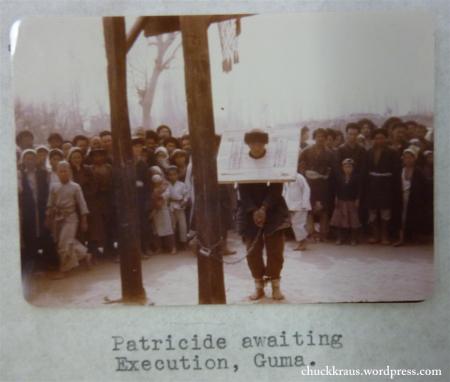
I recently came across this excellent Blog on Xinjiang’s history, which has made me painfully aware of how much of a non-expert I am on this subject (not to mention…). There’s a great deal of thoughtful analysis on a wide variety of topics, from the deaths of the leaders of the East Turkestan Republic, to UFO sightings in the region. I’d particularly recommend the posts on the Photos of J. Hall Paxton, who was U.S. Consul-General in Urumqi from 1946 through 1949. The captions on the photos below particularly caught my eye.


Some small restaurants in Shaoyang, the town in Hunan where I first taught. Probably my favourite places to eat in the world.

Robert Louis Stevenson and his wife, Fanny, on the Marquesas Islands.
Whilst reading Javier Marias’s Poison, Shadow and Farewell, I came across this poem from Stevenson, written near the end of his life, whilst far from Edinburgh. This is the first stanza of To My Old Familiars.
After a day of ‘missile rain’ and ‘belching winter wind’ (such as was today) one could be forgiven for wanting to not only forget, but also to flee. Is there anyone who lives here that doesn’t curse the weather?
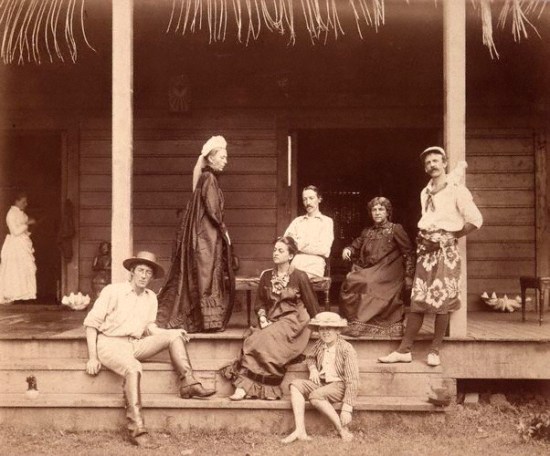
RLS and family, 1891

From Zadie Smith’s excellent piece on The Social Network in the latest NYRB.
World makers, social network makers, ask one question first: How can I do it? Zuckerberg solved that one in about three weeks. The other question, the ethical question, he came to later: Why? Why Facebook? Why this format? Why do it like that? Why not do it another way? The striking thing about the real Zuckerberg, in video and in print, is the relative banality of his ideas concerning the “Why” of Facebook. He uses the word “connect” as believers use the word “Jesus,” as if it were sacred in and of itself: “So the idea is really that, um, the site helps everyone connect with people and share information with the people they want to stay connected with….” Connection is the goal. The quality of that connection, the quality of the information that passes through it, the quality of the relationship that connection permits—none of this is important. That a lot of social networking software explicitly encourages people to make weak, superficial connections with each other (as Malcolm Gladwell has recently argued1), and that this might not be an entirely positive thing, seem to never have occurred to him.
I couldn’t agree more with the following.
Shouldn’t we struggle against Facebook? Everything in it is reduced to the size of its founder. Blue, because it turns out Zuckerberg is red-green color-blind. “Blue is the richest color for me—I can see all of blue.” Poking, because that’s what shy boys do to girls they are scared to talk to. Preoccupied with personal trivia, because Mark Zuckerberg thinks the exchange of personal trivia is what “friendship” is. A Mark Zuckerberg Production indeed! We were going to live online. It was going to be extraordinary. Yet what kind of living is this? Step back from your Facebook Wall for a moment: Doesn’t it, suddenly, look a little ridiculous? Your life in this format?
Yes, we should struggle against it. Yes, our lives are ridiculous. Not what happens, not what we think and feel, but certainly how we try to present ourselves to others. I don’t think there’s anyone I’ve gotten to know any better by being their ‘friend’ on Facebook. I know more about them, that’s all. But knowing which bands or films (or more rarely, books) other people like doesn’t bring us any closer. It does not make for a ‘connection’. It is just a way for us to spy on each other without the risk, or trouble, of actual interaction.
But I will not be quitting Facebook anytime soon. I do things that I want to tell people about, and I use Facebook for that, and it seems only fair that my Facebook ‘friends’ should get to tell me what they’re doing in return. It’s an exchange, a social transaction. But really nothing more.

Traditional Uighur medicine shop in Urumqi
Some photos I took in Urumqi this spring are up at Flickr now.
I have a new piece on the London Review of Books Blog about the plans to stimulate Xinjiang’s economy, and my doubts that the gains will be shared equally.
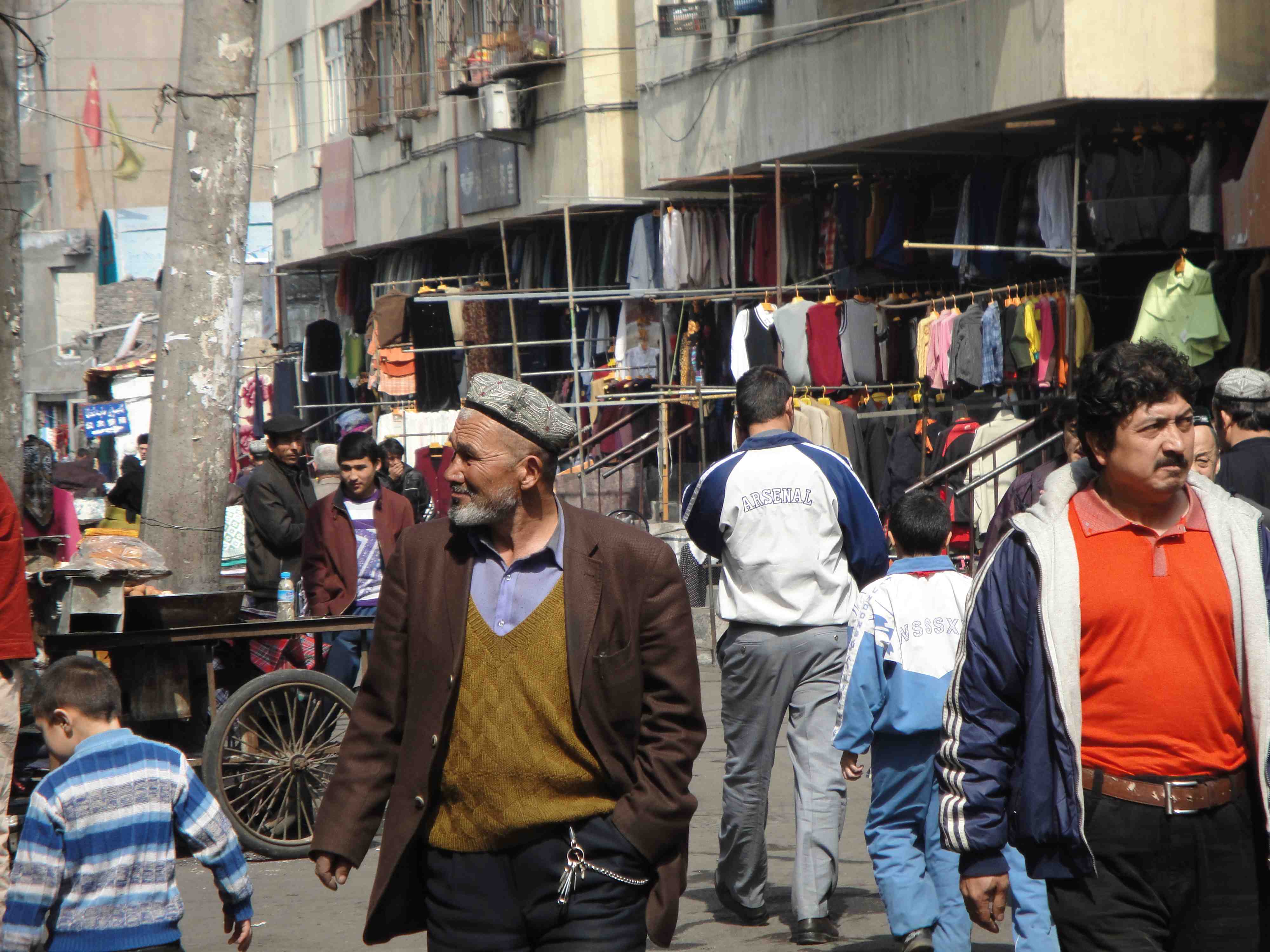
A few good recent Xinjiang pieces, the first from Kashgar about the different responses to the massive social and cultural changes in the city caused by the destruction of the old town. The video is well-worth watching, and gives a sense of the scale of the demolition.

Students at Tongxin Middle School
In the wake of the Tibetan language protests in Qinghai and elsewhere, minority education as a whole is getting more attention. The Uighur Human Rights Project has a very good piece on the issues of so-called ‘bilingual education’, and the obvious political dimensions. The article focuses on a report that appeared in the Chinese press about a visit to a school in Tongxin, in the Kizilsu Kirghiz autonomous area of Xinjiang. The article notes that Tongxin Middle School’s facilities are almost the same as those of schools in eastern China, except for that
“in every classroom, next to the teacher’s podium there is a poster proclaiming an “ethnic unity” pledge, with the second line stating that “every teacher and student should, in thinking and behavior, be fully conscious that the biggest danger to Xinjiang derives from “ethnic splittism” and “illegal religious activities”.
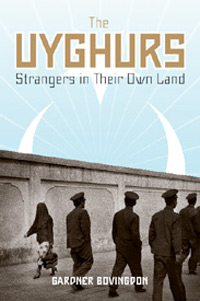
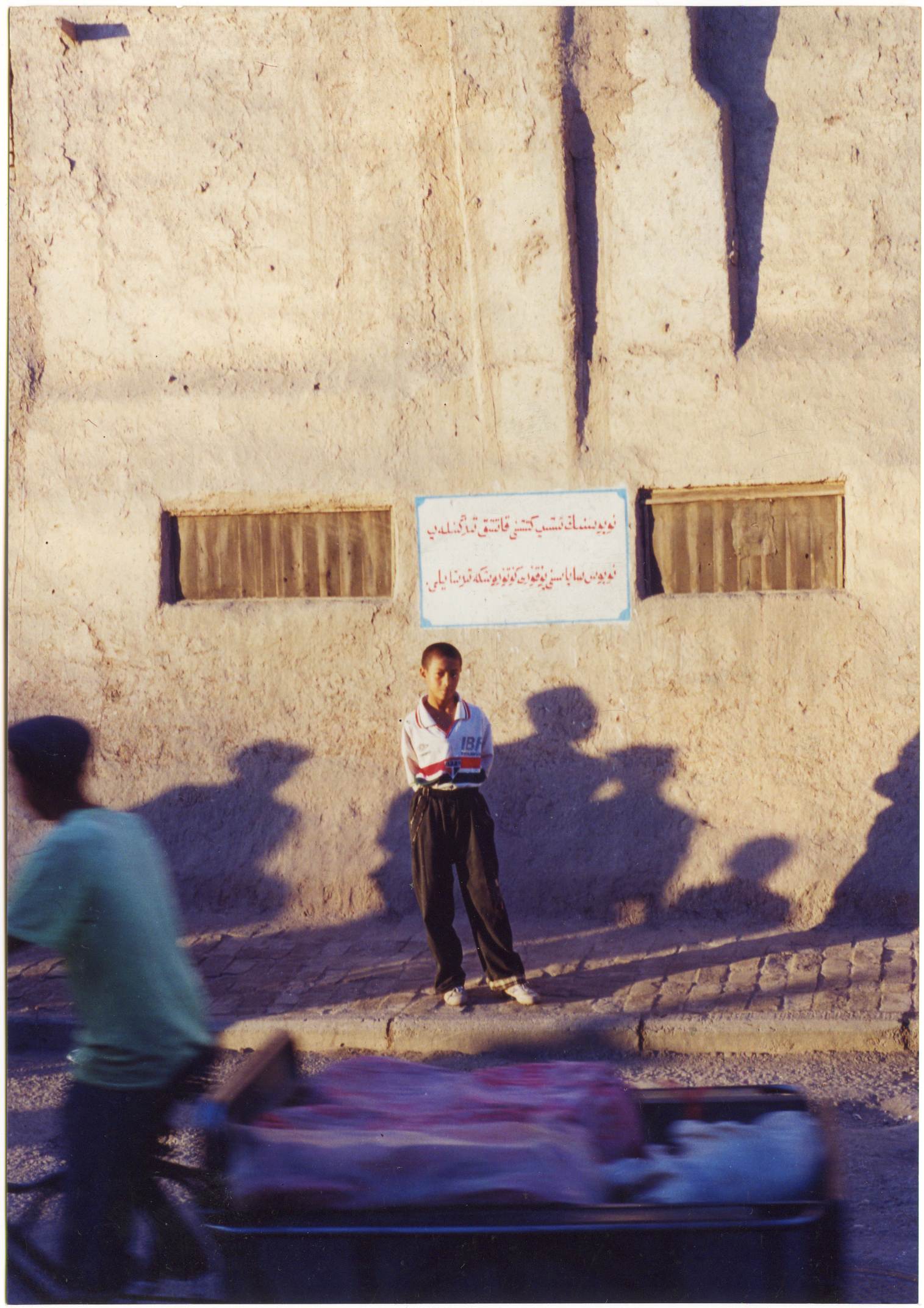
Finally, there’s a review of an interesting new book on the region by Gardner Bovingdon. My grasp of Uighur was, at best, pretty tenuous, so I always had to rely on what people could tell me in English. As a result, I’m particularly interested in the part of the book that deals with
the number of daily public and private ways the Uyghur people defy the Chinese regime. From jokes to songs to stories, Uyghurs invoke the symbols of opposition to Chinese authorities. These varieties of resistance either circulate in trusted private conversations or in allegorical form at public performances.

Girl in Kashgar, 2000
Having just posted that fairly bleak piece about the likelihood of further violence in Xinjiang, here’s a slightly more optimistic one from Radio Free Asia. It doesn’t seem to have been picked up by other news outlets, for reasons that emphasise what constitutes ‘news’.
On October 15th around 100 farmers began protesting in Kashgar against the high fees they have to pay the government to use land. They stayed outside the prefectural government building in Kashgar for 3 days, when the protest came to an end, but not in the manner in which such protests usually do in Xinjiang.
“We had expected armed to police to come take us away, but actually, top officials including the county secretary and village party chief came. Most importantly, they treated us very nicely,” Yusupjan [the leader of the protest] said.
Officials pointed out to the protesters that they would have faced harsher treatment a year ago, after ethnic unrest broke between Uyghurs and Han Chinese in Urumqi, the regional capital. Uyghur men faced widespread arrests in the ensuing crackdown.
“The official said, ‘As you know, if this were last year, you could have seen yourselves surrounded by armed police and your destiny would have been the detention center. But that time is over and such a thing will not happen again. Please listen to us, follow us to return home and we can discuss anything you want with you.’”
The officials are said to have done so, and to be considering the request. Whether or not the land fees get adjusted, this is a unusual story because there seems to be a) agreement from both sides about what happened and b) the protest ended peacefully. I also find it remarkable how candid the officers were about what would usually happen- let’s hope this is due to some general edict about the need for more sensitive policing in the region.
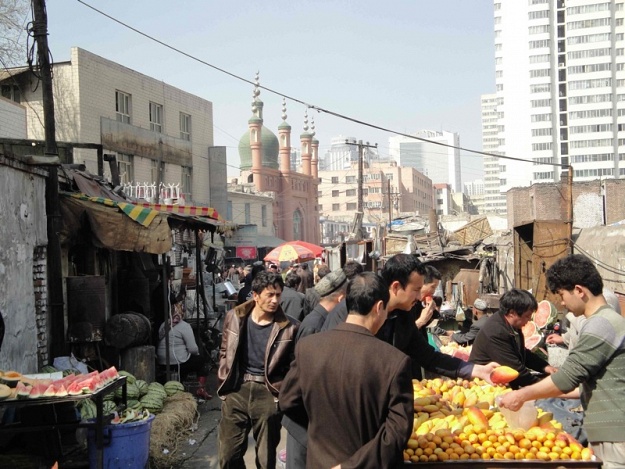
Here is, astonishingly, some actual reportage I did. It’s a long interview I did in Urumqi when I was there in April/May. It’s about protest, violence and terrorism, and will also appear, in some form, in The Tree that Bleeds.

There is something unsettling about new books appearing from dead authors. It makes the writers seem as alive as before, because in most cases we did not know them as people: all we had, as proof of life, was the release of a new book, the barrage of reviews. But in recent years, as the situation of the major publishers has become increasingly straitened, the scouring of literary estates seems to have intensified. Since Kurt Vonnegut died in 2007 there have been several collections of previously published work, and there was recently a collection of 14 previously unpublished stories entitled Look at the Birdie. Whilst there are clear instances of writers wanting something unfinished (or simply unpublished) to appear after their death (Mark Twain, for example, did not want his autobiography published until 100 years after his death) it seems unlikely that a writer of Vonnegut’s popularity had 14 early, unpublished stories more or less kicking around. If he had wanted them published, there is little chance that anyone would have refused, whatever their relative merits. There are probably few serious writers who do not have a few novels or short stories, which although they cannot get rid of- as one cannot discard a child – they prefer to keep in the drawer.
At least the same cannot be said of David Foster Wallce’s forthcoming unfinished novel The Pale King (due April 15th 2011). Wallace is said to have taken considerable pains that the manuscript be in good order, to the point where he left in the open, with lamps shining on it, before he killed himself. The novel focuses on IRS agents in Illinois, and is said to be an attempt to engage with boredom. However, Wallace’s wishes regarding another book are far less clear. In December, Columbia University Press will publish Wallace’s undergraduate theses, entitled Fate, Time and Language. Though it may be, as the promotional material claims, ‘a brilliant philosophical critique of Richard Taylor’s argument for fatalism’, it is hard not to feel uneasy about the appearance of a work which Foster Wallace made no effort to get published during his lifetime. Though there are sound critical motives for wanting to see such a work- it would probably provide an insight into the evolution of Foster Wallace’s ideas on free will and the uses of language -it is hard to say whether these should take precedence over the author’s probable intentions. Whilst one must be glad for some refusals to follow an author’s last wishes (such as Max Brod’s unwillingness to burn Kafka’s work), in other cases it is hard not to be skeptical about a publisher’s motives for wanting to sell an obscure piece of youthful work by a recently deceased major writer.


