A snippet of film of a Uighur backstreet in Urumqi. Highlights include: faces, sounds, a table of bread, sparks from metal being struck.
Tibetan-language protest in Qinghai
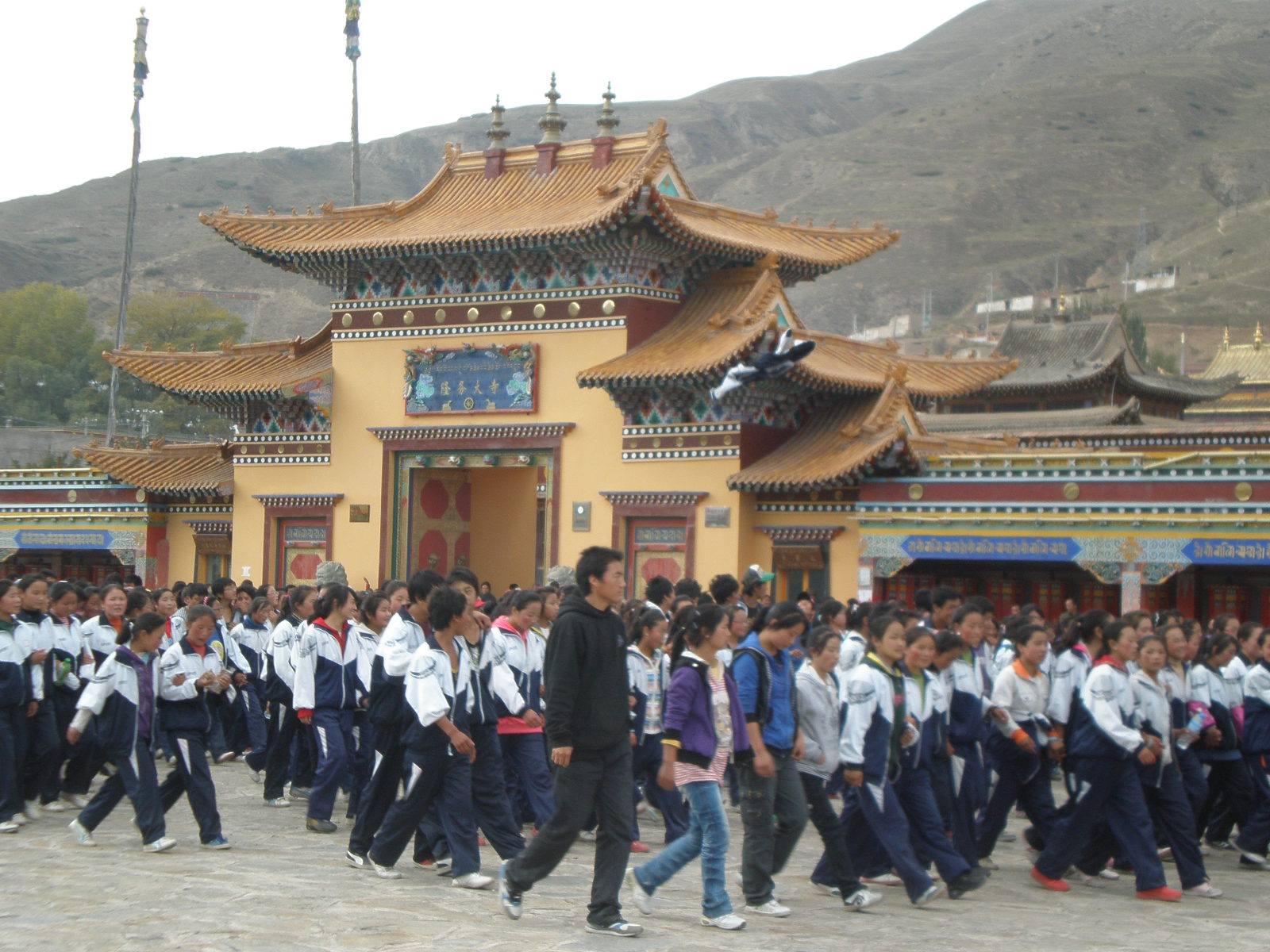
There have been reports (1, 2) of a protest in the western province of Qinghai, where over 1,000 students yesterday marched about plans to restrict the use of the Tibetan language in schools. The protest was peaceful, and the police made no attempt to stop the demonstration. Free Tibet said the protests were caused by educational reforms already implemented in other parts of the Tibetan plateau, which order all subjects to be taught in Chinese and all textbooks to be written in Chinese, except for Tibetan language and English classes.

I don’t have much to add, other than to say that the same thing is happening in Xinjiang, where the Uighur language will soon no longer be used in schools and universities. This is not a new phenomena- in 2001, when I taught in Xinjiang, there were already Uighur children who had gone to predominantly Han schools (‘Min Kao Han’ students) who couldn’t read or write Uighur (which is written using a modified Arabic script:
ھەممە ئادەم زاتىدىنلا ئەركىن، ئىززەت-ھۆرمەت ۋە ھوقۇقتا باب-باراۋەر بولۇپ تۇغۇلغان. ئۇلار ئەقىلگە ۋە ۋىجدانغا ئىگە ھەمدە بىر-بىرىگە قېرىنداشلىق مۇناسىۋىتىگە خاس روھ بىلەن مۇئامىلە قىلىشى كېرەك.
(‘All human beings are born free and equal in dignity and rights. They are endowed with reason and conscience and should act towards one another in a spirit of brotherhood’)
Of course, this only matters if you think that language has anything to do with culture or identity. While it is a good thing for everyone to have a language they can communicate in (Chinese, English), this shouldn’t be at the expense of the language that their culture relies on.
Fortune-telling in Urumqi

Some pictures I took of fortune tellers in Urumqi. Though the state brands such practices as ‘feudal superstition’, many kinds of divination remain popular- several of the fortune tellers said they had been busier since the unrest in July 2009.



Coetzee on Roth
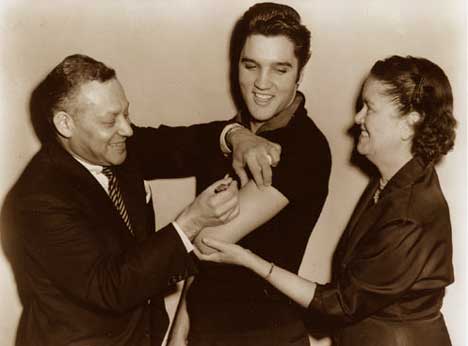
Elvis Presley receiving his polio shot
From J.M. Coetzee’s review of Philip Roth’s latest novel, Nemesis.
How is it possible that we can knowingly act against our own interests? Are we indeed, as we like to think of ourselves, rational agents; or are the decisions we arrive at dictated by more primitive forces, on whose behalf reason merely provides rationalizations?
I hope this is worth 30 seconds of your precious time.

Ladies and gentleman, the Arnolfini Portrait by Jan van Eyck, 1434, in the National Gallery, London. It will be too small on your screen; you will need to click on it to see the carvings on the bedposts. The faces had me pretty much hooked, but then I looked in the mirror behind them, and it was like in a film when suddenly the focus of the image deepens and there is too much horizon. And then there is the green of her dress, its tumbled folds, the hat that seems about to swallow his head.
Please note the oranges.
A few words

Er Dao Qiao street in Urumqi
There’s a brief Q. and A. on the Luath website about my forthcoming book, The Tree That Bleeds.
Charles Burns Animation
Please enjoy.
‘What the hell is water?’

This is the text of David Foster Wallace’s commencement address at Kenyon College in 2005. If anyone can find the full audio, there may be some sort of, um, ‘prize’.
Vineland 323-385
p. 323 The sections starts with a description that seems to be setting up the Traverse/Becker gathering as a kind of rural idyll.
The pasture, just before dawn, saw the first impatient kids out in the dew.
This is followed by a long passage that celebrates communal life in a fairly unambiguous way.
p. 325 Even the Thanatoid’s, that ‘community of the insomniac unavenged’, appear to have found some moment of temporary peace, which leads the narrator to ask
What was a Thanatoid, at the end of the long dread day, but memory?
In terms of their refusal to forget ancient resentments, are the Thanatoids in some sense correct? Should we all therefore be Thanatoids? Their addiction to TV doesn’t seem to impede this kind of memory (which thus run counter to the idea put forth by Huehls et al that TV destroys any sense of historical perspective). However, there seems no suggestion that this sense of being wronged is anything other than personal. But in terms of ‘escape’, or ‘transcendence’, this is perhaps a necessary (though perhaps not sufficient) level at which change must occur.
p. 327 Prairie disdains the representations of girls on TV.
On the Tube she saw them all the time, these junior high gymnasts in leotards, teenagers in sitcoms, girls in commercials learning from their moms about how to cook and dress and deal with their dads, all these remote and well-off little cookies going “Mm! This rilly is good” or the ever-reliable “Thanks Mom,” Prairie feeling each time this mixture of annoyance and familiarity, knowing like exiled royalty that that’s who she was supposed to be, could even turn herself into through some negligible magic she must’ve known once.
But for all her rejection of these gender stereotypes, her role models still come from TV. Her and Che have a ‘star and sidekick routine, going back to when they were little, playing Bionic, Police, or Wonder Woman.’ An awareness of the media’s power to influence is thus no protection against its capacity to do so.
p. 328 The description of Prairie rescuing her friend Che from the mall cops strongly resembles the meeting of DL and Frenesi. Of course, whereas that was in a political context, with Prairie all that’s happening is theft, which can only be seen as an act of resistance in terms of our role as consumers.
p. 335 Hector’s TV fixation is probably the worst in the book:
In the back seat, on loud and bright, was a portable Tube, which Hector had angled the rearview mirror at so he could see, for the highway was a lonely place, and a man needed company.
This is one reason why Hector never seems as much a villain as Brock Vond. Even when in TV detox, he is subject to the whims of those in control, who had
a new policy of letting everybody watch as they wanted of whatever they felt like seeing, the aim being Transcendence through Saturation.
Exactly what kind of ‘transcendence’ this is likely to produce is debatable- perhaps a warped version of the Emersonian ideal, that of removing oneself from one’s surroundings, but only into a kind of hermeneutic fugue state.
p. 337 Unflattering portrait of two Hollywood movie executives, especially their attitude to the audience. To them, Hector is ‘just a guy from the wrong side of the box office’, a judgement that ‘condemned him irrevocably to viewer, that is, brain-defective status’.
p. 340 TV, in its pervasiveness, its saturation of the world (and the narrative of Vineland), is an obvious target of paranoia. In addition to Weed’s belief that it shows too much death (and thus weakens the effect of LSD), Hector imagines what it would be like if
the Tube were suddenly to stop showing pictures and instead announce, “From now on, I’m watching you.”
Though this is a classic Orwellian notion (the view screen that spies on everyone), it is also worth remembering the mental state of Hector. He too depends on TV for his role models, even his own profession (in contradiction to his earlier remarks to Zoyd).
P. 345
It was disheartening to see how much he depended on these Tubal fantasies about his profession, relentlessly pushing their propaganda message of cops-are-only-human-got-to-do-their-job, turning agents of government repression into sympathetic heroes. Nobody thought it was peculiar anymore, no more than the routine violations of constitutional rights these characters performed week after week, now absorbed into the vernacular of American expectations.
It’s easy to forget to who’s ‘talking’ in Vineland, given the number of minds through which the narrative is mediated, some of which sound pretty close to the book’s overall narrator. In this case, it’s Frenesi, as ‘agents of government repression’ suggests, though by the end of the quote, when there’s talk of the ‘vernacular of American expectations’ it sounds like someone else, perhaps the main narrator. This is one of the interesting things about the book- how it slips in and out of free indirect narration so subtly.
p.346 Frenesi’s disillusionment, as shown by her opinion of Hector.
He reminded her of herself when she was in 24fps, inside some wraparound fantasy that she was offering her sacrifice at the altar of Art, and worse, believing that Art gave a shit- here was Hector with so many of the same delusions, just as hopelessly insulated, giving up what already seemed too much for something just as cheesy and worthless
p. 348. TV as a household member, when Hector’s wife cites the TV as correspondent in the divorce, ‘arguing that the TV was a member of the household, enjoying its own space, fed out of the house budget with all the electricity it needed… certainly as able to steal affection as any cheap floozy Hector might have met on the job.’
p. 351 Advice on how to ‘watch’ reality.
The smartest kid Justin ever met, back in kidergarten, had told him to pretend his parents were characters in a television sitcom. “Pretend there’s a frame around ’em like the Tube, pretend they’re a show you’re watching. You can go into it if you want, or you can just watch, and not go into it.”
Though the idea of living as if everything is a TV show doesn’t sound healthy, there doesn’t necessarily seem to be anything wrong with the approach mentioned here- note the emphasis on not having to ‘go into it’, which also suggests the converse- that one can watch TV like watching reality- i.e. in a questioning, detached manner.
p. 358-359 introduces the Sisters, a male motorcycle order, who act as you might expect a biker gang to- the difference is that in addition to their hatred of authority, they believe they cannot sin. Van Meter tells Zoyd:
“Their club tattoo says ‘Full of Grace.’ They believe whatever they do, it’s cool with Jesus, including armed insurrection against the government.”
On the one hand, this seems to be satirising the belief of those (often on the political right) that if they have God on their side, their actions are fully justified, by transposing these beliefs to a gang of bikers. But beyond the comedy of this, there is also the idea that those on the left can be equally self-deluding, especially in terms of the use of force, which Pynchon has previously shown to be a corrupting influence on his protagonists.
p. 364 Another way to view the TV screen- as a window of redemption.
Looking for the magical exact film frame through which the dispossessed soul might reenter the world
p. 365 Weed says
“As a Thanatoid one’s reduced to hanging around monitoring the situation, trying to nudge you if you don’t think it’s moving along fast enough but basically helpless, and, if you give in to it, depressed, too.”
This is a fair summary of the predicament of many of Pynchon’s characters, in particular Oedipaa Maas.
p. 366 Refutes the idea of revenge as a form of closure.
Used to think I was climbing, step by step, right? toward a resolution- first Rex, above him your mother, then Brock Vond, then- but that’s when it begins to go dark, and that door at the top I thought I saw isn’t there anymore, because the light behind it just went off too.
p. 369 Jess Traverse reads from an Emerson passage he found in a jalhouse copy of William James’ The Varieties of Religious Experience.
“Secret retributions are always restoring the level, when disturbed, of the divine justice. It is impossible to tilt the beam. All the tyrants and proprietors and monopolists of the world in vain set their shoulders to heave the bar. Settles forever more the ponderous equator to its line, and man and mote, and star and sun, must range to it, or be pulverized by the recoil.”
Jess and Eula are ‘each year smaller and more transparent’ which we could apply to these words as well- this, and the earlier Emerson passage, seems a case of Pynchon signaling his disagreement of these sentiments that all is fine, if fine within, and that there is some sort of restorative natural justice.
p. 371 asks us to consider if things are bad, or simply, worse.
Other grandfolks could be heard arguing the perennial question of whether the United States still lingered in a prefascist twilight, or whether that darkness had fallen long stupefied years ago, and the light they thought they saw was coming only from millions of Tubes all showing the same bright-colored shadows.
p. 373 Once again, a criticism of the naivete of the Sixties, and people’s failure to resist the distorting influences of living a TV-mediated life.
‘Whole problem ‘th you folks generation’ Isiah opined, “nothing personal, is you believed in your Revolution, put your lives right out there for it- but you sure didn’t understand much about the Tube. Minute the Tube got hold of you folks that was it, that whole alternative America, el deado meato, just like th’ Indians, sold it all to your real enemies- and even in 1970 dollars, it was way too cheap…’
‘Well, I hope your wrong,’ Zoyd breezed on, ’cause plan B was to try and get my case on ’60 minutes’.
Isiah’s opinion is so commonplace in the novel that by now it approaches parody. TV is perhaps too easy a target for Pynchon, and given the events in Gravity’s Rainbow and V., it is safe to say that he does not subscribe to the all-was-fine-till-TV-began school of thought. Zoyd’s response does seem to prove the point however, as he either basically ignores what Isiah has said, or thinks that he can still use the media.
p .376 Vond’s plan to capture Prairie involves him being lowered from a helicopter, so he can
come down vertical, grab her, and winch back up and out- “The key is rapture. Into the sky, and world knows her no more.”
Instead of this peverse kind of deliverance, Brock is suddenly removed, Prairie is saved, and there is something unrealistic about this ending, almost a deus Ex Machina. This is underlined by the fact that Brock is then magically taken down into a deathly kingdom, which ironically fulfils his prophecy of ‘rapture below’ on p.248. But whilst it is satisfying for the reader that the villain is taken away, the manner in which it occurs does not allow us to enjoy it for long. It, too, is a kind of escape, into a fantasy that all (especially the ‘wicked’) get what they deserve (as in the Emerson quote about ‘divine justice’ on p. 369)
p. 382 Sister Rochelle tells Takeshi another allegorical story, about the Earth being a paradise that Heaven and Hell fought. When Hell won, Heaven withdrew upward, and Earth became a kind of vacation spot (i.e. a place to escape to). Eventually
the visitors began to realize that Earth was just like home, same traffic conditions, unpleasant food, deteriorating environment, and so forth. Why leave home only to find a second-rate version of what they were trying to escape?
In the end, the forces of Hell leave, and the people of Earth tell stories about that time.
“We forgot that its original promise was never punishment but reunion, with the true, long-forgotten metropolis of Earth Unredeemed.”
p.383 After the communal feast, the removal of Vond, there is still talk of sinister forces.
The unrelenting forces that leaned ever after the partners into Time’s wind, impassive in pursuit, usually gaining, the faceless predators who’d once boarded Takeshi’s airplane in the sky, the ones who’d had the Chipco lab stomped on, who despite every Karmic Adjustment resource brought to bear so far had simply persisted, stone-humorless, beyond cause and effect, rejecting all attempts to bargain or accommodate, following through pools of night where nothing else moved wrongs forgotten by all but the direly possessed, continuing as a body to refuse to be bought off for any but the full price, which they had never named.
In some ways, this recalls the talk of ‘divine justice’- is this a case of Pynchon affirming this view after all? Or is he satirising the kind of paranoid thinking that prefers there to be dark conspiracies rather than no order (as in the Tristero in Lot 49).
p. 384-385
The book ends in a similarly dark fashion, with Prairie fantasising about Brock as an authority figure (as her mother, and grandmother did). There are ‘silent darkened silver images all around her’, now that the flashbacks, and the screenings are over. She sleeps and the pastoral images return.
Deer and cows grazing together in the meadow, sun blinding in the cobwebs on the wet grass, a redtail hawk in an updraft soaring above the ridgeline.
Then Desmond, her dog, appears with a dead bird in its mouth. This brings the novel full circle, back to the beginning where Zoyd dreamt these same birds had messages for him he could never get to in time. Now, in reality, his daughter has also got to these birds too late. The dog is said to be ‘smiling out of his eyes, wagging his tail, thinking he must be home.’ But for all his happiness, he is mistaken- he is far from home, assuming such a place still even exists.
Coming probably all too soon: The Crying of Lot 49
Elif Batuman on Creative Writing Programmes

Elif Batuman on Creative Writing Programmes- The Posessed, her wonderful book on Russian literature, and those who love it, is out in the UK next year.
‘It’s important that a film is loud’
David Lynch promoting Twin Peaks: Fire Walk with Me.
Considerably more fun than this, where Letterman has clearly not watched Twin Peaks:
‘God is doing great things in China’
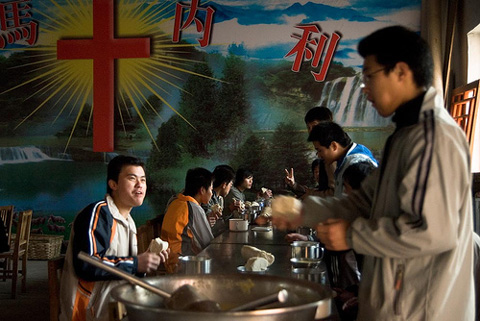
Bible school in rural China
On August 24 the BBC reported that the Chinese government is encouraging the development of Christianity within the country. In addition to supporting the establishment of national seminaries for Catholic and Protestant clergy, the government has provided land, and 20% of the building costs, for a new church in Nanjing, which when completed will be the largest in the country. An official told the BBC that there are at least 20 million Protestants legally worshipping in churches in China. Though this may come as a surprise (on the grounds that a Communist state might be expected to oppose religion), freedom of belief is provided for by article 36 of the Chinese constitution.
It justifies this by arguing that ‘People in China, whether they are religious believers or not, in general love their motherland and stand for socialism. They all work for the country’s socialist modernisation programme. So, it is easy to see that the policy ensuring freedom of religious belief for all citizens is in no way against socialism.’
But although religion is tolerated, there are many restrictions on how people can worship. Believers must worship in registered venues, and all religious publications and appointments must be approved by the authorities. It is this level of surveillance that leads people to worship in house churches throughout the country, which not being registered, are considered illegal. For many years, human rights organisations have criticised the treatment of people arrested for attending these churches, many of whom, according to Amnesty International, ‘continue to experience harassment, arbitrary detention, imprisonment and other serious restrictions’.
Though the government claims that its goal in encouraging Christianity is to ‘better guarantee religious belief in China’, the official the BBC spoke to also made it clear that ‘the Chinese Communist Party believe there is no God in the world’. However, there are other reasons why the government may wish to encourage Christianity. One is that the government could be trying to bring more worshippers into open, where it can keep a watchful eye on them. Another, more pragmatic explanation, is to do with the social role a strong Church might fulfill. In the past, the Communist Party has sought to prevent the formation of national organisations outside the state’s control (such as its campaign against the Falun Gong), fearing these might serve as a focal point for dissent. But as the gap between the rich and poor increases in China, non-state organisations may be needed to deal with the social problems (drug use, homelessness, poverty) likely to result. Given that, in a recent survey of charitable behaviour, China came 147th out of 153 countries surveyed on measures like volunteering and giving to charity, the government may be hoping that state-run churches will encourage a growth in social consciousness. Whatever the reason for the government’s shift in policy, it has been welcomed by many Chinese Christians. One student interviewed by the BBC said, ‘I think this nation will change, and I think God is doing great things in China.’
Vineland 268-322

p.268 Though Brock has been painted fairly blackly thus far, the opening of this section immediately humanises him, and makes him seem far less powerful (and this reminds me of David Letzler‘s talk on the subject of ’round’ characters in Gravity’s Rainbow at IPW 2010).
When had Brock ever posessed her? There might have been about a minute and a half, just after the events at College of the Surf, the death of Weed Atman, and the fall of PR3, though he was no longer sure.
There is also an explanation for why some become college snitches, which again draws on the idea of an escape back to childhood, or at least adolescence.
Another selling point for hiring on would turn out to be this casual granting of the wish implied in the classical postcollegiate Dream of Autumn Return, to one more semester, one more course credit required, another chance to be back in school again… the FBI could even put you on the time machine if that’s what you wanted.
There is then a further explanation for Frenesi (and many others) defection:
Brock Vond’s genius was to have seen in the activities of the sixties left not threats to order but unacknowledged desires for it. While the Tube was proclaiming youth revolution against parents of all kinds and most viewers were accepting this story, Brock saw the deep- if he’d allowed himself to feel it, the sometimes touching -need only to stay children forever, safe inside some extended national Family.
This last phrase about the ‘national Family’ puts a different, if logical slant, on the idea of a return to childhood- that there will need to be parents, or guardians to watch over the kids. If we accept that this is filtered through Vond, then it is slightly at odds with Vond’s disparaging remarks about parenthood on p. 300. All of it, however, may be secondary to his pursuit of Frenesi, which again humanises Vond further.
p. 271 ‘Feel like we been in aMovie of the Week!’ says Roscoe, Brock Vond’s partner, in yet another example of TV being used as a frame of reference to define reality.
p. 283 ‘Childhood’, in Vineland, is not a stable metaphor, signalling, on the one hand, innocence, but at other times, naivete.
Stunned by the great Childward surge, critical abilities lapsed.
p. 285 Not just a paragraph about moments of transcendence, but one with a shift in person.
And these acid adventures, they came in those days and they went, some we gave away and forgot, others sad to say turned out to be fugitive or false- but with luck one or two would get saved to go back to at certain later moments in life.
Though the book does have a narratorial voice, whose sympathies appear to be with Zoyd and his ilk, this ‘we’ is the closest the novel comes to the personal.
p. 287 Frenesi’s Fall from ‘Angel’ status.
Taken down, she understood, from all the silver and light she’d known and been, brought back to the world like silver recalled grain by grain from Invisible to form images of what then went on to grow old, go away, get broken or contaminated. She had been priviledged live outside of Time, to enter and leave at will, looting and manipulating, weightless, invisible. Now Time had claimed her again, put her under house arrest, taken her passport away. Only an animal with a full set of pain receptors after all.
As well as its celestial aspects, the talk of ‘silver recalled grain by grain’ suggests the photographic process.
p. 289 “Taking ‘free’ as far as you can usually leads to ‘dead'” Frenesi’s dad tells her.
p. 290 Pynchon possibly overdoing the child comparisons, with Hub’s face ‘suddenly a kid’s again’, and then, in the next sentence, him and Sasha are said to have started off such ‘happy-go-lucky-kids.
p.293 Long, claustrophobic sentence that uses the metaphor of Frenesi playing an arcade game whose joystick (ahem) is represented by Brock Vond’s penis which she uses to
steer amongst the hazards and obstacles, the swooping monsters and alien projectiles of each game she would come, year by year to stand before… playing for nothing but the score itself, the row of numbers, a chance of entering her initials among those of other strangers for a brief time, no longer the time the world observed but game time, underground time, time that could take her nowhere outside its own tight and falsely deathless perimeter.
‘Falsely deathless’ is a brutal reminder of what lies at the end of a mediated life, whether through TV or within games. It cannot be avoided. And however long she plays, all she can achieve is a meaningless score.
p. 300 Vond presents normality as the escape, not the counter culture. It is thus convention that is the aberration, according to this.
A woman, say, trying to be an average, invisible tract-house mom, anchoring herself to the planet with some innocent hubby, then a baby, to keep from flying away back to who she really is, her responsibilities, hm?
p. 306 What fantasies, and nostalgia are for, perhaps.
Where’d he ever have been without fantasies like that to help bridge him across the bad moments when they came?
p. 314 Zoyd and Mucho reminisce about how acid let them understand they ‘were never going to die’. Mucho then says,
They just let us forget. Give us too much to process, fill up every minute, keep us distracted, it’s what the Tube is for. And though it kills me to say it, it’s what rock and roll is becoming- just another way to claim our attention, so that beautiful certainty we had starts to fade, and after a while they have us convinced all over again that we really are going to die.
Though the idea of the TV being a method of control sounds like something we might want to ascribe to Pynchon, not least because TV is usually portrayed in his novels in a negative fashion (e.g. a TV box is mistaken for heroin in Inherent Vice), the fact that Mucho, who argues this, also believes that the proper use of acid will prevent death, tends to undermine this view. As Brian McHale argues (in Constructing Postmodernism) rather than Vineland being a ‘jeremiad’ against the corrupting influence of TV, it is more an exploration of how it saturates our lives, our vocabulary, and most importantly, acts a mirror to the ontological plurality (the multiple, competing forms of reality) of the postmodern world.
David Shrigley film on why the Arts matter
Vineland 218-267

p. 218 Further criticism of TV’s effects on our sense of time, space and mortality. The Tibetan Book of the Dead is said to inform us that the ‘soul newly in transition’
finds no difference between the weirdness of life and the weirdness of death, an enhancing factor in Takeshi’s opinion being television, which with its history of picking away at the topic with doctor shows, war shows, cop shows, murder shows, had trivialized the big D itself. If mediated lives, he figured, why not mediated deaths?
p. 220 Zoyd describes Holytail, the ‘last refuge for pot growers in North California’ as ‘a community living on borrowed time’.While a reference to the precariousness of their situation, there is also the suggestion of a debt being called in.
p. 223 A paragraph that links childhood in with the ability to find transcendence, thus tying up the metaphors of childhood, naievete, innocence, and escapism that have appeared thus far.
In Van Meter’s tiny house behind the Cucumber Lounge, the kids, perhaps under the influence of the house parrot, Luis, figured out a way to meet, lucidly dreaming, in the same part of the great southern forest. Or so they told Van Meter. They tried to teach him how to do it, but he never got further than the edge of the jungle- if that’s what it was. How cynical would a man have to be not to trust these glowing souls, just in from flying all night at canopy level, all shiny-eyed, open, happy to share it with him? Van Meter had been searching all his life for transcendent chances exactly like this one the kids took for granted, but whenever he got close it was like can’t shit, can’t get a hard on, the more he worried the less likely it was to happen.
Even from the second sentence Van Meter is distrustful (‘Or so they told…), despite the fact that he ‘had been searching all his life for transcendent chances’. As for the question of ‘how cynical would a man have to be not to trust these glowing souls?’, the fact that he is, that we are, despite all we might hope for in the way of release, or escape, could lead us to the idea that the greatest Fall we suffer is from childhood, and that this is what most of us, whether hippies or not, are searching for, but cannot accept even when we find it, or something that at least resembles it.
p. 226 May possibly mirror the cut to an advertising break.
Because Thanatoids relate in a different way to time, there was no compression towards the ends of sentences, which meant they always ended by surprise.
p. 229-230 Rex’s approach to resistance aims for a denial of all forms of pleasure, to transcend all appetites, whose culmination is death.
Rex himself saw the revolution as a kind of progressive abstinence… As the enemies attention grew more concentrated, you gave up your privacy, freedom of movement, access to money, with the looming promise finally of jail and the final forms of abstinence from any life at all free of pain.
p. 232 Rex offers a recapitulation of Weber’s ideas in The Protestant Ethic and the Spirit of Capitalism.
“You’re up against the True Faith here, some heavy dudes, talking crusades, retribution, closed ideological minds passing on the Christian Capitalist Faith intact, mentor to protege, generation to generation, living inside their power, convinced they’re immune to all the history the rest of us have to suffer.
But Pynchon usually undermines most forms of duality- so the fact that they are supposedly evil, is no guarantee of ‘us being good.
“They are bad, bad’s they come, but that still doesn’t make us good, not 100%, Weed.”
p. 236 TV described as a drug, or at least a form of sustenance.
Embarassed, he reached for the Tube, popped it on, fastened himself to the screen and began to feed.
p. 236 Frenesi describes make believe as ‘her dangerous vice’, one of the few moments where a character shows some insight.
p.237
Beginning the night she and Rex had publicly hung the snitch jacket on Weed, Frenesi understood that she had taken at least one irreversible step to the side of her life, and that now, as if on some unfamiliar drug, she was walking all around next to herself, haunting herself, attending a movie of it all.
Here Frenesi is trying to distance herself from her own life, with its betrayals, by pretending it is a movie, and thus not real.
If the step was irreversible, then she ought to be all right now, safe in a world-next-to-the-world that not many would know how to get to, where she could kick back and watch the unfolding drama.
On the one hand, this seems problematic- that there isn’t this safe place where she can avoid the consequences of her actions (in her case, betrayal and accessory to murder). But within there is also the possibility of redemption- that the step is not irreversible, that one can go back, at least in memory, and seek some measure of atonement. And arguably this is something Frenesi achieves by the end of the novel.
p. 239 Suggestion that everyone is complicit to some degree with the ills of the system, the abuse of power, the erosion of liberty.
No one, Frenesi was finding out, no matter how honorable their lives so far, could be considered safely above it, wherever “above” was supposed to be.
p. 248 Brock Vond, when talking about the disappearance of many protestors, makes a joke about murder being a form of transcendence.
Taken one by one, after all, given the drop out data and the migratory preferences of the time, each case could be accounted for without appealing to anything more sinister than a desire for safety. At his news conference Brock Vond referred to it humorously as “rapture”.
He goes on to say that they have ‘gone underground’, that they have sought ‘rapture below’.
p. 252-253 DL’s sense of karma while doing the ‘bookkeeping on this caper’.
If the motive itself was tainted, then the acts, no matter how beautifully or successfully executed, were false, untrue to her calling, to herself, and someday there would be a payback.
p.256 Frenesi’s Dream of the Gentle Flood. In this a California beach town is partially, gently submerged, in such a manner that no one dies, and life can regroup on the higher slopes. She dreams of hearing a song about
divers, who would come, not now but soon, and descend into the Flood and bring back up for us “whatever has been taken”, the voice promised, “whatever has been lost….”
Yet another fantasy that dolphins, aliens or some other entity will come and ‘save’ us. Here there is also a temporal displacement, in that the Flood is arguably what she is actually wishing for, but within this future state, there is also her present desire of wanting ‘whatever has been taken’. Perhaps also worth noting the difference between ‘taken’ and ‘lost’ (why else virtually repeat the phrase?). ‘Taken’ makes her sound more like a victim; ‘lost’ allows for her playing a more active role, and perhaps comes closer to the truth.
p. 258 More talk of bookkeeping.
Those framable pieces of the time, which had demanded, when the bookkeeping was done, damn near everything.
p. 259 Repetition of question on p. 29. Frenesi asks DL
So what difference did we make? Who’d we save? The minute the guns came out, all that art-of-the-cinema handjob was over.
But given the context in which she asks this (having just betrayed Weed) her motivations for being skeptical of the achievements of their guerilla film unit are perhaps doubtful. But denigrating it she also lessens the import of her betrayal.
p. 260-261 Repetition of the idea of Frenesi as an angel who has fallen
She waited, guttering with a small meek defiance, standing at the window and trembling, moonlight from a high angle pouring over her naked back, casting on it shadows of her shoulder blades, like healed stumps of wings ritually amputated long ago, for some transgression of the Angel’s Code.
But the fact that the moonlight is coming ‘from a high angle’ should make us, as reader’s (or in a sense, eavesdroppers), wary of the romanticising power of such depictions.
And all this is taking place as oral narration, Prairie hearing it from DL, so when the phone rings, and DL stops talking,
Prairie, reentering non movie space, felt like the basketball after a Lakers game- alive, resilient, still pressurized with spirit yet with a distinct memory of having been, for a few hours, expertly bounced.
Because what a movie, or a novel does, is move you around between different places and times, often without your knowledge. All art being manipulation, the only question to what end.
p. 264 Mention of place of detention that were ‘not fun or sitcom prison camps’- as with death, such places are now trivialised.
Too long in the library #5

A fairly disapproving comment on postmodernism (from Arthur Kroker’s essay in The Postmodern Scene: Excremental Culture and Hyper-Aesthetics New York, St Martin’s Press, 1986).
We don’t have to wonder; we know just for the “fun of it.” We write just for the fun of it, just as we think, make love, parody and praise… we are having a nice day, maybe a thousand nice days. The postmodern scene is a panic site, just for the fun of it. And beneath the forgetting, there is only the scribbling of another [Georges] Bataille, another vomitting of flavourless blood, another heterogenity of excess to mark the upturned orb of the pineal eye. The solar anus is parodic of postmodernism, but again, just for the fun of it.
I was pretty much with him, until the ‘flavourless blood’. I think it is not entirely irrelevant to mention that Kroker was also one of the editors of the volume in which this appeared.
I was hoping Kroker had coined the term ‘solar anus’ but Bataille beat him to it. Here, in closing, is the sun itself.
Vineland 192-217

p.192 Description of a movie-lot converted to housing.
Space devoted to make-believe had, it was thought, been reclaimed by the serious activities of the World of Reality.
Lest we miss the capitals of ‘World of Reality’, and the slight irony of ‘serious activities’, this idea is further undercut by the tentativeness of ‘it was thought’. We are thus invited to think that rather than there being a shift from ‘make-believe’ to ‘Reality’, all that is happening instead is the substitution of one form of fantasy for another. It seems to me that this could be read in (at least) two ways, the first being that there is no reality, only constructions, which in a way is liberating, as it means there is no ‘Reality’ to escape from. The second is a more critical view of our endless attempts at delusion.
p. 194 Television schedules are used as a point of temporal orientation.
It was just before prime-time
Again, as with the cinematic vocabulary, and Zoyd’s shift in perspective in memory, Pynchon is suggesting that our ways of perceiving time and space, or at least how we talk about them (which isn’t automatically the same thing) have been heavily influenced by TV.
p. 195 24fps idealism (and naivete) regarding the power of the image to reveal the ‘truth’.
They particularly believed in the ability of close ups to reveal and devastate. When power corrupts, it keeps a log of its progress, written into that most sensitive memory device, the human face. Who could withstand the light? What viewer could believe in the war, the system, the countless lies about American freedom, looking into the mug shots of the bought and sold? Hearing the synchronized voices repeat the same formulas, evasive, affectless, cut off from whatever they had once been by promises of what they would never get to collect on?
Though meant as a series of rhetorical questions, they do, however, invite skeptical answers. Because there’s no indication that TV or film has made viewers less trusting, less willing to believe ‘the countless lies’. The end of the passage’s reference to ‘what they would never get to collect on’ is interesting, as there may be something hopeful in this idea that there is something beyond the reach of the ‘they’ of the passage. However, it is equally possible that this is just further wishful thinking.
p.202 Frenesi’s love of the TV.
Did she really believe that as long as she had it inside her Tubeshaped frame, soaking up liberated halogen rays, nothing out there could harm her?
Obviously not, judging by the fact she goes over to Brock Vond.
p. 207 Rex’s view of the Vietnamese revolutionaries:
These men and women, few of whose names he would ever know, had become for him a romantic lost tribe with a failed cause, likely to remain unfound in earthly form but perhaps available the way Jesus was to those who “found” him- like a prophetic voice, like a rescue mission from elsewhere which had briefly entered real history, promising to change it, raising specific hopes that might then get written down, become programs, generate earthly sequences of cause and effect. If such an abstraction could have found residence in this mortal world, then- of the essence to Rex- one might again.
This idea of an external, mythic agency that offers deliverance (‘like a rescue mission’) will return in Inherent Vice, in the form of Lemuria (see previous entries). It also appears in The Crying of Lot 49, on p. 85.
Catching a TWA flight to Miami was an uncoordinated boy who planned to slip at night into aquariums and open negotiations with the dolphins, who would succeed man.
p. 216 Some explanation for why Frenesi changes sides, allegedly in despair at the direction she sees things going. If there’s no escape, one can at least survive.
She understood as clearly as she could allow herself to what Brock wanted her to do, understood at last, dismally, that she might even do it- not for him, unhappy fucker, but because she had lost too much control, time was rushing all around her, these were rapids, and as far ahead as she could see it looked like Brock’s stretch of the river, another stage, like sex, children, surgery, further into adulthood perilous and real, into the secret that life is soldiering, that soldiering includes death, that those soldiered for, not yet and often never in on the secret, are always, at every age, children.
The idea that those we struggle, or ‘soldier’ for, are children, can be taken literally, but also, given the earlier comparisons of hippies to children, it can also be taken as referring to anyone in a state of innocence (or from another point of view, ignorance). As for the talk of them being children ‘always, at every age’, this supports the second reading- a state of perpetual childishness (which we can envy or disparage). ‘Every age’ also has a suggestion of this being true in different historical periods.
However, there is also way to read this. I think one of the traps in Pynchon is confusing authorial voice with that of the character. This is, after all, being filtered through Frenesi, for whom the idea that her betrayal is in some sense to benefit not just others, but the ‘innocent’ is probably a fairly appealing notion, in that it at least partially justifies (and thus redeems) her actions. Whilst she might think it a ‘secret’ that ‘life is soldiering’, if so, it is one that is extremely poorly kept.
Too long in the library #4

From Max Weber’s The Protestant Ethic and The Spirit of Capitalism, pub. 1904, and still pretty much on the money.
The care for external goods should only lie on the shoulders of the saint “like a light cloak, which canbe thrown aside at any moment”. But fate decreed that the cloak should become an iron cage… No one knows who will live in this cage in the future, or whether at the end of this tremendous development entirely new prophets will arise, or there will be a great rebirth of old ideas and ideals, or, if neither, mechanized petrification, embellished with a sort of convulsive self importance. For of the last stage of this cultural development, it might well be truly said: “Specialists without spirit, sensualists without heart; this nullity imagines that it has attained a level of civilisation never before achieved.”
Vineland 141-191

p. 141 Prairie asks about her mother,
“How could she’ve ever gone near somebody like this Brock guy?”
“I never could figure it either, kid. He was everything we were supposed to be against.”
I think this is one of the central questions of the novel. Leaving aside the possibility that maybe Vond isn’t so different to them, or that their own ideological stance is not as defined or principled as they might think ( an idea raised by the phrase ‘supposed to be against’), the reasons for Frenesi’s defection are never made explicit. Though the powerful-man-in-uniform hypothesis gets floated, another possibility is that after her experiences with the guerilla film crew, she could not doubt the eventual outcome of the struggle between the forces of authority, and those who wanted an alternative. This need not be anything so crude as simply wanting to be on the winning side. If she stopped believing in the counter-culture’s ability to provide a viable alternative (a means of escape if you will), then perhaps she thought there was only one other option, to join the ranks of the self-designated elect.
For DL, Frenesi’s betrayal is enough to make her doubt reality itself.
She’d wonder if this was all supposed to be some penance, to sit, caught inside the image of the one she’d loved, been betrayed by just sit… Was it a koan she was meant to consider in depth, or was she finally lost in a great edge-to-edge delusion, having only read about Frenesi Gates once in some dentist’s waiting room or standing in line at the checkout, whereupon something had just snappped and she’d gone on to make up the whole thing?
There’s a sense that this abstract possibility might almost be preferable.
p. 155 Sister Rochelle criticises DL for her lack of focus
“All we see’s somebody running because if she stops running she’ll fall, and nothing beyond.”
To some extent, DL is almost the mirror of Frenesi. Though she dreams (p. 133-134) of escaping into a universe where she can lead a normal, Clark Kent existence, it is Frenesi who stops running, in a sense, gives up on trying to escape, and by stopping, enters a version of suburban normality, with a husband and child. In the end it is, in some ways, as much a fiction, and as fragile, as any other attempt at escape.
p. 166 Sister Rochelle’s version of the Creation story.
This is important, so listen up. It takes place in the Garden of Eden. Back then, long ago, there were no men at all. Paradise was female. Eve and her sister, Lilith, were alone in the Garden. A character named Adam was put into the story later, to help make men look more legitimate, but in fact the first man was not Adam- it was the Serpent.
Morality and notions of good and evil are then described as just another ‘confidence game’. Apart from the notion that these are just ways of controlling people, this may also be a reference to the fact that in Calvinism it is crucial to feel confident that one is part of the elect- anything less is a sign of insufficient faith.
p. 170 ‘Thanatoid’ means ‘like death, only different.’ Thanatoids have few possessions, and live in communities, and ‘watch a lot of Tube.’ Thanatoids are said to have learned
to limit themselves, as they already did in other areas, only to emotions helpful in setting right whatever was keeping them from advancing futher into the condition of death. Among these the most common by far was resentment, constrained as they were by history and by rules of imbalance and restoration to feel little else beyond their needs for revenge.
p.172 DL and Takeshi get in on the ‘karmic adjustment’ business. The list of Thanatoid complaints is enough to make them a synedoche of the entire nation.
They heard of land titles and water rights, goon squads, and vigilantes, landlords, lawyers and developers always described in images of thick fluids in flexible containers.
p.173
They were victims, he explained, of karmic imbalances- unanswered blows, unredeemed suffering, escapes by the guilty
When they look out the window, there is a parallel to Zoyd watching himself on TV on page 14.
Although the streets were irregular and steeply pitched, the entryways and setbacks and forking corners, all angles ordinarily hidden, in fact, were somehow clearly visible from up here at this one window.
p. 174 The suggestion that everyone bears some level of responsibility for the ills of the present.
“And by fixing each beef, that’ll bring back the lost limbs, erase the scars, get people’s dick to working again, that it?”
“No, and we don’t restore youth, either! Why- you don’t have enough else- to feel guilty about?”
Even karmic adjustment, and the healing of resentments, the bestowing of forgiveness, is a form of commodity exchange.
Everything had moved as slowly as the cycles of birth and death, but this proved to be too slow for enough people to begin, eventually, to provide a market niche. There arose a system of deferment, of borrowing against karmic futures. Death, in Modern Karmic Adjustment, got removed from the process.
p.180 A wonderful sentence about the sins of the past.
with the past as well, and the crimes behind the world, the thousand bloody arroyos in the hinterlands of time that stretched somberly inland from the honky tonk coast of Now.
p. 186-187 has the myth of the woge
p.191 Prairie has a TV-influenced fantasy, wishing they could be
only some family in a family car, with no problems that couldn’t be solved in half an hour of wisecracks and commercials, on their way to a fun weekend at some beach.
Vineland 91-140

p. 92 Ralph Wayvone’s momentary escape:
[He] could take another of what he’d come to think of as microvacations on an island of time fragile and precious as any Tahiti or one of them.
This is perhaps the only kind of escape that is accessible and unproblematic. Grace, but only for an instant. Later, in Mason & Dixon, Pynchon will explore the way in which many different temporal experiences can be embedded in a single perceptual/narrative moment.
p.97 A little joke for postmodern theroists. The band consult The Italian Wedding Fake Book by Deleuze and Guattari. Who also authored Capitalism and Schizophrenia, which consists of A Thousand Plateaus and Anti-Oedipus.
p.117 Whilst Wayvone’s escape is a solitary moment of peace, for Frenesi ‘the best chances of light’ are to be found in action. The final sentence, however, may possibly undermine the sacrifices described.
Frenesi dreamed of a mysterious people’s oneness, drawing together toward the best chances of light, achieved once or twice that she’d seen in the street, in short, timeless bursts, all paths, human and projectile, true, the people in a single presence, the police likewise simple as a moving blade- and individuals who in meetings might only bore or be pains in the ass here suddenly being seen to transcend, almost beyond will to move smoothly between baton and victime to take the blow instead, to lie down on the tracks as the iron rolled in or look into the gun muzzle and maintain the power of speech- there was no telling, in those days, who might change unexpectedly, or when. Some were in it, in fact, secretly for the possibilities of finding just such moments.
The first thing to say is that all this is only a dream of Frenesi’s, how she would like things to be. Does that mean this cannot exist? Not necessarily, but the fact that the people are ‘a single presence’, and the police are ‘likewise simple’ almost seems to echo the accusations of childishness levelled by Hector at Zoyd earlier in the novel. And again, there is this notion of an altered temporal sense.
p. 127 DL’s sensei offers advice that addresses a rather different notion of grace and election- one which does not deny our Fallen status, and our own limitations.
This was what he felt he had to pass on- not the brave hard-won grace of any warrior, but the cheaper brutality of an assassin. When DL finally tumbled, she brought it to his attention.
“Sure,” he told her, “this is for all the rest of us down here with the insects, the ones who don’t quite get to make warrior, who with two tenths of a second to decide fail to get it right and live it with the rest of our lives”
When DL protests that ‘everybody’s a hero at least once’ he tells her she is ‘seeing too many movies, maybe’.
p.131 Wayvone tells DL
“We know your history, it’s all on the computer.”
p 133-134 A long passage where DL tells Frenesi about how “Superman could change back into Clark Kent”.
“Don’t underestimate it. Workin’ at the Daily Planet was the Man o’ Steel’s Hawaiian vacation, his Saturday night in town, his marijuana and his opium smoke, and oh what I wouldn’t give…”
What’s interesting is that it is Frenesi, not DL, who tries to live this fantasy, that of giving up on anything remotely heroic. By throwing in her lot with Brock Vond, and then becoming an informer, Frenesi ends up living a perverted version of this, one where all the solid normality is bought at other’s expense. Which makes her objection to DL’s daydreaming (and DL has arguably had to deal with far worse than Frenesi, which in some ways would make any such escape, however it was bought, more understandable) all the more ironic.
Why should anybody want to be only mortal? Better to stay an angel, angel.”
If DL did go on to try and escape, in a literal sense, by moving to Columbus and compiling an ‘invisibility wardrobe’ it was for good reason. If Frenesi thinks of DL as an ‘angel’, it is because she doesn’t grasp what DL has had to do.
p. 139 Ralph says to DL (in flashback)
“All that great gift? You wanted to just escape it?”
She doesn’t even bother to address this when she answers him, so obviously is her situation not a ‘great gift’.
Vineland 68-90

p.71 Frenesi on remembering the Sixties:
Sure, she knew folks who had no problem at all with the past. A lot of it they just didn’t remember. Many told her, one way and another, that it was enough for them to get by in real time without diverting precious energy to what, face it, was fifteen or twenty years dead and gone.
The idea of having no problem with the past is reminiscent of the mentions of being blessed with Doper’s Memory in Inherent Vice– the best thing, even better than nostalgia, is to forget. Nostalgia whilst being a crutch, is also a distraction.
Frenesi goes on to consider the strange form of ‘freedom’ she hoped to gain at the end of the 60s by collaborating with the authorities. In an inversion of the usual liberal view of the period, she sees the ‘Nixonian repression’ as ‘her Woodstock, her Revolution’ (which echoes Hector’s comments on p. 27).
She understood her particular servitude as the freedom, granted to a few, to act outside warrants and charters, to ignore history and the dead, to imagine no future, no yet-to-be-born, to be able simply to go on defining moments only, purely, by the action that filled them.
But even this escape (which is not really an escape) is going to be taken away by the economic forces of the Reagan era.
p.76-77 has a different kind of nostalgia, one that perhaps isn’t even that, if by this we mean something sentimental, and somewhat selective in a self-serving way.
[Eula] discovererd what she really wanted- the road, his road, his bindlestiff life, his dangerous indenture to an idea, a dream of One Big Union, what Joe Hill was calling “the commonwealth of toil that is to be”.
This has a markedly straigher tone than all the talk of the Magic Sixities- and is an interesting contrast to the nostalgia for, or denial of, the past in the novel thus far.
Growing up, Frenesi heard stories of those prewar times, the strike at the Stockton cannery, strikes over Ventura sugar beets, Venice lettuce, San Joaquin cotton… of the anticonscription movement in Berkeley, where, as Sasha was careful to remind her, demonstrations had been going on before Mario Sava was born.
Sasha continues in this vein on p. 82
After a while her thoughts started falling into place. The injustices she had seen in the streets and fields, so many times, too many times unanswered- she began to see them more directly, not as world history or anything theoretical, but as humans, usually male, living here on the planet, often well within reach, commiting these crimes, major and petty, one by one against other living humans. Maybe we all had to submit to History, she figured, maybe not- but refusing to take shit from some named and specified source- well, it might be a different story.
Though Sasha herself is immediately undercut by Hub saying how he wasn’t really listening, this does not necessarily refute what she has said. And there is something refreshing about bringing it all down to a very human level- where it is not some ‘distant others’ or some abstract force like Capital or Technology, but a ‘named and specified source’, which is for the most part where most of the ills of the world come from (please supply your own list of these). It is far from the defeated tone one often gets from Pynchon’s characters.
p. 81 has a passage that almost seems to be against the metahistorical (the idea that there are can only be Histories)
“History in this town,” Sasha muttered, “is no more worthy of respect than the average movie script, and it comes about in the same way- soon as there’s one version of a story, suddenly it’s anybody’s pigeon. Parties you never heard of get to come in and change it. Characters and deeds get shifted around, heartfelt language gets pounded flat when it isn’t just removed forever.
It is as if she is lamenting that there are these multiple histories, which is unusual, as the idea of plurality is commonly thought to be a beneficial corrective to the homogenising, and usually deeply compromised, narrative that is presented as History.
p. 83 Magical properties are ironically imputed to the TV.
Believing that the rays coming out of the TV screen would act as a broom to sweep the room clear of all spirits, Frenesi now popped the Tube on.
While watching a motorcycle cop show, she gets aroused, which is offered as part of the explanation for why she ends up with Brock.
Since her very first Rose Parade up till the present, she’d felt in herself a fatality, a helpless turn towards images of authority, especially uniformed men.
Sasha (who suffers from the same fetish) is obliged to face ‘the dismal possibility that all her oppositions, however just and good, to forms of power were really acts of denying that dangerous swoon’. Though this unsurprisingly angers Frenesi (it seems incredibly sexist and patronising to argue that women have this kind of uncontrollable, almost hysterical weakness), she eventually more or less accepts it. ‘Let the grim feminist rave’ she thinks (or at least we are encouraged to think that she does) and then, unexpectedly, Pynchon does not undercut this idea. One possibility is that mother and daughter would rather believe it was due to some uncontrollable urge, instead of a series of decisions, or choices ignored, that has led to the submission (sexual and otherwise) to authority.
p. 87 Frenesi’s son goes to find his parents, the ‘cartoons having ended and his parents now become the least objectionable programming around here’. Reality is thus just another show that one sometimes must unhappily turn over to.
p. 90 on how we will be executed:
It would all be done with keys on alphanumeric keyboards that stood for weightless, invisible chains of electronic presence or absence.
Vineland 35-67

p. 37 A possibly wishful affinity between surfers and drivers.
Beer riders of the valleys having found strange affinities with surfers and their music. Besides a common interest in beer, members of both subcultures, whether up on a board or beind a 409, shared the terrors and ecstacies of the passive, taken rider, as if a car engine held encapsulated something likewise oceanic and mighty- a technowave, belonging to distant others as surf belonged to the sea, bought into by the riders strictly as is, on the other party’s terms.
The interesting thing about this is that we might expect Pynchon to place these groups at odds with one another- mainstream vs counterculture. Both, however, are ‘subcultures’, not least in the sense that they are beneath, and subservient to, the ‘distant others’, who dictate the ‘terms’. Both share ‘the terrors and ecstacies of the passive, taken rider’, one via technology, the other via the sea. Pynchon may intend to suggest that there is also political common ground between these (and other) groups, because whether one is driving a car, or riding a board, one is still far from being in control of the forces (natural, financial) that shape one’s environment. It is questionable whether Pynchon really intends the description of the car engine as encapsulating ‘something likewise oceanic and mighty’ as a simile- it can also be taken as synedoche of the whole socio-economic system of consumption. Another effect of pairing surfers and drivers in this fashion is to reduce the extent to which the surfers can really be said to be an alternative lifestyle. They, too, are no less in thrall to the ‘distant others’.
p.38 has what begins as a piece of nostalgia for the unhurried, ‘Mellow Sixities’, one where people’s sense of time, as a continuous flow, has not yet been disrupted (see all the stuff about temporal distortion (Currie, Huehls et al) in the Inherent Vice posts).
It may have taken hours or been over in half a minute, there were few if any timepieces among those assembled, and nobody seemed restless, this after all being the Mellow Sixties, a slower moving time, predigital, not yet so cut into pieces, not even by television.
However, this is not being shown, it is being remembered (like so much else in the book).
It would be easy to remember the day as a soft focus shot, the kind to be seen on ‘sensitivity’ greeting cards in another few years.
The fact that this is remembered as ‘a soft focus shot’ is telling- it suggests that our vocabulary (lexical, visual, memorial) has been changed by film and TV. Even if the actual moment was experienced as a temporally uncertain event, it is not recalled this way. And perhaps, to return to an earlier thought, this pre-digital ‘timelessness’ is no more socially beneficial than the ‘crisis of historicity’ that many new media are said to have produced. The paragraph continues in a supposedly rosy tone:
Everything in nature, every living being on the hillside that day, strange as it sounded later whenever Zoyd tried to tell about it, was gentle, at peace- the visible world was a sunlit sheep farm. War in Vietnam, murder as an instrument of American politics, black neighborhoods torched to ashes and death, all must have been off on some other planet.
But they weren’t (and aren’t) ‘on some other planet’. These horrors were happening concurrently. Though at the time, and also in memory, they have escaped into the fantasy of everything being a ‘sunlit sheep farm’, such a view is only possible if one ignores, or forgets, what else was happening. However, this is probably the only way that we can live on a daily basis- by denying what we know to be happening, while telling ourselves that we care. This is a delicate balancing act, this satisfying of one’s (inevitably) selfish urges, while trying to maintain the self-image of being a ‘good’ person (which brings us back to Weber’s ideas of ‘the elect’ seeking reassurance that they were in fact so).
The description, and the erasure of evil, has been said to be reminiscent of Emerson’s passage in Experience:
When I converse with a profound mind, or if at any time being alone I have good thoughts, I do not at once arrive at satisfactions, as when, being thirsty, I drink water, or go to the fire, being cold: no! but I am at first apprised of my vicinity to a new and excellent region of life. By persisting to read or to think, this region gives further sign of itself, as it were in flashes of light, in sudden discoveries of its profound beauty and repose, as if the clouds that covered it parted at intervals, and showed the approaching traveller the inland mountains, with the tranquil eternal meadows spread at their base, whereon flocks graze, and shepherds pipe and dance. (41).
As Dickson(1998) argues, Emersonian ‘transcendence takes place through a removal not of the self from the realm of ordinary activity, but through a removal of ordinary reality away from the self.’
Emerson is directly referenced at the end of the novel, on page 369.
p. 41 has a reference to karma:
He wrote her a postdated check he’d still have to scramble, this day already so advanced, to cover.
p. 51 Hector wants to make a movie of the whole Zoyd, Frenesi, and Brock Vond story.
Ernie’s been waitin years for the big Nostalgia Wave to move along to the sixties, which according to his demographics is the best time most people from back then are ever goin to have in their life
In a sense, this is what we are watching for most of the book, given how much of it is flashback, and only rarely in the voice of the person telling/remembering what happened.
And it is worth asking what good nostalgia does, in a political sense? is there any real difference between being nostalgic for the ‘Mellow Sixties’ or a (possible equally) imaginary past like Lemuria in Inherent Vice? Are either an impetus to an action which might lead to change?
p. 58 Frenesi as portayed as a habitual escapist.
Sasha was as angry as she’d ever been at Frenesi’s habit, developed early in life, of repeatedly ankling every situation that it should have been her responsibility to keep with and set straight. Far as Sasha could make out, this eagerness to flee hadn’t faded any over the years, with its latest victim being Zoyd.
In her case, the question is not only what she is fleeing from, but also what she is fleeing to- why does she flee Zoyd (as an exemplar of the counter culture of which, she herself, via her role in guerilla film making, is a part) and end up with with his opposite (Brock Vond) and even as the opposite of herself (from documenting the ills of the powerful, to being an informer who conspires with them). What does her narrative suggest about our need to Fall?
p. 60 Death, the greatest form of escape, is also commodified. Hawaii is said to be ‘where men from California bring their broken hearts’. Zoyd is offered ‘several travel agents who offer Suicide Fantasy packages.’
Vineland 1-34

After the feral success of my posts on Inherent Vice– we’re talking about daily hits sometimes in double digits -I thought I’d do the same for Vineland because a) it’s an obvious point of comparison, in terms of setting (California), time period (the 70s and 80s) and preoccupations (the many ways that the counter culture has been, um, countered) and b) because it’s my ‘job’ to (in terms of being a doctoral student, though let’s face it, it’s a pretty strange job where you have to pay your employer for the right to work, and then still find yourself slacking off).
Anyway, my reading of Vineland is going to be based around two interests- its similarities with Inherent Vice, and how the characters in the novel use different strategies to escape/deny/avoid various mental and emotional states, with a particular emphasis on ideas of Redemption, Transcendence etc. (which is starting to sound dangerously like I might have some notion of what this PhD is about).
Given that the book doesn’t have numbered sections, I’ll just be doing it in as large a chunks as I can. And forgive me if I don’t provide much in the way of plot summaries- life, I am given to understand, is really very short. All page numbers from the Vintage UK 1990 edition.
Pages 1-14
Introduces Zoyd Wheeler, his daughter Prairie and Hector Zuniga, DEA field agent. The novel opens with Zoyd waking to hear blue jays, which reminds him of his dream where carrier pigeons have a special message for him that he can never receive. He understands this as ‘another deep nudge from forces unseen, almost surely connected with the letter that had come along with his latest mental-disability check.’
Of course, there’s no necessary connection between the real and dream birds and the letter, and Pynchon quickly undermines Zoyd’s reliability with the reveal of mental-disability. One reading of this is to satirise people’s tendency to see significance and pattern (not to say conspiracy) where there is mostly randomness. (As Sortilege says in Inherent Vice, “That’s because you think everything is connected”).
As in Inherent Vice, there is also the start of a thread about going over to the other side by becoming a snitch.
Hector had been trying over and over for years to develop him as a resource, and so far- technically -Zoyd had hung onto his virginity.
That ‘technically’ is pretty damning- and maybe also softens the realisation that ‘one day, just to have some peace, he’d say forget it, and go over.’
14-21
Zoyd watches himself on the TV (‘in Tubal form’) jumping through a window, ‘in midair with time to rotate into a number of positions he didn’t remember being in’
TV thus distorts memory, either by showing us what didn’t happen, or what did but we have forgotten. Memory is thus as rewritable a medium as any other technology.
p.19 has a bit on the commodification of violence
Isaiah’s business idea was to set up first one, eventually a chain, of violence centres, each on the scale, perhaps, of a small theme park.
p.27
“This ain’t tweakin around no more with no short-term maneuvers here, this is a real revolution, not that little fantasy hand-job you people was into, is it’s a groundswell, Zoyd, the wave of History, and you can catch it, or scratch it.”
The Right (as personified by Hector- an equivalence that will blur as the novel goes on) is here appropriating the terminology of the left- a revolution that is not Progressive, but is actually the opposite, in that it solidifies the exisiting structures of power and wealth.
p.28 In the same vein, Hector attacks 60s radicalism
I know you still believe in all that shit. All o’ you are still children inside, livin your real life back then. Still waitin for that magic payoff.
There’s a lot of talk in the novel about ‘innocence’ and other supposedly child-like states, which although is meant by Hector in a derogatory way, can be viewed in a more tolerant fashion. The retreat back into childhood, or nostalgia (the ‘real life back then’) may be the only safe haven (and it’s worth noting that at least half of the novel occurs in flashback, as a tale related). But even this innocence must be questioned
Impossible to tell with you, Zoyd. Never could figure out how innocent you thought you were.
Hector then asks a difficult question.
I won’t asks you to grow up, but just sometime, please, asks yourself, OK, ‘Who was saved?’ That’s all, rill easy, ‘Who was saved?’ “
Of course no one can be ‘saved’ (unless we buy into a non-secular world view) but the idea of personal redemption, of joining some kind of ‘elect’ or at least not being so clearly part of the preterite (yes, I have been reading Weber), is a powerful impulse, one that it is difficult to discount.
p. 29 Already Hector is becoming a deeper character:
It was the closest Hector got to feeling sorry for himself, this suggestion he liked to put out that amongst the fallen, he had fallen further than most
This notion of the Fallen recurs in Inherent Vice, and with it all the talk of karma.
p .31 Further talk from Hector of youth and innocence being a kind of distortion that needs, by implication, to be rubbed off.
“I used to worry about you, Zoyd, but I see I can rest easy now the Vaseline of youth has been cleared from your life’s lens by the mild detergent solution of time, in its passing….”
There seems like a extra level of disingenuity in this use of the language of advertising- a consequence of Hector being a TV addict. The changes wrought by time (especially in historical terms) are not usually ‘mild’.
Hector then refers to the counterculture as
“A certain kind of world that civilians up on the surface, out in the sun thinkin’ em happy thotz, got no idea it’s even there”
Rather than it being a place to escape to, for Hector it is more like a dark sercet, a Welles-ian subterranean nightmare. This seems like an inversion of how we like to think of the 60s- rather than a happy, carefree time, with a dark undercurrent (Manson, riots, Nixon, Vietnam) it is here the counterculture that is the corrosive force.
Of course, the loss of innocence (or rather the belief in one’s own innocence), and the ensuing inability to escape into nostalgia, leads to bitterness. At the end of Inherent Vice Doc talks about how hippies ‘don’t know nuthin’. And as Zoyd says to Hector on p. 31
“Nothin’ meaner than a old hippie that’s gone sour, Hector, lot of it around.”
To which Hector answers, “You pussies set yourself up for it”.
p. 33 TV equated with any other harmful substance. There’s the ‘National Endowment for Video Education and Rehabilitation’ whose acronym is ‘NEVER’. Maybe this stands for the possibility of us ever recognising and being willing to actually confront this aspect of TV.
There’s also talk of ‘Tubal abuse’ and ‘A dryin’-out place for Tubefreeks.’
Which raises the question- how much of Hector’s worldview is supposed to be attributable to watching too much TV? And isn’t it also perhaps his partial salvation, in terms of how he acts at the end of the book, when trying to make the film?
‘A conjuror of high magic to low puns’

It’s definitely more fun to write about being an academic than to actually do academic stuff.
As proof, I cite this piece of mine in n + 1 and Elif Batuman’s The Possessed.
***Thanks to The New Yorker, American Fiction Notes, The Millions, Longform.org, The New York Observer and other places for linking to the piece.
Festival readings

A patas monkey
I’ll be reading on the shoulders of a few distinguished folk- first with Ron Butlin, the Edinburgh Makar, and author of The Sound of My Voice and many other acclaimed books, at Wordpower at 1pm on Thursday August 12th.
Then I’ll be reading at the Golden Hour at the Forest cafe on Wednesday 25th Wednesday 18th from 8pm. Also on the bill is AL Kennedy, whose novel Day won the Costa award, and more importantly, is amazing. As in a great book that actually deserved to win. She, like Ron, is also a wonderful reader, so this should appeal to my enemies as well as my few allies: come and see my literary ass get kicked by these people.
Click to enlarge
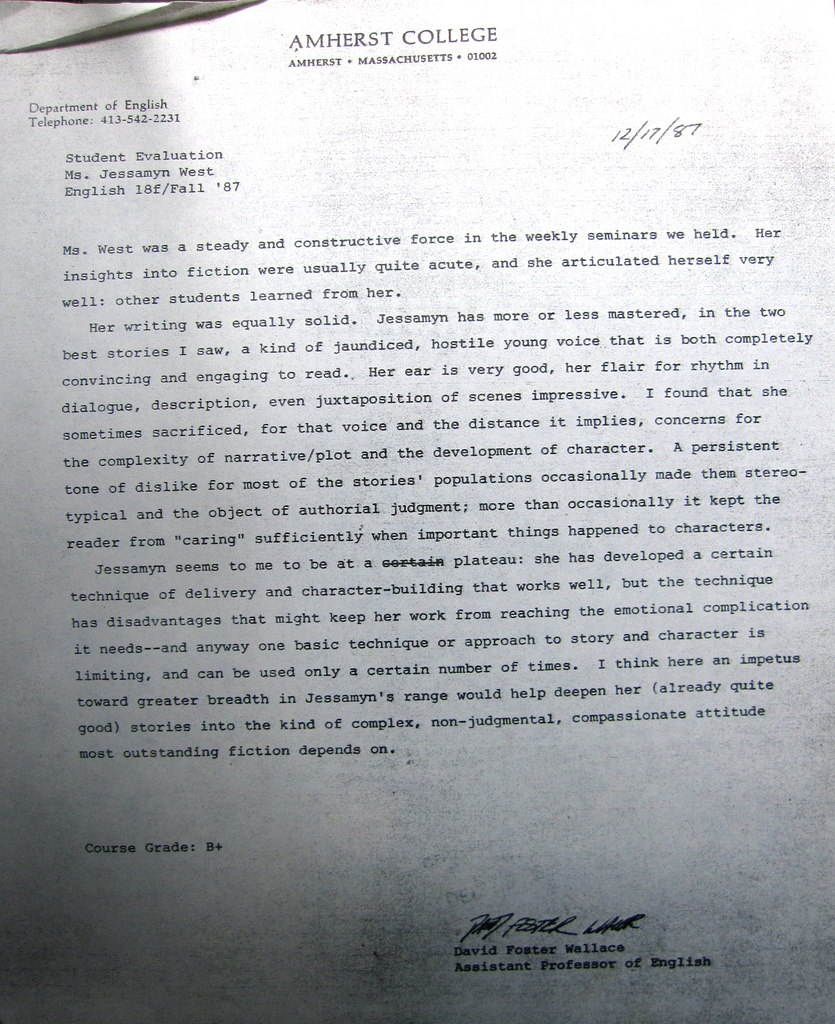
Blackwells and the Tories
I have a post on the LRB Blog about how Blackwell’s give a discount to Conservative Party members.
The Spot

David Means has a new collection out. It is called The Spot. It is probably awesome. I came across his previous collection, The Secret Goldfish (a Salinger reference) whilst in a bookstore in Ireland (Rep. of) and decided to check out ‘A visit from Jesus’. It is the only time I have ever stood and read an entire short story in a bookstore, and also the only time my parasympathetic nervous system reacted so strongly to a bunch of marks on a page that I staggered so much I had to grab hold of the shelf to keep balance.
Here’s a recent story of his from The New Yorker.
Burning Books
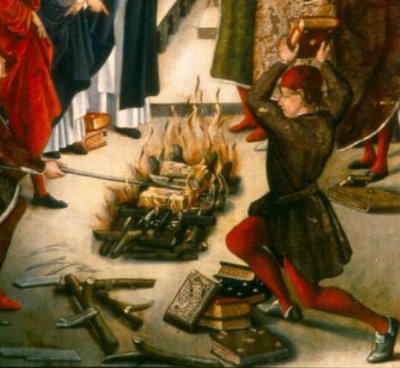
I have a piece in the latest London Review of Books. This is how it begins:
I began burning books during my third year in China. The first book I burned was called A Swedish Gospel Singer. On the cover there was a drawing of a blonde girl wearing a crucifix with her mouth wide open and musical notes floating out of it. Inside was a story, written in simple English, about a Swedish girl who loved to sing. One day, passing a church, she heard a wonderful sound. When she went in, the congregation welcomed her and asked her to join their gospel choir. Through these songs she learned about Jesus, his compassion, his sacrifice, the love he feels for all.
It was originally longer, and took in all kinds of other personal stuff, but I think they kept the core. There’s no better cure for one’s tendency to be precious than having a thousand words just cut.
Suspicious Timing

Policeman on a side street in Urumqi
I have a brief piece on the London Review of Books blog about the recent arrest of a ‘terror cell’ in Xinjiang, conveniently just in time for the one year anniversary of the Urumqi riots.

