The photos of Lu Guang

I used to live in Shaoyang, a small town in Hunan province, in the south of China. When I told strangers where I was living they said, ‘There are many criminals there’ or ‘They have many oranges’. But the most frequent response was ‘That is a dirty place’. In many respects they were right. There were always piles of litter on the street, some of which were never swept up. The water in the Shao Shui river was a dubious green, like that of a jade milkshake (a colour some attributed to the presence of a dragon that slept in there). Even the people of the town said they disliked it being for dirty, though there was often a double standard at work- those who wiped the seat of a bus or chair in a restaurant, or who insisted on sitting on newspaper, were also the same people I saw throw cans and tissues out of train and bus windows.

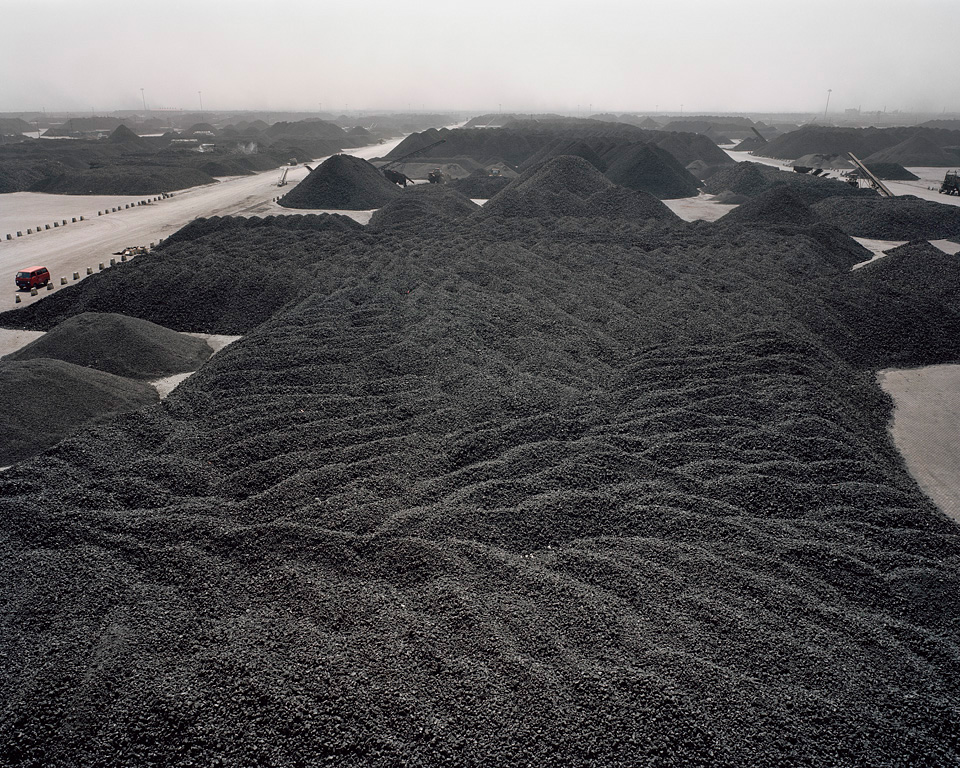
But Shaoyang was in an agricultural region. Whilst I often saw rubbish caught in the sluice gates of the dam- and once the burst body of a pig -there were few signs of industrial pollution, nor of the alterations of landscape depicted in Edward Burtynsky’s photos (click on them to enlarge).

CHNA_STE_TAN_10_05

Tanggu Port, Tianjin 2005

TGD_FJ_04_02

Feng Jie #4

TGD_WZ_04_02

Wang Zhou #4

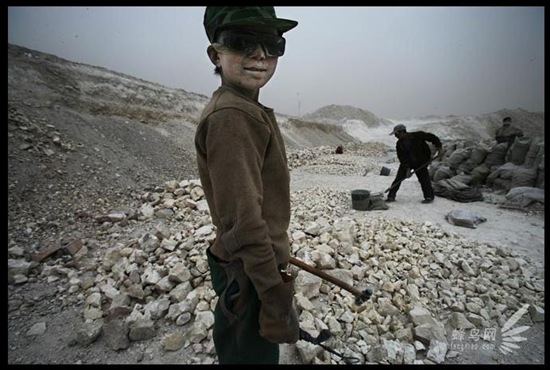
Though it is clear from watching Manufactured Landscapes (the documentary about his work) that Burtynsky has a strong environmental stance, his pictures often have a neutrality about them- the sense of judgement witheld. The same cannot be said of Lu Guang’s photos which make plain the environemntal costs of China’s reliance on coal-fired power stations (approximately 80% of their energy).

20091020luguang23

15-year-old boy from Tianshui, Gansu Province

20091020luguang17

Longmen town in Hanchen city, Shaanxi Province

20091020luguang16

Tianjin Steel Plant, She County, Hebei Province, March 18, 2008

Great corrections #1

fowl1

From a review of the new Jonathan Safran Foer book about vegetarianism in the Nov. 9th New Yorker:

Correction, November 4, 2009: The number of chickens currently being raised in the United States is nearly two billion, not four hundred and fifty billion, as originally stated.

I like that no one noticed this- I wonder how many chickens it would take to fill the US- can someone please do the math?

LRB archive goes to Austin

18588_500

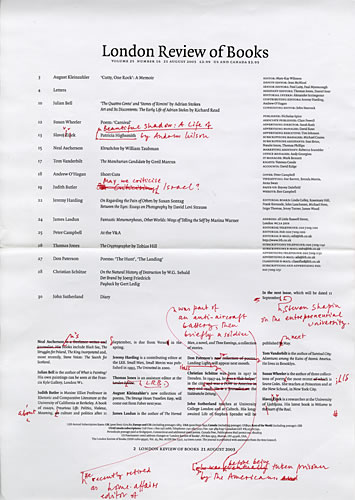
Galley for LRB contents page

Nearly 600 boxes (or 275 linear feet’s worth) of material from the 30 years of the London Review of Books has gone to the archives of the University of Texas, in Austin. The files contain correspondence (between editorial staff, contributors and readers), typescript submissions and page proofs, complete with annotations. There are also pieces (and here my heart skips a beat) that failed to make it to publication, on which are written comments such as ‘not urgent’, ‘not this week’ or worst of all, ‘Killed’. The only frustrating thing about the scans included in the article is that the annotations on the pages are (no doubt deliberately) not quite legible. More here.

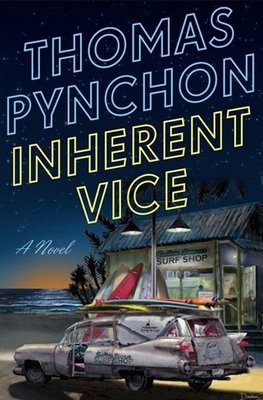
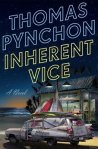
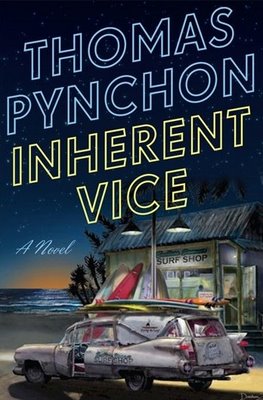
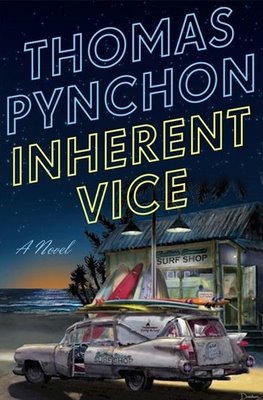
Inherent Vice, Chapter 10

pynchon

PLOT

Doc gets a damsel in distress call from Jade, who turns out to be in no distress at all. He ends up speaking to Jason Velveeta, her self-styled pimp, who says the Golden Fang is a heroin cartel. Later he bumps into Coy Harlingen again, who only wants to be back with his wife and daughter.

Not a lot to say about this chapter, other than that the description of the Golden Fang’s operation as a ‘vertical package’ that finances, grows, processes and distriubtes the drugs is little different to that of a corporation (p.159).

Here’s the song that gets to Doc, Roger and Hart’s ‘It Never Entered My Mind’


Here are the lyrics to the song sung on p.160, Dietz and Schwartz’s ‘Alone Together’, which seem a comment on community, and solidarity, but maybe also their limits.

Alone together, beyond the crowd,
Above the world, we’re not too proud
To cling together, We’re strong
As long as we’re together.
Alone together, the blinding rain
The starless night, were not in vain;
For we’re together, and what is there
To fear together.
Our love is as deep as the sea,
Our love is as great as a love can be,
And we can weather the great unknown,
If we’re alone together.

p. 162 A nice piece of genre-appropriate writing here, with the right amount of sentiment.


Inherent Vice, Chapter 9

pynchon

PLOT

Doc goes to see Coy Harlingen at the Boards mansion, but is driven away by English zombies and threatening suits. There are two counts of cunninlingus. Clancy Harlingen, Coy’s sister turns up and tells Doc that Mickey had a plan to give away a lot of the money he made.

p.125 Mention of Hokusai’s Great Wave off Kanagawa, described as ‘the eternally suspended monster’ (p.126), about as ominous (and vague) a symbol as one could ask for.

p.126 Cantor’s Delicatessan
Georg Cantor (1845-1918) was a German mathematician who pioneered the subject of set theory, now at the foundation of all modern mathematics. He proved that there are different sizes of infinity – for example, the set of natural numbers is smaller than the set of real numbers, though both sets are infinite.

This is perhaps a comment on what can be known, and how even vague concepts like ‘infinity’ or ‘time’ can be broken down (a bit of a stretch, I know)

p.128 A TV soap opera features

‘something called “parallel time”, which was confounding the viewing audience nationwide, even those who remained with their wits about them, although many dopers found no problem at all in following it. It seemed basically to mean that the same actors were two different roles, but if you’d gotten absorbed enough, you tended to forget that these people were actors.’

The implication is that our regular ‘wits’ are insufficient to understand that people are not single, consistent selves, but instead are fractured constellations of memories and competing impusles.

It can also be read as a sop to the critics, or at least those who complain that Pynchon’s work (esp. Against the Day) is hard to follow and lacks fully developed characters (most vocally, Mr James Wood).

It also recalls this passage in V.

Rachel was looking into the mirror at an angle of 45°, and so had a view of the face turned toward the room and the face on the other side, reflected in the mirror; here were time and reverse-time, co-existing, cancelling one another exactly out. Were there many such reference points, scattered through the world, perhaps only at nodes like this room which housed a transient population of the imperfect, the dissatisfied […]

This passage is immediately followed by another swipe at TV, when Doc realises ‘the scope of the mental damage one push of the “off” button of a TV zapper could inflict on this roomful of obsessives’.

p.129-130 has what appears at first sight to be an either paranoid (or highly perspicacious) condemnation of the activities of those in authority.

If everything in this dream of prerevolution was in fact doomed to end and the faithless money-driven world to reassert its control over all the lives it felt entitled to touch, fondle, and molest, it would be agents like these, dutiful and silent, out doing the shitwork, who’d make it happen.

Was it possible, that at every gathering- concert, peace rally, love-in, be-in, and freak in, here, up north, back east, wherever -those dark crews had been busy all along, reclaiming the music, the resistance to power, the sexual desire from epic to everyday, all they could sweep up, for the ancient forces of greed and fear?

But for Doc, and perhaps for Pynchon, this is somewhat over the top- the ‘epic’ sexual drive, the ‘faithless money-driven’ etc. It’s function may be to send up people’s paranoia, and show the desperation with which people construc tales of conspiracy. And in case any readers are still nodding at these sentiments, there is always Doc’s verdict”

“Gee,” he said to himself out loud, “I dunno…”

(The alternative is that only someone in Doc’s state of perpetual befuddlement could doubt this idea).

p.146 Masse shots are forbidden- In billiards, a massé shot is when a player strikes a ball with the cue at a sharp angle and causes the ball to curve drastically or even eventually reverse direction. Given Pynchon’s predilection for the imagery of arcs, rainbows, refraction etc, he is most likely commenting on the status quos resistance to change, especially of a revolutionary nature.

Too long in the library #3

Pablo-Picasso-The-Dream-7558

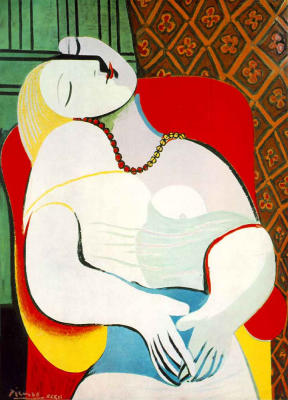
The Dream by Pablo Picasso

When people ask me what my PhD is about (almost a weekly occurence), my current answer is that it’s on Thomas Pynchon and [blank]. At the moment I’m trying some different words in this space- ‘visions’, ‘utopia’, occasionally ‘time’. The combination of these words led me to Frederic Jameson’s Archaelogies of the Future, a book about the constructions and uses to which utopias have been, and might be, put. Though I have a passing familiarity with Jameson’s work from his reviews in the LRB, this is the first time I have been exposed to a book-length display of his erudtion. He quotes this passage by Freud about creativity as a kind of wish fulfilment:

You will remember how I have said that the day-dreamer carefully conceals his phantasies from other people because he feels he has reasons for being ashamed of them. I should now add that even if he were to communicate them to us he could give us no pleasure by his discolsures. such phantasies, when we learn them, repel us or at least leave us cold… The essential ars poetica lies in the technique of overcoming the feeling of repulsion in us.

Jameson puts this is in simple terms I think we can all relate to.

Anyone who compares the fascination we often feel for our own dreams with the boredom that suddenly overcomes in listening to the account of another will know what Freud means.

Art, then, consists of disguising and softening the egotistic content of such day dreams or phantasies, by bribing the reader, viewer, or listener with aesthetic pleasure. In my opinion, there is nothing that needs more disguising than a dream itself. But in their efforts to make the dreams of others interesting, most writers or film makers usually end up with too simplified a product, whose symbolism is too overt. The demons our heroine is pursused by are those we have already seen.

Pushcart Prize nomination

pic_book_2009

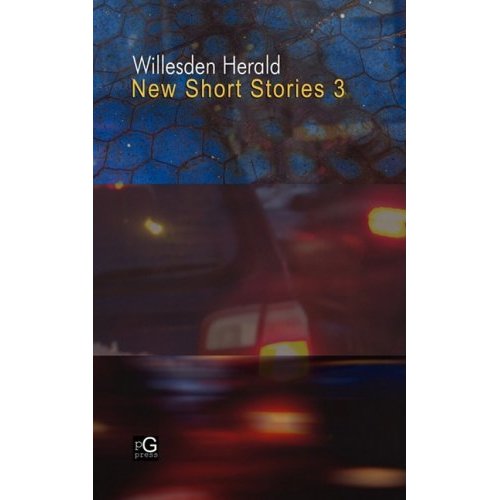
I’m pleased to say that I have been nominated for a a Pushcart Prize for my story ‘Amy’, which appeared in New Short Stories 3. I still have a few copies of the anthology, which you can buy by sending a paypal payment of £6 (includes P + P) to nholdstock@hotmail.com.

Inherent Vice, Chapter 8

pynchon

PLOT – Doc meets up with his parents; Nixon’s face appears a lot (on banknotes, and TV); Coy Harlingen, pretending to be someone else, disrupts a Nixon rally.

p.113 The parking regulations at Gordita are said to have been devised ‘by fiendish anarchists to infuriate drivers into one day forming a mob and attacking the office of town government’.

If only it were so… I suppose this might be construed as the idea that technology will enslave us, and control us, far more than even the forces of order might have bargained for.

p.116-117

After Doc’s parents get a random phone call, threatening them, Doc reflects that

in the business, paranoia was a tool of the trade, it pointed you in directions you might not have seen to go.

As Michael Wood said in his NYRB review, being crazy can, in a circuitous manner, lead one back to insight.

p. 118 Further parallels between domestic and foreign US policy, with Nixon’s face being found in banknotes, in the same way he was put on bills in Vietnam.

p.122 Coy Harlingen turns out to be a police informant, something that Doc has already been approached about. He is here identified as Ric Doppel, which means ‘double’ in German and might refer here to the ‘doppelganger’-motif or shifting identities in a more general way. The theme seems to be prominent in this chapter. The films mentioned on p.115 belong in this context, for example. In Black Narcissus, Kathleen Byron’s character, Sister Ruth, can be seen as the dark double of Deborah Kerr’s Sister Clodagh. In Robert Wiene’s Das Cabinet des Dr. Caligari, the somnambulist Cesare commits crimes when he is under the hypnotic spell of the title figure; Caligari himself may be director of a circus attraction or of a psychiatric hospital. In Fritz Lang’s Metropolis, a character called Maria is replaced by a robot.

The Golden Hour Book Vol. 2

cover_web

Now on sale from Forest Publications, the latest volume of prose, poetry and music (it comes with a CD) from the monthly Golden Hour cabaret at the Forest Cafe in Edinburgh.

It features contributions from Andrew Philip, Alan Gillis, Robert Alan Jamieson, Kapka Kassabova and myself. Ron Butlin, Edinburgh’s current Makar, had this to say about it

‘There is genuine wit, deep feeling and real entertainment in this most enjoyable volume. Light-hearted and serious by turns, ‘The Golden Hour Book Volume II’ contains some of the best and freshest new writing I have come across for quite a while.’

You can now also buy Stolen Stories (an anthology I c0-edited) from the Forest Publications site, as well as many other fine publications.

Interview with Mary-Kay Wilmers, editor of the LRB

51zjkpr+LpL._SS500_

Today’s Guardian has a detailed profile of Mary-Kay Wilmers, editor of the LRB, which reveals that she was the person who came up with the title for Oliver Sacks’ book, The Man Who Mistook His Wife For a Hat. The Eitingons, a memoir of her family, will be out in November.

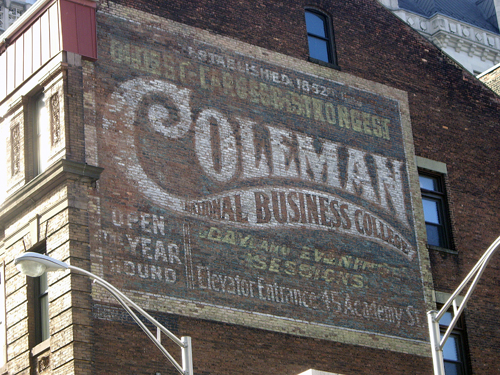
‘We play football, we play soccer — We keep matzohs in our locker’

newark_coleman01

Very odd story about Philip Roth joining a tour of Philip Roth’s, Newark. If this were in one of his novels, no one would recognise him and he would be chased away from his old haunts, forced to wander through back alleys in dejected irony.

Reviewing by numbers

n305873

There’s a chance of me doing some reviewing in the near future, so I am of course paying particular attention to such pieces, especially the lead sentence. The following, from William T. Vollmann’s review of Philip Caputo’s Crossers, seems like it could be endlessly reused, with only the author’s name altered.

Once when I was so weak with amebic dysentery that all time not spent on the toilet was passed in bed, I found in my host’s house one book in a language I could read. It was one of those storm-tossed but ultimately upbeat women’s romances, a genre I had not yet sampled. I read it, then read it again and again, since there was nothing better to do. If I ever have the luxury of repeating such an experience, I hope to do so with a Philip Caputo book.

All I would need after that is a plot summary and a few sentences of mostly unsubstantiated opinion. That usually does the trick.

Bridport prize shortlist

falseriver

A story of mine entitled ‘The False River’ has been shortlisted for the Bridport prize.

Whilst this is all very nice, please do not confuse this with me having a) won anything or b) being in contention for anything. The Bridport ‘shortlist’ is actually about 80 people long. The real shortlist is the 13 people who are still in contention for the prize itself. Being shortlisted for the Bridport prize is one of the boxes that short story writers like to check, especially in their bios.

Vasectomania, and other cures for sloth

A rebellious monkey refuses to give up its glands

A rebellious monkey refuses to give up its glands

Cabinet magazine issue 29 has a fascinating article on the use of monkey glands by Christopher Turner.

The physiologist Serge Voronoff, a Russian working in Paris, was one of the most infamous of the gland doctors. He thought that the lazy, mentally disabled, run-down, and aged could be revitalized by testicular transplants. Many wealthy men underwent the costly surgery; Voronoff transplanted the testes of executed criminals into millionaires. Legal contracts were drawn up with prospective donors, but apparently willing individuals were in such short supply that what one scientist called a “despicable trade in organs” began to develop. According to one newspaper, men were even being mugged for their testicles, “knocked unconscious and then robbed of the long-sought-for organs.”

Voronoff solved this crisis by slicing and grafting the testicles of monkeys onto those of the men who sought his treatment. In his book, Rejuvenation by Grafting (1925), Voronoff promised the patients who acquired his monkey glands that they’d be able to work longer, and that they would be blessed with improved memories, eyesight, and sex drives. He set up a special breeding center on the Italian Riviera for chimpanzees, gorillas, and orangutans that was run by a former circus-animal keeper.

Inherent Vice, Chapter 7

pynchon

PLOT

Sauncho fills Doc in on the Golden Fang’s mysterious history, which includes a 50 year disappearance in the Bermuda Triangle. Doc hangs out with some surfers who end up talking about Lemuria, an Atlantean lost continent of the Pacific. On an LSD trip Doc meets a Lemurean who shows him a vision of Shasta on the deck of the Golden Fang.

p.89 Sauncho (which only now has made me think of Don Quixote, and Doc being the one who tilts at windmills) grows ‘strangely evasive’ when asked about the Golden Fang. Not for the first time, he avoids what is, at least within the narrative, a siginificant question by changing the subject to something that happened on TV. Whilst this puts watching TV (and perhaps also reading books) on a par with drug use, in their capacity to tranquilise our fears, it also undercuts this by showing how even our best attempts to avoidance can inadvertantly lead back to what we wish to avoid.

There was pulse of embarassed silence as both men realized this could all be construed as code for Shasta Fay and Mickey Wolfmann

p.90 Sauncho talks of debt from credit cards obtained ‘from institutions in places like South Dakota that you send away for by filling out the back of a match cover’ which echoes Zoyd’s thoughts in Vineland in regard to Isaiah Two Four’s business proposition: “expecting some address in a distant state, obtained from a matchbook cover.” (p. 19 )

p.90 When Doc sights the Golden Fang, it is described as having ‘not a flag of national origin in sight’, which recalls Michael Wood’s comments about the vessel representing global capitalism (New York Review of Books, Sept. 24, 2009 ).

p.91 ‘Tentacles of sin and desire and that strange world-bound karma which is of the essence in maritime law’- this takes us back to the novel’s title, and with it the suggestion that there is something inevtiable about our Fall, that we are continually paying for the sins of ourselves or those we would have been in times before. This is in many ways the antithesis of paranoid conspiracy theories: there is no ‘they’ who can be blamed; there is only ‘us’.

p.93 Sauncho on the fate of the Preserved, which later became the Golden Fang:

Better she should have got blown to bits in Halifax fifty years ago than be in the situation she’s in now.

We can read this as a general comment from Sauncho, namely that losing the First World War (and all the death and destruction this would entail) would be preferable to the state of society (both in the late 1960s, and by extension, now). In some ways, this extreme nihilism could be viewed as an entirely legitimate response to what Sauncho perceives as the dire state of society. Anything else is denial.

However, it is Doc, not Sauncho, who here changes the subject:

Sauncho, get that weird look off your face, man, you’ll wreck my appetite.

p.98 Merging of the motifs of the desert and the automobile.

the exhaust from millions of motor vehicles mixing with fine Mojave sand to refract the light toward the bloody end of the spectrum, everything dim, lurid and biblical, sailor-take-warning skies.

This also recalls the motif of light being refracted in Against the Day.

p.100 Further talk of general sin and exculpation, in a description of the Saint.

the deep focus of a religious ecstatic who’s been tapped by God to be wiped out in atonement for the rest of us.

But we might question the tone of this: the idea that some old surfer is a Christ-like figure who will redeem us may be a joke, but it also speaks of desperation. Whilst we might smile at the idea of the old surfer as Christ, there is a tension behind our amusement, borne of the notion that whilst the Saint may be no messiah, we may still need forgiveness.

p.100 Another coined acronym’ GNASH, the Global Network of Anecdotal Surfer Horseshit’. Possibly meant to mock the claims to knowledge and usefulness of MICRO and especially ARPA, the internet precursor.

p.101 First mention of Lemuria, ‘Atlantis of the Pacific’, ‘something that sank long ago and is rising now slowly to the surface again’. More info about Lemuria here, which has, in cultural terms, been around, so to speak.

Lemuria may be a lost glory, but also one that may be regained. It is thus part of the classic narrative of Fall and Restoration. What is Utopia if it is not a kind of Heaven on earth?

The dream of Lemuria is quickly punctured. On p. 105 it is suggested that both Lemuria and Atlantis sank ‘into the sea because Earth couldn’t accept the levels of toxicity they’d reached’. The theme of environemntal devastation also appears on p.104 where ‘Channel View Estates reminded him strangely of jungle clearings’ (the implication being that both domestic and foreign policy has similar goals- dispossesion for the purpose of profit) and on p.108, with ‘Tiny Tim singing “The Ice Caps Are Melting”… which had somehow been programmed to repeat indefinitely’.

During Doc’s acid trip he finds himself

in the vividly lit ruin of an ancient city that was, and also wasn’t, everyday Greater L.A… [He] and all his neighbors , were and were not refugees from the disaster which had submerged Lemuria thousands of years ago.

Even this, a retreat into fantasy, may, as in Doc and Sauncho’s opening phone conversation, have accidentally circled back to the truth, or at least a cousin of it, so long as one accepts that there was a period, perhaps even before history, when things were not as bad.

p 109. Extends the fantasy to include the war in Indochina which in these terms is actually ‘repeating a karmic loop as old as the geography of those oceans’. Doc, true to form, remembers nothing of his trip.

After just over 100 pages of convoluted plot, suspicion, paranoia and mysterious coincidences, Pynchon provides us with a warning (p. 108):

“I’d be very surprised if they weren’t connected,” Vehi said.

“That’s because you think everything is connected,” Sortilege said.
Genteelisms

David Foster Wallace was a contributing author to the Oxford American Writer’s Thesarus. This is his note on the word ‘pulchritude’

A paradoxical noun because it means beauty but is itself one of the ugliest words in the language. Same goes for the adjectival form pulchritudinous. They’re part of a tiny elite cadre of words that possess the very opposite of the qualities they denote. Diminutive, big, foreign, fancy (adjective), colloquialism, and monosyllabic are some others; there are at least a dozen more. Inviting your school-age kids to list as many paradoxical words as they can is a neat way to deepen their relationship to English and help them see that words are both symbols for things and very real things themselves.

In the above clip, he responds to the use of phrases like ‘prior to’ and ‘at the present time’, and even finds time to take a swing at ‘utilise’ and ‘individual’.

WARNING: you should only bother watching it if you’re interested in, you know, words.

More on DFW and the Thesarus at Maud Newton

An army with no uniforms

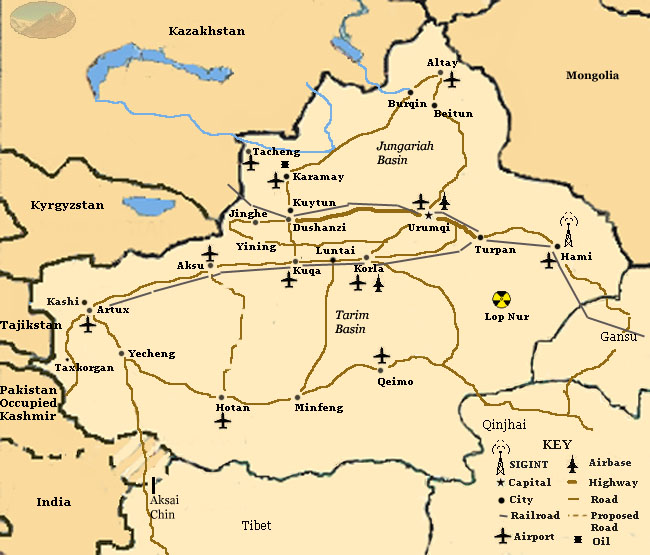
I have a letter in the new LRB (dated September 24) which expands on one of the major causes of unrest in Xinjiang: the massive resettlement of Han Chinese in the province, many of whom are part of the Xinjiang Production and Construction Corps, a paramilitary organisation that has a controlling presence in both agriculture and industry in the region. I also respond to the claim (made in a letter responding to my piece) that the reports of atrocities during the riots in Urumqi in early July were in all liklihood true.

When I lived in Xinjiang I thought I understood how pervasive the XPCC presence was. In the process of doing only mild research, I have come to realise that I still underestimated the extent of their influence- they have their own TV station, they have built their own cities, and even have a parallel education system, from primary schools all the way up to university. Although parallels are often drawn between Xinjiang and Tibet, perhaps an equally instructive one could be drawn between the Israeli settler movement and the activities of the XPCC.

Scottish Journey

Canongate Tolbooth

Canongate Tolbooth

The pleasures of travel writing are obvious. We visit places, and meet their inhabitants, with none of the trouble, expense (and sometimes, danger) a real trip might entail. There is no risk of missed connections, inclement weather, of being hurt or robbed (and even if these mishaps occur, it is not to us, which makes them enjoyable). Best of all, there is no chance of boredom, of knowing you are wasting more time and money than usual. In place of the meaningless sequence of events that make up most trips, there is always a purpose, better still, a narrative. In travel books, things are always done for a reason (even if it is only so they can be written about).

Consider then the added appeal of the out of date travel book (by which I mean those that are non-contemporary). One is transported in not just space, but time as well. One need not resent the author for showing oneself up by virtue of having gone somewhere, and done something, which one could easily have done, given enough nerve or imagination.

Edwin Muir’s Scottish Journey, based on his travels in 1934, provides all these pleasures, plus the added one of being about the place I currently live in.

The first sight of Edinburgh after an absence is invariably exciting. Its bold and stony look recalls ravines and quarried mountains, and as one’s eye runs up the long line of jagged roofs from Holyrood to the Castle, one feels that these house-shapes are outcroppings of the rocky ridge on which they are planted, methodical geological formulations in which, as an afterthought, people have taken to living… Perhaps it is the height of the houses, the great number and smallness of the windows, and the narrowness of the space in which one has to walk that give [a] sense of watchfulness and sinister familiarity. But there is in it, too, something of the terror of narrow rocky passes in savage and possibly inhabited regions.

Often, he articulates thoughts that have gurgled in my own mind:

Nowhere that I have been is one so bathed and steeped and rolled about in floating sexual desire as in certain streets of Glasgow and Edinburgh.

The joy of his book (for me at least) is that it is both familiar and strange (a contradictory combination that one, from habit, declines to believe is possible, until it occurs with particular force, from sentence, to paragraph, then page). One sees the city as it was, as it is, as it may perhaps shall be. There is an awareness of what has survived amidst the spill of change.

Edinburgh has a style, and that style was at one time, indeed as recently as a century ago, the reflection of a whole style of life. While the city itself remains, this style of life has now been broken down, or rather submerged, by successive waves of change which were first let loose during the Industrial Revolution, an event that has on a large scale swept from the great towns of Europe the character they once possessed. the waves have almost completely submerged London; but Edinburgh, being a high, angular place, is more difficult to drown. So it presents outwardly the face it had a hundred years ago, while within it is worm-eaten with all the ingenuity in tastelessness which modern resources can supply.

Hear, hear, one thinks, but does not say (after 9 years, still not feeling one has the right).

So although Edinburgh is Scottish in itself, one cannot feel that the people who live in it are Scottish in any radical sense, or have any essential connection with it. They do not even go with it. They look like visitors who have stayed there for a long time.

There is still this air of transiency, of people who were passing through but never made it out the other side. As I mentioned earlier this year, I do still (occasionally) try and move on. It may happen. It may.

Willesden Herald competition

3260891805_cec27c5b9f

The Willesden Herald short story competition is now open, and worth entering for several reasons.

Firstly, in addition to three prize-winners, they put out an anthology that features the top 10 stories, so unlike many other competitions, there’s a chance of publication even if you’re not in the top 3 (which I wasn’t last year).

Secondly, though you have to pay to enter this year (as opposed to the previous years, when it was free), it’s only £3, far less than competitions like the Bridport prize (about which I should also like to say that no one who places highly in it seems to be ever heard from again).

Thirdly, if we have even a passing interest in having any sort of literary culture that does not revolve around celebrity-written memoir or novels, we’re going to have do some work ourselves. Which means buying literary magazines and supporting small presses, not dutifully, or because we feel we should, but because there’s a lot of good work out there which will otherwise be ignored (especially if, as Mr James Kelman said earlier this week, it falls outside the more heavily-marketed genres).

Sale of stuff

In a rearguard action to gain some shelf-space (and to support various legal ‘habits’) I’m selling some magazines and anthologies I’ve been in. I only have a few copies of each, so fortune will favour the bold.

For £6 (+£1 postage, UK only) you can get a copy of The Southern Review, which my story ‘The Ballad of Lucy Miller’ appeared in. Here’s a short Review of it.

tsr_spring2009

For the same price, there’s the Edinburgh Review special issue on China that has a non-fiction piece about Xinjiang.

124

For £7 ((+£1 postage, UK only) you can buy a copy of the Willesden Herald Anthology that features my story ‘Amy’, and a fine story by Jo Lloyd entitled ‘Work’. There’s a review here.


41dOHV+K4fL._SS500_

Payments only accepted by PayPal. Send the £7 or £8 to nholdstock@hotmail.com

Inherent Vice, Chapter 6

pynchon

PLOT

Doc has lunch with Deputy DA Penny Kimball, with whom he’s having a low-key affair. For the most part, she questions him about Wolfmann and Sasha’s disappearances and the murder. She also asks about two stewardessess, Lourdes and Motella (or as Pynchon puts it, ‘stewardii’), and their connection to two guys named Cookie and Joaquin. Finally, she passes him onto the FBI, who question him, also about the stewardii. When he meets up with them later they go to Club Asiatique, where Doc meets up with the not-deceased Coy Harlingen, who warns him about the Golden Fang, a shadowy organisation based around a boat of the same name.

As I may have mentioned before (and will doubtless do so again), after a while it is hard to take anything in Pynchon’s novels literally. Everything starts to seem ominous, symbolic, a synedoche of the vast, but perhaps not entirely organised conspiracy that may (or even worse, may not- which would mean we were (gulp) responsible for the ills of the world) be in operation. So it is with Penny’s take on Doc’s frequent passing-out (p.69-70), most notably before Glen Charlock’s murder (in Chapter 2. Or 3).

“Besides, maybe you did do it, has that crossed your mind yet? Maybe you just conveniently forgot about it, the way you do so often forget things, and this peculiar reaction of yours now is a typically twsited way of confessing the act?”

On the simplest level, this is about Doc trying to evade responsibility, which is perhaps all that he can do. Pynchon’s characters are often cursed with the knowledge of what needs to be done, what should be stopped, but usually have neither the idea, means or opportunity of how to do so. In the face of such impotence, who can blame them for taking recourse in whatever comfort comes to hand? As Coy comments on page 86.

Only one or two of the old crew are left, and they’re suffering, or do I mean blessed, with heavy Doper’s Memory.

But since this is a historical novel, Pynchon may be suggesting that this kind of thinking is what has led to our twisted present. Also, that we need to do the opposite, to prevent things from getting worse (no one should ever doubt that this is possible).

On page 70 there’s a brief, almost summary-like passage about the case against trust.

He wished he could believe her more, but the business was unforgiving, and life in psychedelic-sixties L.A. offered more cautionary arguments than you could wave a joint at against too much trust, and the seventies were looking no more promising.

On page 73 there’s a mention of a ‘demonstration against NBC’s plans to cancel Star Trek‘, which, even more the passage discussed above, could be there for period detail, for plain fun (‘a convoy of irate fans in pointed rubber ears’) or as a nod to the death of utopian visions. We may never know.

There is a further attempt to make Doc an informer on p.75

More images of concealment on p.80.

At night it [Club Asiatique] seemed covered, in a way protected, by something deeper than shadow- a visual expression of the convergence, from all around the Pacific Rim, of numberless needs to do business unobserved.

Inherent Vice Chapter 5

pynchon

PLOT: Doc goes to visit Wolfmann’s wife, who lives in a luxurious house and has the requisite beefy yoga instructor with whom she may be in league. Just to compound her potential villany, she has an ‘English smoker’s voice’ (p.55). Unsurprisingly, he doesn’t discover much except for a rack of pornographic ties.

p.55/56- Doc pretends to be from an organisation called MICRO, the ‘Modern Institute for Cognitive Repatterning and Overhaul’. We can read this as a continuation of the not especially subtle linking of computers with the less permissive times to come. But I think there’s another side to this, namely the optimism with which some looked forward to a machine-orientated future, one where people would have more time for themselves (which, now that I write this, suddenly doesn’t seem such an absolute good), be ‘freer’ etc. This dream, alas, seems to have gone the way of that of the counter-culture.

The idea that everyones dreams are spiralling away from fulfillment is even partially extended to the police. On page 57 the LAPD are getting in some ‘last minute catering before their federal overlords showed up’ and then on page 65 a uniformed cop who is riding with Bigfoot is listening to them

way too attentive, maybe even, if you wanted to be paranoid about it, as if he was undercover, reporting to some other level inside the LAPD, his real job basically, to keep an eye on Bigfoot…

It is not just the subculture of stoner-hippiedom that is going to lose out, but also those who support the status quo (no ‘system’ ever being concerned with the greatest good for the greatest number).

A fine joke on p. 58 about misattributing a quote from Robert Moses (who the Pynchon wiki says was “master builder” of mid-20th century New York City, Long Island, and Westchester County, New York. His career is summed up by his sayings “cities are for traffic” and “if the ends don’t justify the means, what does?)

You get that first stake driven, nobody can stop you.

to Van Helsing, the vampire hunter. In addition to being funny, this links the disparate enterprises of real estate, urban planning and perhaps surveying (see Mason & Dixon) to dark and unholy practices, the sucking of lifeblood etc.

Extended reference to John Garfield on p.58-59 (liberal actor who refused to name names when called before the House Committee on Un-American Activities, which led to his ruin).

Doc has a sudden erection on p.59 at the mere mention of Ida Lupino.

Every time her name comes up, so does this.

This recalls the conditioned erections of Tyrone Slothrop in Gravity’s Rainbow.

Finally, I am indebted to the Pynchon wiki for decoding ‘Arrepentimietno’ on page 62.

Spanish: n. repentance, penitence, contrition–all concepts important to Inherent Vice. There’s also a cool trilingual pun here: “pentimento” (now an English word, but from the Italian for ‘repent’) refers to an image in a painting that was painted over but then, with time, begins to show through the top layer of represented images.

‘A profound lesson in blood’

_46015541_007602849-1

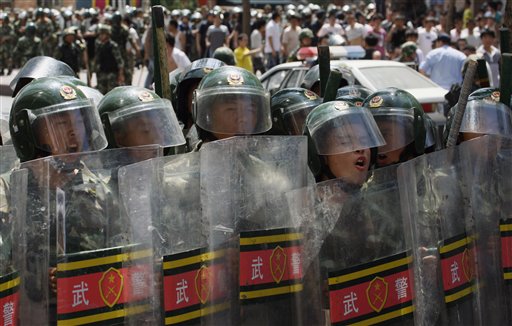
Police in central Urumqi

I have a new piece about Xinjiang at Eurozine, which is a bit more speculative than my piece in the London Review of Books. It also fills in some of the gaps of the last few years, between the time I left Yining (2002) and the Urumqi riots in July.

These are not my twisted words

artwork

One day, when I am too bloated with fame and adulation and the blurbs on my back-covers, I shall no doubt be comissioned to write 500 words on why I love Radiohead. Thankfully, for all concerned, that day remains far distant.

It is definitely much more fun to dance about architecture.

And to download (legally and for free) their new song here.

Inherent Vice, Chapters 3 & 4

pynchon

These are both very short chapters that mainly convey plot (that Bjornsen and Mickey G are close friends, and that Doc used to be a repo man).

Chapter 4 has this interesting passage:

Suddenly he was on some planet where the wind can blow two directions at once, bringing in fog from the ocean and sand from the desert at the same time, obliging the unwary driver to shift down the minute he entered this alien atmosphere, with daylight dimmed, visibility reduced to half a block, and all colors, including those of traffic signals, shifted radically elsewhere in the spectrum. (p.50)

Once again, Pynchon is describing an altered state of perception, this time the product of two elements that he has previously singled out (sand, in the references to the beach and the desert, and fog, or rather its polluted equivalent, smog). The aim here, as perhaps before, is to defamiliarise the setting, to highlight a loss of vision, certainly immediate, perhaps also on a grander scale (Doc here, as in Chapter 2, is driving whilst experiencing this).

The other point of interest is the ARPA, a forerunner of the Internet, which is described as looking like a ‘science fictional Christmas tree’ (p.53), which is  a more positive image than the mention of precursors to search engines in Chapter 2, which should caution us not to confuse Pynchon with a technophobe.

There is also a not particularly subtle aside about the only weapon Doc carrying when he was a repo man was a truth serum that looked like a set of drug ‘works’. What is  more interesting is that he never ended up using it.

It wasn’t long before he noticed how many of the delinquents he and Fritz visited seemed unable to keep their eyes off of it. He understood that if he was lucky, he might not have to so much as unzip it (p.52).

‘Lucky’ could be read as being ironic- that maybe it is not wholly fortunate to avoid the truth (though there are of course many good reasons why people work so hard at their denial).  There is a fundamental dilemma in trying to analyse these kinds of passages, not just in Pynchon, but also in postmodern literature in general, which is that of tone. As Linda Hutcheon has pointed out, it is often difficult to know just how much of an ironical attitude we should assume on the part of the author. Sometimes this means we just have to read more carefully; at other times, all we have to go on are our preconceptions.

The Rumpus

rumpus_header_colored_1

Seth Fischer writes a good piece about the continuing pariah status of the short story (in publishing, at least) at The Rumpus, a great site which I urge you to check out, not least because, along with sections on Art, Music, Books and Politics, it has the decency (yes, that is the word, I think) to have one for Sex as well. Peter Orner’s column is also particularly good.

Inherent Vice, Chapter 2

pynchon

PLOT

Doc goes to Channel View Estates to find Glen Charlock, Tariq’s friend (and Wolfmann’s bodyguard). On arriving the scene morphs into a brothel, then Doc loses consciousness, only to wake up with Charlock murdered and himself a suspect. Bigfoot Bjornsen of the LAPD eventually releases him, then tries to persuade him into becoming an informer. Mickey is reported as missing, as is Shasta. Doc gets a call from a woman named Hope Harlington, asking him to try and find her dead husband Coy.

The chapter opens with a description of the different kinds of vehicles on the freeway, what amounts to social typology, all of whom are subject to

the white bombardment of a sun smogged into only a smear of probability, out in whose light you began to wonder if anything you’d call psychedelic could ever happen or if- bummer!- all this time it had really been going on up north.

There is lot to unpack here. First, a general proposition about the unreliability of knowing even something as concrete (and natural) as the sun (and light, for Pynchon, is a frequent image- e.g. the frequent mention of splitting and refraction in Against the Day); then there is the uncertainty that in such light, which has been filtered through smog (an industrial product), anything psychedelic can happen. Before we go any further, let’s define some terms.

Psychedelic adj. 1a Expanding the mind’s awareness. (Oxford Concise English Dictionary)

My feeling, then, is that we shouldn’t get too hung up on the drug use in itself. What perhaps matters more is their effect (and also, I guess, that they are prohibited, controlled substances). I would like to plop down the opinion that this passage is about how constricted our awareness is in the modern world, how everything is mediated and controlled by the technological web (as also symbolised by the cars which everyone, despite differences in age, wealth and status, are driving) we have enmeshed ourselves in. The only snag is that I have no frakkin’ idea what that bit about ‘going on up north’ means.

There is a recurrence of the epigraph on page 20, but instead of beach, there is now ‘desert beneath the pavement’ , a much starker image, with connotations of ruin (past, future, imagined, actual) and sterility.

Doc, after realising that the ‘Pussy Eaters Special’ does not require his participation, experiences a spatial distortion and passes out. It’s too early to say whether this blackout is mainly for the purposes of plot (it also makes the transitions between scenes much simpler) or whether it is motivated (as a kind of avoidance, denial etc).

Nice piece of irony on page 24. Bjornsen, after being exposed as an avid collector of ‘all kinds of Wild West paraphenalia’, is quick to agree with Doc that it is a ‘man’s own business what he puts in his pick-up’ (p.25), yet constantly mocks Doc’s drug use and calls him ‘hippie scum’.

Hilarious notion of Donald Duck having to shave his beak (p.28).

When Bjornsen explains the murder on TV (p.30), he concocts a story about it being from some civilians taking place in a ‘training exercise in anti-guerrilla warfare’, what he calls a ‘harmless patriotic scenario’ gone tragically wrong. In addition to satirising the media’s need to make everything into a synecdoche (a crime one could never accuse a literary analyst of), Pynchon may also be making a wider political comment on American militarism.

Ominous predictions on page 32 and 40- the former from Bjornsen about Nixon having ‘the combination to the safe’, the latter from Doc about it being ‘perilous times, astrologically speaking, for dopers’ who’d been born between ‘Neptune, the doper’s planet, and Uranus, the planet of rude surprises’. Which I think we can also take as meaning that the counter-culture is about to be  shit on.