Trailer for Win Riley’s forthcoming documentary about Walker Percy, appropriately featuring Richard Ford, who has spoken often, and eloquently, about the influence of Percy’s The Moviegoer on The Sportwriter.
Coming to a shelf near you…

I have a piece on the London Review of Books blog about the use of video trailers for literary fiction. It features a wonderful animation for Kazuo Ishiguro’s Nocturnes, and also one of Pynchon giving a monologue.
Inherent Vice, Chapter 14

PLOT- Tito drives Doc to the Kismet casino, a joint that has fallen on hard times. After placing a deliberately suspicious bet on the ‘Mickey book’, he is taken into the office of Fabian Fazzo, who tells him that Mickey was trying to build a new city out in the desert. In a private area he runs into the man himself, in the arms of the FBI. Out in the desert, he finds the half-completed, half-destroyed dream city of Arrepentimiento. Finally, Tito and Doc lose themselves in a Toob-fest.
Here, at around the two-thirds mark, a lot of the novel, both in terms of plot and also thematically, seems to come together.
In a Pynchon novel, this is somehow disquieting.
p.235 In the description of North Las Vegas- the neglected sibling of the Strip to the south -as being ‘away from the unremitting storm of light’ and this same glow then disappearing ‘as if into a separate “page right out of history”, as the Flintstones might say’, there is perhaps a somewhat optimistic message. On one level this can be viewed as prophetic- that all structures are subject to inevitable ruin. If this fate can befall North Las Vegas, there is no reason why the Strip, that accumulator of Profit (see Chapter 13) should not one day submit.
However, the presence of a second, also ruined city in the chapter, perhaps undermines this hope- unlike North Las Vegas, Arrepentiemento was envisaged by Mickey Wolfmann as as act of atonement, and it too was quickly destroyed. One reading of this is that in the world to come (which we live in) intentions count for even less against the profit motive.
p.238 One of Pynchon’s favourite tropes- the relationship between cartography and power.
He says when Americans move any distance, they stick to lines of latitude. So it was like fate for me, I was always supposed to head west.
And just for good measure there is both the invocation of manifest destiny and the colonisation of the West.
p.238 Doc and Fabian’s long conversation about what might have happened to Wolfmann, during which they run through all the possible alternatives, nicely trivialises the whole Quest aspect of the plot (and the genre). They’re only talking about these outcomes in terms of gambling odds, not because anyone particularly cares. From what little I know of classic detective fiction (Chandler, Hammett) this is very much a staple of the genre. One could, I suppose, construe a more depressing interepretation- that someone’s life is only worth discussing in terms of how it might yield profit.
p.240 Even money is not to be trusted.
The half-dollar coin, right? ‘sucker used to be ninety percent silver, in ’65 they reduced that to forty percent, and now this year no more silver at all. Copper, nickel, what’s next, aluminium foil, see what I’m saying? Looks like a half-dollar, but it’s really only pretending to be one.
p.241 Doc remembers his acid trip as ‘trying to find his way through a labyrinth that was slowly sinking into the ocean’. As well as being a description of the present (both then, and now) ecological and political crisis, it is also a reference to the sunken continent of Lemuria, suggesting, somewhat gloomily, that even our impending disasters are far from original.
p.243 When Doc glimpses Mickey Wolfmann, he has
the same look as he had in his portrait back at his house in the L.A. hills— that game try at appearing visionary —passing right to left, borne onward, stately, tranquilized, as if being ferried between worlds
It is, alas, only an attempt at appearing (as opposed to being) visionary. But perhaps it still counts for something- whether or not it does depends on how we view his building the city in the desert- whether it is a meaningful (albeit doomed) attempt at atonement.
We might also ask which worlds he is being ferried between.
p.244 The FBI agent accuses Doc and his ilk of being the ones to inspire Wolfmann’s guilt.
It’s you hippies. You’re making everybody crazy.
It is undeniably unpleasant to reflect on the inequalities of the world, and especially on one’s own complicity in this state of affairs. So many of the book’s characters are doing their best to retreat from the world, by any means- psychedelic, mystical, insanity.
Wolfmann’s mea culpa, which summarises a persistent sentiment of the novel:
I feel as if I’ve awakened from a dream of a crime for which I can never atone, an act I can never go back and choose not to commit. I can’t believe I spent my whole life making people pay for shelter, when it ought to’ve been free. It’s just so obvious.
It is, however, not in a dream that these things were done, but by himself, in reality. This kind of distancing suggests that even when admitting responsibility, he is still preserving a modicum of denial. Furthermore, whether or not the wrongness of his acts is ‘so obvious’ is perhaps not the point. People are able to supply a justification for even the most obviously heinous acts e.g. mass murder, bombing civilians, genocide, etc.
p.246 The wackiness of the Gilligan’s Island/Godzilla clash gives way to Henry Kissinger on TV saying “Vell den, ve should chust bombp dem, schouldn’t ve?” There is then a ‘lengthy honking’ which drowns him out.
On the one hand, the funny voice, and juxtaposition with Godzilla,, serves to satirise Kissinger. However, there is also an argument that TV, by presenting the banal and the serious in alternation, trivialises all it depicts. As for the lengthy honking, I’m starting to notice the way that Pynchon’s characters are often quick to change the subject when something of importance is said- the honking (from a car, not a goose) feels like more of the same.
p.247 Classic the-conspiracy-is-only-a-cover-for-the-real-conspiracy stuff
“Ain’t like this is the Mob. Not even the pretend Mob you people think is the Mob.”
p.248 Arripentimiento is ‘Spanish for ‘sorry about that’.’
Also on this page, Doc gives Trilium and Puck his rental car. This, and the amount of time devoted to Coy Harlingen and his wife, reminds me that Pynchon, for all his pessimism, rarely strays into direct cynicism- there is nothing ironic about the way love is portrayed.
p.249 ‘Like spacemen in a space ship, they were pressed violently into the seat’
Further images of moving into the future- which, I think, is maybe what we, as readers of this historical novel, end up doing to the characters, in that we relate them to our present.
Is the idea of ‘a wake-up joint’ a contradiction? Or a nod to the need to disengage with reality in order to be able to cope with it?
p.250 Out in the desert, ‘the zomes ahead, like backdrop art in old sci-fi movies, never seemed to come any closer’.
Nor, alas, does the promised future where harmony prevails.
p.251 Spatial distortion inside the zome.
More space, judging from the outside, than there could possibly be in here.
Some paranoia about how things, even when destroyed, cannot be ‘history’, “because they’ll destroy all the records, too”.
p.253 The disruption, then resumption of the TV signal occurs ‘as if through some form of mercy peculiar to zomes’.
Though TV has been portrayed in mostly negative terms in the book thus far, here, in the wreckage of a supposed dream city, the TV appears to be almost a necessary means of escape.
This TV theme continues on p.254, but here the tone seems to have shifted, and the TV, for Doc, is once again disturbing. Watching John Garfield’s last picture ‘before the anti-subversives did him in’ (again, the sense of the patterns, and repetitions, of history) was
Somehow like seeing John Garfield die for real, with the whole respectable middle class standing there in the street smugly watching him do it.
After a litany of TV scenes, there is this passage, which I will, if you’ll forgive me, allow to speak for itself.
And here was Doc, on the natch, caught in a low-level bummer he couldn’t find his way out of, about how the Psychedelic Sixties, this little parenthesis of light, might close after all, and all be lost, taken back into darkness… how a certain hand might reach terribly out of darkness and reclaim the time, easy as taking a joint from a doper and stubbing it out for good.
Doc didn’t fall asleep till close to dawn and didn’t really wake up till they were going over the Cajon Pass, and it felt like he’d just been dreaming about climbing a more-than-geographical ridgeline, up out of some worked-out and picked-over territory, and descending into new terrain along some great definitive slope it would be more trouble than he might be up to turn and climb back over again.
OK, what I will say about this is that it could be read as TV being one of the things to ‘reclaim the time’, literally as well as metaphorically.
A fair summary, I think

Courtesy of the NASA MODIS Rapid Response System.
Scottish Arts Council Grant

I’m pleased to say I’ve been awarded a professional development grant by the Scottish Arts Council which will help fund a trip to China in March. The purpose of the trip is to visit my old students, most of whom are either in the south east, around Guangzhou (which can be considered the new workshop of the world), in the south, in Hunan province (far poorer, more agricultural) or in the far west, in Xinjiang. I’m primarily interested in how they’ve fared in the far more open (and far more perilous) labour market that developed in the last decade. While all trained to be teachers, many have found their way into other occupations (soldier, businessman, postal worker), often in regions far from their hometowns. It is also possible that I may visit some interesting places in Xinjiang and have interesting conversations, and that these conversations, should they occur, may or may not help me understand the events of last summer and autumn.
It looks like The Tree that Bleeds will be out in the summer.
Golden Hour Book 2 reviews

Some nice reviews for the GHB 2 (here and here), most recently in the Edinburgh Evening News by the wonderful Peggy Hughes. There’s also a thoughtful one in the latest Northwords Now (in the print edition, but soon to be online). The book can still be bought here.
Oh, and happy new year!
David Simon interview at Vice
A long, rich, rewarding interview with David Simon at Vice.
Inherent Vice, Chapter 13
PLOT- Bigfoot alerts Doc to a possible connection between Puck Beaverton (one of Wolfmann’s bodyguards) and Coy Harlingen. Blatnoyd’s death is revealed as being due to bites, as from a pair of fangs… Trillium Fortnight asks Doc for help finding Puck Beaverton… These names are really incredible… um… Doc and Trillium fly to Vegas, where they run into Tito, and after Trillium has sex with someone called Osgood, and two one-armed bandits spew out jackpots, Doc arranges to meet with Puck at the Kismet Lounge.
p.207
Time was when Doc used to actually worry about turning into Bigfoot Bjornsen, ending up just one more diligent cop, going only where the leads pointed him, opaque to the light which seemed to be finding everybody else walking around in this regional dream of enlightenment… never to be up early enough for what might one day turn out to be a false dawn.
Here we see again the fears of transformation, selling out, of missing out on the dream of enlightenment- although you know it is most likely a delusion, it is still one you crave, and perhaps, need.
p.209 Even Bigfoot falls prey to the paranoia (or the very real sense of worse times to come) in his talk of
“the evil subgod who rules over Southern California… who off and on will wake from his slumber and allow the dark forces that are always lying there just out of the sunlight to come forth?”
and how much closer they are ‘to the end of the world’.
p.214
“Everybody’s time is precious,” philosophized Bigfoot, reaching for his wallet, “in its own way.”
This feels like a comment on how people are inevitably present-centred- how easy it is to feel that the time in which one lives is distinctive and special. But if each time is precious, then perhaps none of them is.
p.231
A nice description of a slot machine that seems to recapitulate political history:
A long line of half-dollars went disappearing down a chute of yellowing plastic, the milling around the edges of the coins acting like gear teeth, causing each of the dozens of shining John F. Kennedy heads to rotate slowly as they jittered away down the shallow incline, to be gobbled one after another into the indifferent maw of Las Vegas.
Thus politics is only something that drives and feeds the profit motive. Las Vegas, as a Marxist economist comments on p.232, is arguably the purest form of capitalism for it
produces no tangible goods, money flows in, money flows out, nothing is produced. This place should not, according to theory, even exist, let alone prosper as it does. I feel my whole life has been based on illusory premises. I have lost reality. Can you tell me, please, where is reality?
Perhaps this corresponds to the bewilderment that greets the end of history (in a Marxist sense).
Pynchon’s quest to ‘keep scholars busy for several generations’
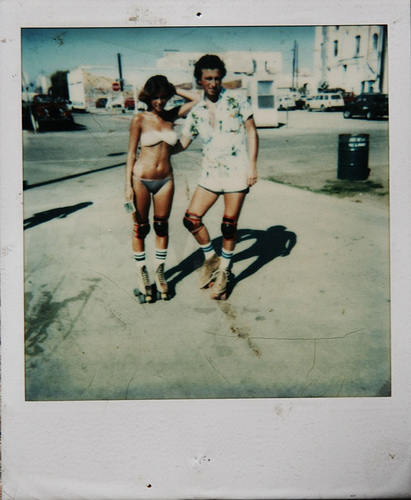
Green cords, purple shirts, teenage groupies, weed and cheeseburgers: favourites of Pynchon in late 1960s California, which also crop up aplenty in Inherent Vice. More in Bill Pearlman’s account of those days in the LRB.
Inherent Vice, Chapter 12

PLOT
Doc pays a visit to the Chryskylodon ‘laughing academy’, where he runs into (again) Coy Harlingen, who expresses doubts that he can ever ‘get out’ of his involvement with various powers. Wolfman’s missing tie, with the nude of Shasta, is seen on an orderly. Denis’ flat gets trashed, and not even by him. Doc pays a home visit to one of the volunteer police force who were involved in the battle in chapter… 2?3? And then there is a dream in which Doc is a child and does not understand death.
p.188 Ominous talk at Chrskylodon of their ‘Noncompliant Cases Unit’, ‘not quite operational but soon to be the Institute’s pride and joy.’
Also, a spatial distortion where Doc has a feeling that Sloane is close by, but ‘in some weird indeterminate space whose residents weren’t sure where they were, inside or out the frame.’
p.190 Further pessimism about the direction of things:
The world had just been disassembled, anybody here could be working any hustle you could think of, and it was long past time to be, as Shaggy would say, like gettin out of here, Scoob.
p. 194 ‘Back in junior college, professors had pointed out to Doc the ussful notion that the word is not the thing, the map is not the territory.’
The whole signs and signification thing. Not sure whether this is meant as giant reminder of the unreality of the text.
p.195 Small joke about use of the ARPA (the proto-internet) being like ‘surfin the wave of the future’. Then it is said to be ‘like acid, a whole ‘nother strange world- time, space and all that shit’. Down the rabbit hole of this sentence there is a big (though possibly trivial) debate about what globalisation and the internet have allegedly done to our sense of time (and in particular, sense of history) and space. Believe me, I know. I just wrote 3,000 words on it. Postmodernism and Time and Narrative and…
p.205 A short, but disquieting dream sequence, in which Doc is with a kid who resembles his brother, but is not, and a woman who resembles his mother, but is not. They are in a diner and the young Doc asks when a waitress named Shannon is coming back.
“Didn’t you hear what the girl said? Shannon’s dead.”
“That’s only in stories. The real Shannon will come back.”
“Hell she will.”
“She will, Mom.”
“You really believe that stuff.”
“Well what do you think happens to you when you die?”
“You’re dead.”
Why would he, or anyone else, think that people only die in stories?
I’m not sure if the following (on p.206) helps, or just makes it both sadder and more mysterious.
And now grown-up Doc feels his life surrounded by dead people who do and don’t come back, or who never went, and meantime everybody else understands which is which, but there is something so clear and simple that Doc is failing to see, will alwyas manage not to grasp.
It’s almost a lapse in the main genre register of the book, which so far hasn’t really been interested in a richer set of emotions for Doc (though it would be less distinctive in Against the Day or Mason & Dixon). If I had already finished the book (as would have been sensible, rather than this chapter by chapter, twice, approach) I would know whether it marked a shift in emotional tenor, as Doc realises that the 60s (whatever they were) are definitely over.
DFW story in The New Yorker

I can’t recall the last time I saw a story in the New Yorker by a writer I hadn’t heard of (i.e. someone like me). From what I gather, a lot of the ‘biggest’ (by which I mean prestige, not size) writers have exclusive contracts with them, so there is really no reason for them to ever look in the virtual slush pile- I’m amazed they even accept unsolicited fiction.
This, however, is not to complain. All the fiction they publish is available free online, which is why I am able to urge you to click your way to the late David Foster Wallace’s beautiful, sad, and very genuine story ‘All That’ which I’m guessing is an extract from his unfinished novel, The Pale King, due in April 2011.
Entitled

I’m currently reading (and much enjoying) Frank Kermode’s (1967) The Sense of an Ending, which is about how narratives, both spiritual and profane, use their respective ends (often death, and the Apocalypse) to structure themselves.
The age of perpetual transition in technological and artistic matters is understandably an age of perpetual crisis in morals and politics. And so, changed by our special pressures, subdued by our scepticism, the paradigms of apocalypse continue to lie under our ways of making sense of the world.
There’s a piece on him in today’s Guardian, and he’s also giving a talk on ‘Shakespeare and the Shudder’ on February 8th at the British Museum. He has two new books coming out, one on E.M. Forster, the other a collection of pieces from the LRB.
Crumb and Speigelman talk comics
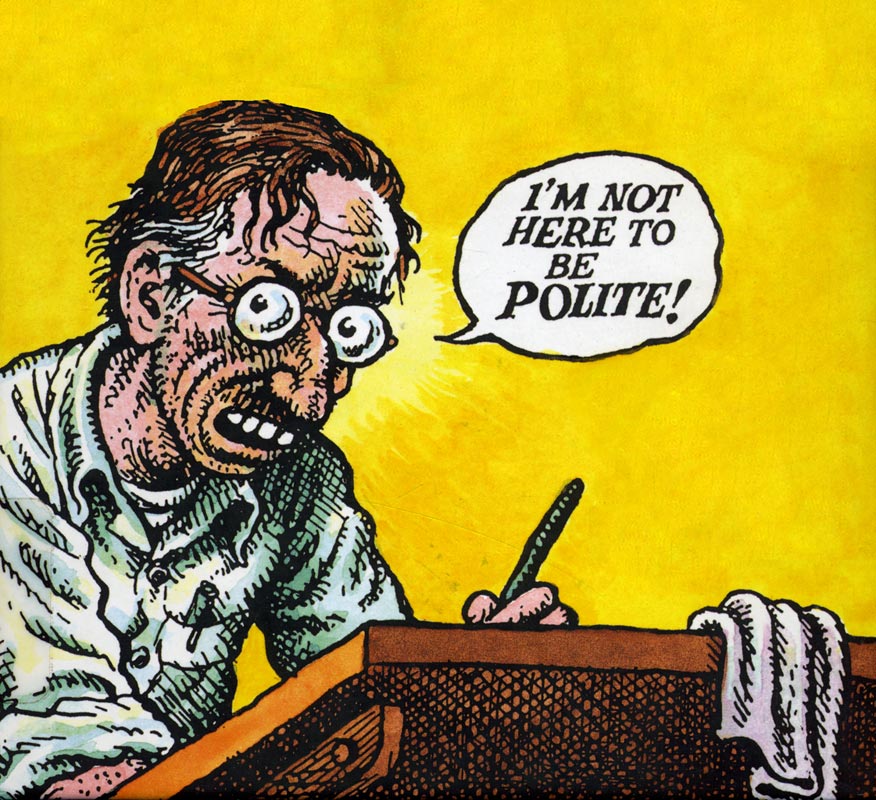
A very enjoyable account of their conversation from The Rumpus:
Spiegelman has drawn Santa pissing in the snow next to a “Remember the Homeless” sign, Bill Clinton getting a blowjob in front of a firing squad. In regard to a published New Yorker cover depicting a Hassid kissing an African-American woman, Spiegelman says a girl wrote him a letter saying how nice it was for him to have drawn Abraham Lincoln kissing a slave.
Underground
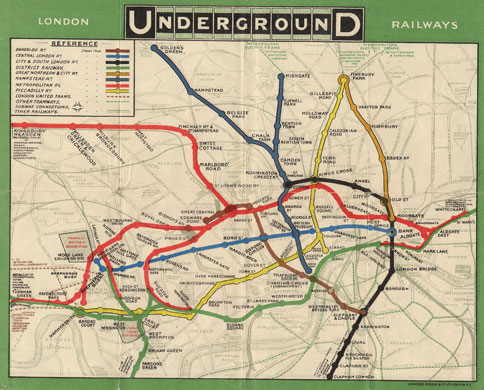
The Guardian has a nice visual history of the London Underground map, including several pre-diagrammatic versions like the one pictured above.
Found #7

Found in The Price of Glory by Alistair Horne. Interesting stance of the man in the corner.
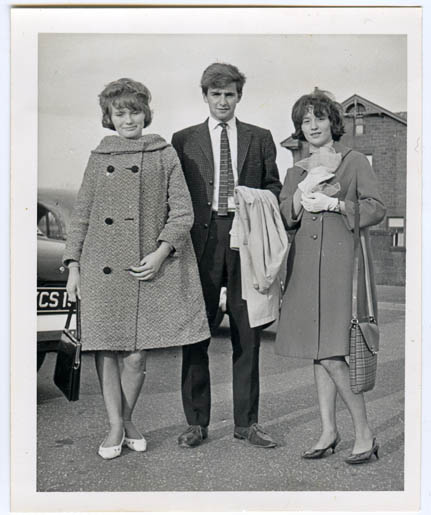
Similarly interesting legwork above.
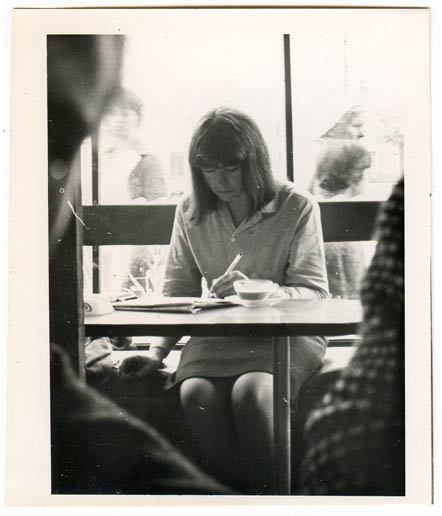
Classic stalker-shot. A crossword, perhaps.
A Working Life

A friend of mine, Erlend Clouston, has been writing a series of wonderful pieces for The Guardian about some of the less glamorous and yet most essential jobs in Scotland. I particularly reccommend the piece on the The Forth bridge painters and the one about a marine engineer on the Calmac ferries.
For some reason, these have appeared in the Money section of the Guardian, rather than in G2, perhaps because they have insufficient celebrity or scandal content. By putting them in a section which few of us read, the Guardian seems to be affirming the notion that these jobs, though essential, are better off unseen.
The Birds of Midway Atoll

I wish the bird in this photo were part of some shamanic ritual, or failing that, an art piece by a hermit who lives on the coast of Novia Scotia. Unfortunately, this is not the case. It, and the other photos below, were taken by Chris Jordan a month ago on Midway Atoll.
These photographs of albatross chicks were made just a few weeks ago on Midway Atoll, a tiny stretch of sand and coral near the middle of the North Pacific. The nesting babies are fed bellies-full of plastic by their parents, who soar out over the vast polluted ocean collecting what looks to them like food to bring back to their young. On this diet of human trash, every year tens of thousands of albatross chicks die on Midway from starvation, toxicity, and choking.
To document this phenomenon as faithfully as possible, not a single piece of plastic in any of these photographs was moved, placed, manipulated, arranged, or altered in any way. These images depict the actual stomach contents of baby birds in one of the world’s most remote marine sanctuaries, more than 2000 miles from the nearest continent.
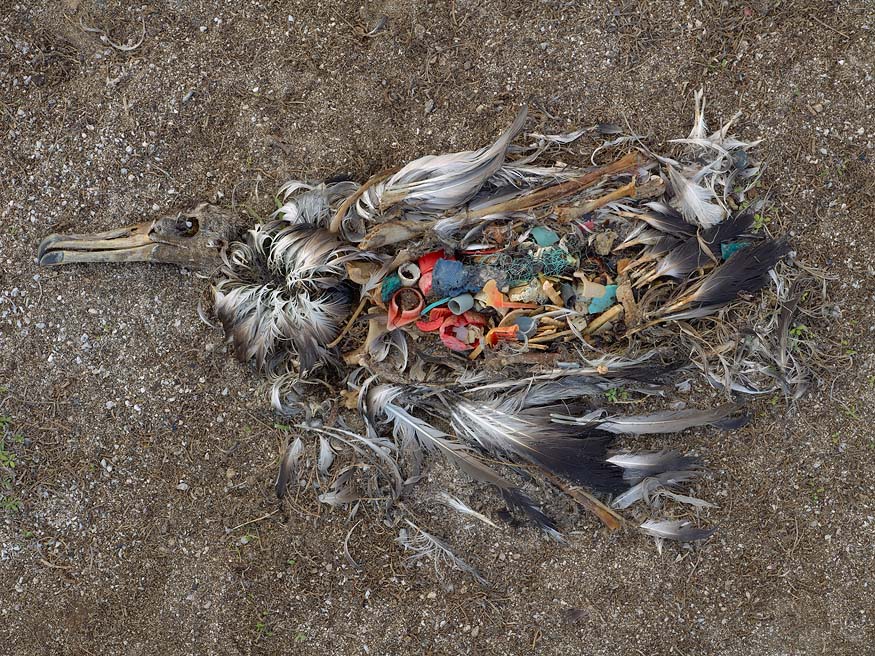


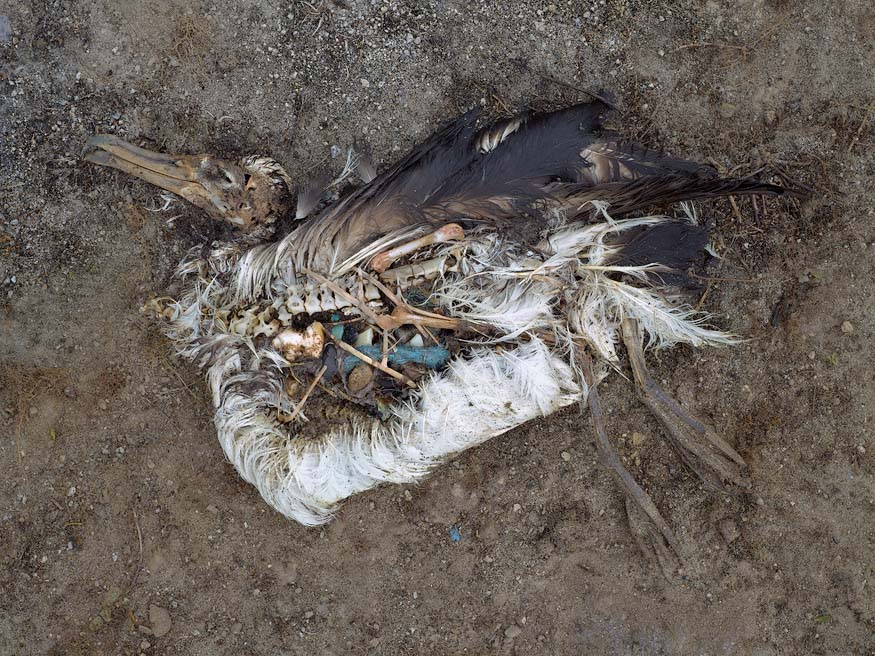
There’s something about these pictures, and also Lu Guang’s, which troubles me, and not just because they starkly demonstrate the degree to which we have devastated our environment. What I find equally upsetting is how beautiful they are- as if even pollution now has its own aesthetic. Even as we push species into extinction, and ecosystems into radical change, we are making art from these actions. The fault, of course, is not in the photographers, but in those who provide subjects for them.
Cormac McCarthy Interview
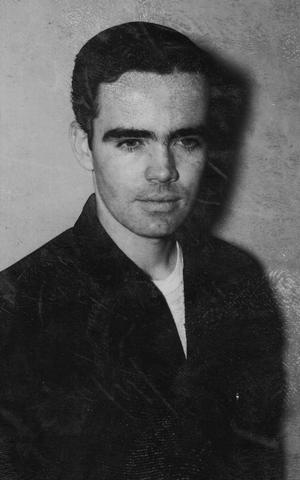
Cormac Mccarthy, mid-1960s
A rare, intriguing, and somewhat provocative interview with Cormac Mccarthy and ‘The Road’ director John Hillcoat at the Wall Street Journal.
I don’t find it surprising that he describes the ‘800-page books that were written a hundred years ago’ as ‘indulgent’, though I cannot agree. McCarthy has said he has no interest in authors who do not ‘deal with issues of life and death’, but it seems to me that there are other, equally valid concerns for an author, some of which cannot be dealt with in a concise manner.
Inherent Vice, Chapter 11
PLOT
Doc gets a postcard from Shasta that reminds him of when a Ouija board sent them on a fool’s errand. When he revists the location he finds a golden building shaped like a fang. Inside he meets Japonica Fenway, a girl from a previous case, who has wraparound hallucinations. After Denis crashes his car, Doc takes it to Tito Stavrou, who tells him he was supposed to pick up Wolfman from Chryskyolodon, but he never showed. And that Chryskylodon is, at a push, Greek for ‘Golden Fang’.
p.163- An amusing alternative postal delivery system- ‘catapult mail delivery involving catapult shells, maybe as a way of dealing with an unapproachable reef’.
p.165- A little extra sensory paranoia to add to all the fears about the living
Around us are always mischevious spirit forces, just past the threshold of human perception, occupying both worlds, and that these critters enjoy nothing better than to mess with all of us still attached to the thick and sorrowful catalogs of human desire.
p.166- During a torrential storm Doc imagines floods that lead to the ‘karmic waterscape connecting together, as the rain went on falling and the land vanished, into a sizable inland sea that would presently become an extension of the Pacific’. Lest we miss the reference to Lemuria, Sortilege has a dream about it, where she reveals that ‘We can’t find a way to return to Lemuria, so it’s returning to us’ (p.167). Just because this is an imagined Eden, it is no less potent (and perhaps painful). Once again, we are dealing with the Fall. Which is perhaps the only tolerable way to explain the present. At least there is the comfort that in the past things were different.
p.166- Doc and Shasta, whose relationship is all but over, make out in a car (this is a flashback) just so they can forget ‘for a few minutes how it was all going to develop anyway’. This is pretty much a synedoche of the novel.
p.170- The Golden Fang Procedures Handbook has a chapter on ‘Hippies’.
Dealing with the Hippie is generally straightforward. His childlike nature will usually respond positively to drugs, sex, and/or rock and roll’
p.171 Doc has a vision of ‘an American Indian in full Indian gear, perhaps one of those warriors who wipe out Henry Fonda’s regiment in Fort Apache (1948)’. Though a comic moment, this is also a nod to a history of disposession, of massacre and counter-massacre.
p.172 Japonica’s delusion (‘actually visiting other worlds’ p. 175) is not without its truth, and also recalls the figures from the future in Against the Day.
Among those who could afford to, a stenuous mass denial of the passage of time was under way. All across a city long devoted to illusory product, clairvoyant Japonica had seen them, these travellers invisible to others, poised, gazing, from smogswept mesa-tops above the boulevards, acknowledging one another across miles and years, summit to summit, in the dusk, under an obscurely enforced silence.
p.176 Another ominous technological development, when Doc sees people listening to music on headphones,
in solitude, confinement and mutual silence, and some of them later at the register would actually be spending money to hear rock ‘n’ roll. It seemed to Doc like some strange kind of dues or payback. More and more lately he’d been brooding about this great collective dream that everybody was being encouraged to stay tripping around in. Only now and then would you get an unplanned glimpse at the other side.
The disturbing implication here is that all of the experimentation and freedom of the 60s actually helped the interests of capital and authority. That the last thing the latter wanted was a public fully engaged with actuality.
The photos of Lu Guang
I used to live in Shaoyang, a small town in Hunan province, in the south of China. When I told strangers where I was living they said, ‘There are many criminals there’ or ‘They have many oranges’. But the most frequent response was ‘That is a dirty place’. In many respects they were right. There were always piles of litter on the street, some of which were never swept up. The water in the Shao Shui river was a dubious green, like that of a jade milkshake (a colour some attributed to the presence of a dragon that slept in there). Even the people of the town said they disliked it being for dirty, though there was often a double standard at work- those who wiped the seat of a bus or chair in a restaurant, or who insisted on sitting on newspaper, were also the same people I saw throw cans and tissues out of train and bus windows.
But Shaoyang was in an agricultural region. Whilst I often saw rubbish caught in the sluice gates of the dam- and once the burst body of a pig -there were few signs of industrial pollution, nor of the alterations of landscape depicted in Edward Burtynsky’s photos (click on them to enlarge).
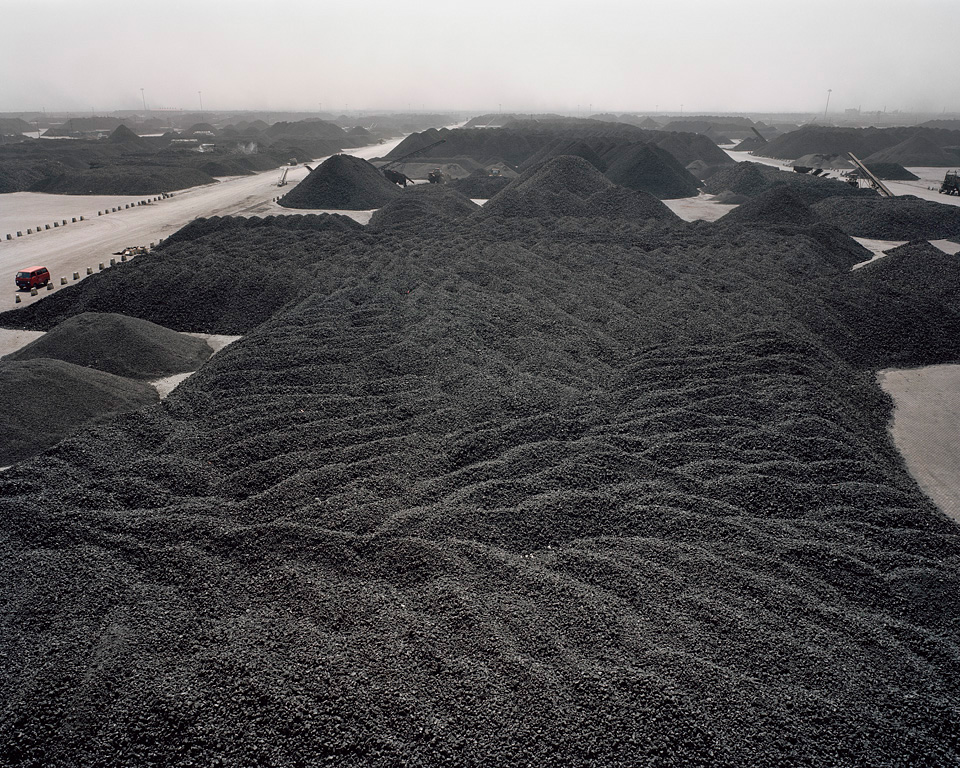
Tanggu Port, Tianjin 2005

Feng Jie #4

Wang Zhou #4
Though it is clear from watching Manufactured Landscapes (the documentary about his work) that Burtynsky has a strong environmental stance, his pictures often have a neutrality about them- the sense of judgement witheld. The same cannot be said of Lu Guang’s photos which make plain the environemntal costs of China’s reliance on coal-fired power stations (approximately 80% of their energy).

15-year-old boy from Tianshui, Gansu Province

Longmen town in Hanchen city, Shaanxi Province

Tianjin Steel Plant, She County, Hebei Province, March 18, 2008
Great corrections #1

From a review of the new Jonathan Safran Foer book about vegetarianism in the Nov. 9th New Yorker:
Correction, November 4, 2009: The number of chickens currently being raised in the United States is nearly two billion, not four hundred and fifty billion, as originally stated.
I like that no one noticed this- I wonder how many chickens it would take to fill the US- can someone please do the math?
LRB archive goes to Austin
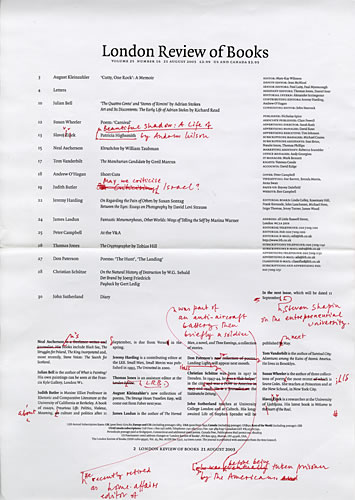
Galley for LRB contents page
Nearly 600 boxes (or 275 linear feet’s worth) of material from the 30 years of the London Review of Books has gone to the archives of the University of Texas, in Austin. The files contain correspondence (between editorial staff, contributors and readers), typescript submissions and page proofs, complete with annotations. There are also pieces (and here my heart skips a beat) that failed to make it to publication, on which are written comments such as ‘not urgent’, ‘not this week’ or worst of all, ‘Killed’. The only frustrating thing about the scans included in the article is that the annotations on the pages are (no doubt deliberately) not quite legible. More here.
Inherent Vice, Chapter 10
PLOT
Doc gets a damsel in distress call from Jade, who turns out to be in no distress at all. He ends up speaking to Jason Velveeta, her self-styled pimp, who says the Golden Fang is a heroin cartel. Later he bumps into Coy Harlingen again, who only wants to be back with his wife and daughter.
Not a lot to say about this chapter, other than that the description of the Golden Fang’s operation as a ‘vertical package’ that finances, grows, processes and distriubtes the drugs is little different to that of a corporation (p.159).
Here’s the song that gets to Doc, Roger and Hart’s ‘It Never Entered My Mind’
Here are the lyrics to the song sung on p.160, Dietz and Schwartz’s ‘Alone Together’, which seem a comment on community, and solidarity, but maybe also their limits.
- Alone together, beyond the crowd,
- Above the world, we’re not too proud
- To cling together, We’re strong
- As long as we’re together.
- Alone together, the blinding rain
- The starless night, were not in vain;
- For we’re together, and what is there
- To fear together.
- Our love is as deep as the sea,
- Our love is as great as a love can be,
- And we can weather the great unknown,
- If we’re alone together.
p. 162 A nice piece of genre-appropriate writing here, with the right amount of sentiment.
Inherent Vice, Chapter 9

PLOT
Doc goes to see Coy Harlingen at the Boards mansion, but is driven away by English zombies and threatening suits. There are two counts of cunninlingus. Clancy Harlingen, Coy’s sister turns up and tells Doc that Mickey had a plan to give away a lot of the money he made.
p.125 Mention of Hokusai’s Great Wave off Kanagawa, described as ‘the eternally suspended monster’ (p.126), about as ominous (and vague) a symbol as one could ask for.
p.126 Cantor’s Delicatessan
Georg Cantor (1845-1918) was a German mathematician who pioneered the subject of set theory, now at the foundation of all modern mathematics. He proved that there are different sizes of infinity – for example, the set of natural numbers is smaller than the set of real numbers, though both sets are infinite.
This is perhaps a comment on what can be known, and how even vague concepts like ‘infinity’ or ‘time’ can be broken down (a bit of a stretch, I know)
p.128 A TV soap opera features
‘something called “parallel time”, which was confounding the viewing audience nationwide, even those who remained with their wits about them, although many dopers found no problem at all in following it. It seemed basically to mean that the same actors were two different roles, but if you’d gotten absorbed enough, you tended to forget that these people were actors.’
The implication is that our regular ‘wits’ are insufficient to understand that people are not single, consistent selves, but instead are fractured constellations of memories and competing impusles.
It can also be read as a sop to the critics, or at least those who complain that Pynchon’s work (esp. Against the Day) is hard to follow and lacks fully developed characters (most vocally, Mr James Wood).
It also recalls this passage in V.
Rachel was looking into the mirror at an angle of 45°, and so had a view of the face turned toward the room and the face on the other side, reflected in the mirror; here were time and reverse-time, co-existing, cancelling one another exactly out. Were there many such reference points, scattered through the world, perhaps only at nodes like this room which housed a transient population of the imperfect, the dissatisfied […]
This passage is immediately followed by another swipe at TV, when Doc realises ‘the scope of the mental damage one push of the “off” button of a TV zapper could inflict on this roomful of obsessives’.
p.129-130 has what appears at first sight to be an either paranoid (or highly perspicacious) condemnation of the activities of those in authority.
If everything in this dream of prerevolution was in fact doomed to end and the faithless money-driven world to reassert its control over all the lives it felt entitled to touch, fondle, and molest, it would be agents like these, dutiful and silent, out doing the shitwork, who’d make it happen.
Was it possible, that at every gathering- concert, peace rally, love-in, be-in, and freak in, here, up north, back east, wherever -those dark crews had been busy all along, reclaiming the music, the resistance to power, the sexual desire from epic to everyday, all they could sweep up, for the ancient forces of greed and fear?
But for Doc, and perhaps for Pynchon, this is somewhat over the top- the ‘epic’ sexual drive, the ‘faithless money-driven’ etc. It’s function may be to send up people’s paranoia, and show the desperation with which people construc tales of conspiracy. And in case any readers are still nodding at these sentiments, there is always Doc’s verdict”
“Gee,” he said to himself out loud, “I dunno…”
(The alternative is that only someone in Doc’s state of perpetual befuddlement could doubt this idea).
p.146 Masse shots are forbidden- In billiards, a massé shot is when a player strikes a ball with the cue at a sharp angle and causes the ball to curve drastically or even eventually reverse direction. Given Pynchon’s predilection for the imagery of arcs, rainbows, refraction etc, he is most likely commenting on the status quos resistance to change, especially of a revolutionary nature.
Too long in the library #3
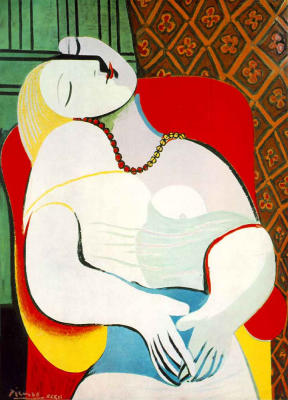
The Dream by Pablo Picasso
When people ask me what my PhD is about (almost a weekly occurence), my current answer is that it’s on Thomas Pynchon and [blank]. At the moment I’m trying some different words in this space- ‘visions’, ‘utopia’, occasionally ‘time’. The combination of these words led me to Frederic Jameson’s Archaelogies of the Future, a book about the constructions and uses to which utopias have been, and might be, put. Though I have a passing familiarity with Jameson’s work from his reviews in the LRB, this is the first time I have been exposed to a book-length display of his erudtion. He quotes this passage by Freud about creativity as a kind of wish fulfilment:
You will remember how I have said that the day-dreamer carefully conceals his phantasies from other people because he feels he has reasons for being ashamed of them. I should now add that even if he were to communicate them to us he could give us no pleasure by his discolsures. such phantasies, when we learn them, repel us or at least leave us cold… The essential ars poetica lies in the technique of overcoming the feeling of repulsion in us.
Jameson puts this is in simple terms I think we can all relate to.
Anyone who compares the fascination we often feel for our own dreams with the boredom that suddenly overcomes in listening to the account of another will know what Freud means.
Art, then, consists of disguising and softening the egotistic content of such day dreams or phantasies, by bribing the reader, viewer, or listener with aesthetic pleasure. In my opinion, there is nothing that needs more disguising than a dream itself. But in their efforts to make the dreams of others interesting, most writers or film makers usually end up with too simplified a product, whose symbolism is too overt. The demons our heroine is pursused by are those we have already seen.
Pushcart Prize nomination

I’m pleased to say that I have been nominated for a a Pushcart Prize for my story ‘Amy’, which appeared in New Short Stories 3. I still have a few copies of the anthology, which you can buy by sending a paypal payment of £6 (includes P + P) to nholdstock@hotmail.com.
Inherent Vice, Chapter 8

PLOT – Doc meets up with his parents; Nixon’s face appears a lot (on banknotes, and TV); Coy Harlingen, pretending to be someone else, disrupts a Nixon rally.
p.113 The parking regulations at Gordita are said to have been devised ‘by fiendish anarchists to infuriate drivers into one day forming a mob and attacking the office of town government’.
If only it were so… I suppose this might be construed as the idea that technology will enslave us, and control us, far more than even the forces of order might have bargained for.
p.116-117
After Doc’s parents get a random phone call, threatening them, Doc reflects that
in the business, paranoia was a tool of the trade, it pointed you in directions you might not have seen to go.
As Michael Wood said in his NYRB review, being crazy can, in a circuitous manner, lead one back to insight.
p. 118 Further parallels between domestic and foreign US policy, with Nixon’s face being found in banknotes, in the same way he was put on bills in Vietnam.
p.122 Coy Harlingen turns out to be a police informant, something that Doc has already been approached about. He is here identified as Ric Doppel, which means ‘double’ in German and might refer here to the ‘doppelganger’-motif or shifting identities in a more general way. The theme seems to be prominent in this chapter. The films mentioned on p.115 belong in this context, for example. In Black Narcissus, Kathleen Byron’s character, Sister Ruth, can be seen as the dark double of Deborah Kerr’s Sister Clodagh. In Robert Wiene’s Das Cabinet des Dr. Caligari, the somnambulist Cesare commits crimes when he is under the hypnotic spell of the title figure; Caligari himself may be director of a circus attraction or of a psychiatric hospital. In Fritz Lang’s Metropolis, a character called Maria is replaced by a robot.
The Golden Hour Book Vol. 2
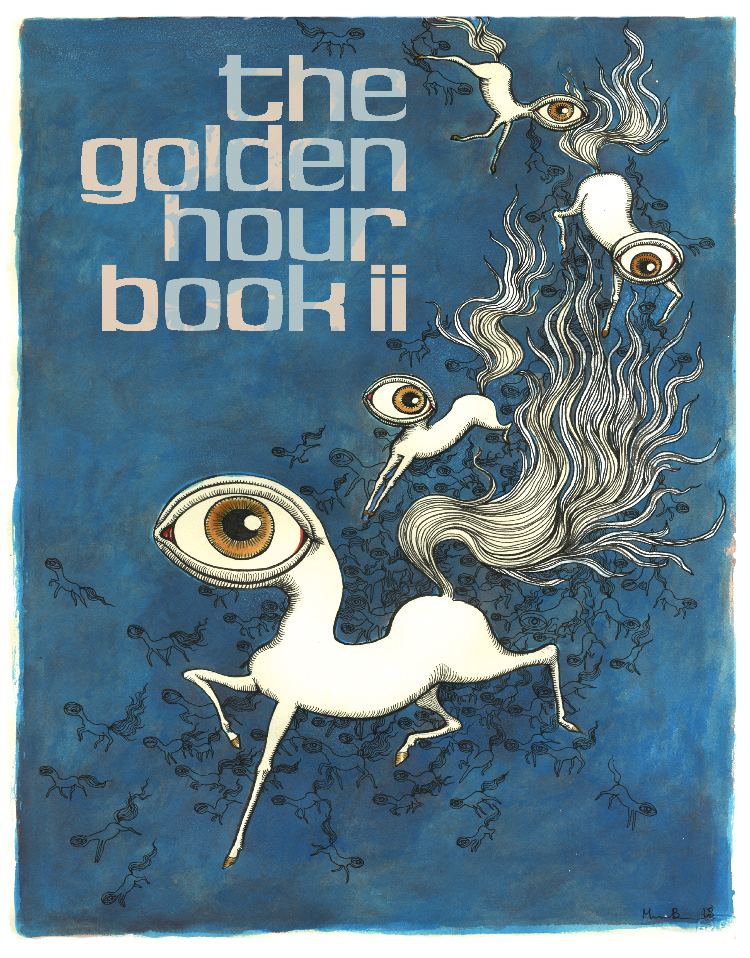
Now on sale from Forest Publications, the latest volume of prose, poetry and music (it comes with a CD) from the monthly Golden Hour cabaret at the Forest Cafe in Edinburgh.
It features contributions from Andrew Philip, Alan Gillis, Robert Alan Jamieson, Kapka Kassabova and myself. Ron Butlin, Edinburgh’s current Makar, had this to say about it
‘There is genuine wit, deep feeling and real entertainment in this most enjoyable volume. Light-hearted and serious by turns, ‘The Golden Hour Book Volume II’ contains some of the best and freshest new writing I have come across for quite a while.’
You can now also buy Stolen Stories (an anthology I c0-edited) from the Forest Publications site, as well as many other fine publications.
Interview with Mary-Kay Wilmers, editor of the LRB

Today’s Guardian has a detailed profile of Mary-Kay Wilmers, editor of the LRB, which reveals that she was the person who came up with the title for Oliver Sacks’ book, The Man Who Mistook His Wife For a Hat. The Eitingons, a memoir of her family, will be out in November.
‘We play football, we play soccer — We keep matzohs in our locker’
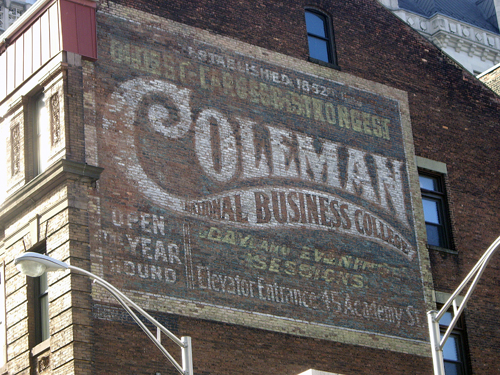
Very odd story about Philip Roth joining a tour of Philip Roth’s, Newark. If this were in one of his novels, no one would recognise him and he would be chased away from his old haunts, forced to wander through back alleys in dejected irony.

