These are not my twisted words

artwork

One day, when I am too bloated with fame and adulation and the blurbs on my back-covers, I shall no doubt be comissioned to write 500 words on why I love Radiohead. Thankfully, for all concerned, that day remains far distant.

It is definitely much more fun to dance about architecture.

And to download (legally and for free) their new song here.

The Rumpus

rumpus_header_colored_1

Seth Fischer writes a good piece about the continuing pariah status of the short story (in publishing, at least) at The Rumpus, a great site which I urge you to check out, not least because, along with sections on Art, Music, Books and Politics, it has the decency (yes, that is the word, I think) to have one for Sex as well. Peter Orner’s column is also particularly good.

Pynchon narrates trailer for Inherent Vice

Yes, apparently so, according to Penguin.

For my money, better than a photo, hearing the old master’s voice.

Still feels strange to have a trailer for a book.

The Road trailer

Worth it for Garret Dillahunt (‘That boy looks hungry’) alone.

***You Tube seems to have stopped allowing me to embed this- you’ll need to click on the screen to watch it.

Stone Voices

Salisbury Crags

Salisbury Craigs

I am continually disgusted by my ignorance of Scottish literature, history, geography, poetry and art. Where once I had purposefully spent hours exploring, going down streets and alleys simply because I had not done so before, now it is a matter of getting to my destination as quickly as possible. The city has plenty of decent museums and galleries, but these days my knowledge of what goes on in them is limited to the posters on walls I glimpse as I cycle by. I have probably not been to an exhibition for almost 2 years.

By no means is this something willful. It is what usually comes of living in the same place for a long period of time (in my case, almost 7  years in Edinburgh). I am aware of this lamentable state of affairs, but it is too comfortable a rut to get out of. Only occasionally do I lift my head and look around and properly comprehend how rich and interesting it is to live here. Usually after I’ve read something like Neal Ascherson’s Stone Voices, which, in its tour through Scottish political history, makes many interesting stops.

For instance, whilst I vaguely knew that Edinburgh had been the site of some serious shifts in geological thinking, I did not realise how profoundly they had altered people’s thinking.

At the end of most streets in Edinburgh’s Old Town rises the crimson wall of Salisbury Craigs, a lesson in the unimaginable force and lapses of time which have gone to shape the world. The Craigs are a basalt intrusion, a fossil tide of volcanic rock which surged through the foundations of a dead volcano some 200 million years ago. Geology and paleontology, with their revelations of deep time and alien life-forms, towered up wherever nineteenth century Scots turned their eyes. The ‘testimony of the rocks’ threatened their moral universe, its narrative incompatible with a creation myth or even with a creator.

Equally powerful testimony exists less than a twenty minute walk from my house, on Blackford Hill, where there is a rock i have passed dozens of times (on which, now I think of it, there is even a plaque). As Ascherson says, “Here, in 1840, the Swiss naturalist and geologist Louis Agassiz arrived in the company of Charles Maclaren, the Scotsman‘s first real editor.” It was his observations of the horizontal scratches on the stone that led him to claim they were the work of stones carried by a moving force, in particular ice masses.

From the Scotsman, the entire British public learned for the first time that there had been an Ice Age in their own land and throughout the northern hemisphere. Conventional religion was faced with proof that much of the world had been overrun, buried and reshaped by an ice-cap and glaciers hundreds of feet thick- and at a relatively recent period. Here was a cataclysm which the Book did not even mention.

As it with the Aggasiz rock, so it is with the shaped stones that constitute the buildings of a city. These too have their plaques that speak of what was done and said within, usually before our time. Perhaps, when we occasionally pause to read them- when the bus is late, when she is late -we find nothing of interest, no connection to the person who lived there or wrote X while doing so. The fault for this is entirely our own. We must unblock our ears.

Too long in the library #2

3614270233_78240b9bee

from Terry Eagleton’s piece in the LRB, 3oth April 2009:

During the Second World War, a woman was interned for five months when the authorities discovered an entry in her diary reading ‘Destroy British Queen. Install Italian Queen.’ She turned out to be a beekeeper.

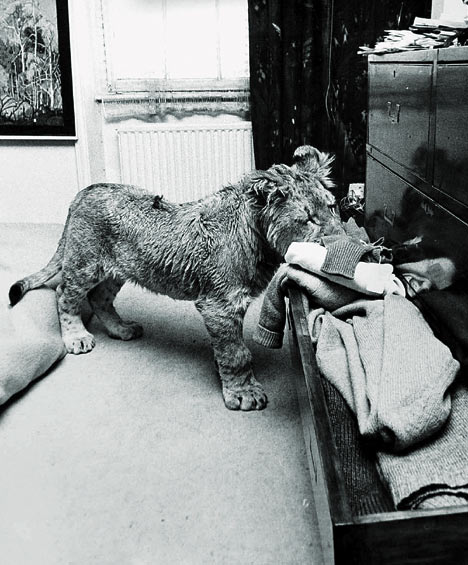
Christian the lion

liontv_468x649

“Sometimes, he’d see people staring at him through the back window of the car, keep very still on purpose – and then, just when they were convinced he was a stuffed toy, he would very slowly turn his head and freak them out.”

This lion was bought (as a cub) from Harrods, then lived in a London flat in the Sixties. Eventually its owners had him released in Africa, and were then, even more improbably, reunited with him years later. If this all seems horribly cute, I’m sorry, it is Friday. Further details here.

Also, here is the sickeningly happy video when they are all reunited.

liondraw_468xx565

New Ishiguro Book

51VnVP0jRPL._SS500_-1

This, of course, is cause for rejoicing. His previous novel, Never Let Me Go is probably as good a book as any published in the last decade. In a recent interview in The Guardian he admits to feeling that he peaked in his 30s, and that now it’s all just trying new things, which is either a brave admission, or a mark of how secure his position is.

The piece also contains the-should-be-horrifying news that Never Let Me Go is being butchered into film form, and will star… Keira Knightley.

As a thought experiment, let us breath deeply and consider what good might come of this. Yes, Knightley’s much vaunted looks will detract from the narrator’s averageness (from which a considerable amount of the novel’s pathos derives). Yes, the film will lack the interiority that made the novel so compelling.

But (and here I pause, and scrape the cloud hard)… I like to think that one reason why poorly written genre books (Patricia Cornwell, James Patterson etc) are so popular is because they are agressively marketed, inevitably to the detriment of more thoughtful books. If Keira Knightleys’ face on the cover makes more people pick up the novel, this is not only one more good book being read, but also, and as importantly, one less bad one too.

(There should probably now be a long, self critical paragraph that deals with my patronising belief that I know what’s best for people, what they should read, what is ‘good’ and ‘bad’ etc. Perhaps we can take this as read.)

Morbid anatomy

anatomicaltheatre06-1

anatomicaltheatre03

anatomicaltheatre042These images are from the La Specola Museum of Anatomy in Florence, which has a large collection of wax models. Though these are mostly of individual limbs and organs, there are several full figures, which are arranged with particular care (the pregnant woman, whose stomach is opened to display the baby, has long, brown, sensuous hair and wears a string of pearls).

If you have an interest in such things, Morbid Anatomy, which surveys “the Interstices of Art and Medicine, Death and Culture” has an embarassment of such riches (kudos to the cats at Fox and Comet for bringing this site to my notice).

Mason & Seidel

41lz7qi1e2l_sl500_aa240_

From a recent piece in the New York Times

One night after Christmas last year, in a dark, well-upholstered restaurant on Manhattan’s Upper West Side, the American poet Frederick Seidel, an elegant man of 73 with an uncommonly courtly manner, told me a story about poetry’s power to disturb. “It was years ago,” Seidel explained in his measured voice, “in the days when I had an answering machine. I’d left my apartment, briefly, to go outside to get something, and when I came back there was a message. When I played it, there was a woman’s voice, a young woman’s voice sounding deeply aroused, saying: ‘Frederick Seidel . . . Frederick Seidel . . . you think you’re going to live. You think you’re going to live. But you’re not. You’re not going to live. You’re not going to live. . . .’ All this extraordinary, suggestive heavy breathing, getting, in the tone of it, more and more intensely sexual, more gruesome, and then this sort of explosion of sound from this woman, and: ‘You’re . . . not . . . going . . . to . . . live.’ ”

Wyatt Mason, the author of the piece, writes a very fine blog for Harpers (which also has a fun piece on Seidel that casually bashes Garrison Keillor). I first came across Mason’s work in the LRB, where he wrote an article about DFW, in which he expressed doubts about the level of patience and close reading required to fully appreciate the stories in Oblivion, DFW’s last collection. Though he did not doubt the quality of the pieces, in his opinion an average, literate reader could be forgiven for being unwilling to make the considerable effort required. At the time I disagreed with him, perhaps in the belief that this made me more than an average reader. The fact that DFW’s last few published pieces (particularly Good People in the New Yorker) seemed to eschew such tricks or puzzles suggest that DFW had become aware of the diminishing returns of such forms.

Attention, Audio-lovers

“Vigelands Parken” in Oslo

Sculpture in Vigelands Parken, Oslo

Having raised a statue to Vollmann, I should make it talk (Real Player required).

This is from the Conjunctions Audio Vault which features recordings from many existing members of the pantheon, such as William Gass (three times) and Philip Roth.

William T. Vollmann

41wusrco33l_sl500_aa240_

Interviewer: I want to talk about your artwork on the walls here. There’s so much sexuality- particularly female sexuality- represented. Tell me about it.

Vollmann: Oh, it gets my dick hard, sweetheart.

(from an interview in Tin House Vol. 9 No. 3)

William T. Vollmann, at age 49, has already written too many damn books, more than I will ever write, let alone get published. This is not really a complaint. I am delighted that an author of his ability is able to be so productive: 19 or so large books, some fiction, some non-fiction, the longest being Rising Up and Rising down, which, in its unabridged form, clocks in at 3,300 pages. I have only read a few of these, but from You Bright and Risen Angels alone, it is horribly, wonderfully clear that he is trying to map out territory in very unpleasant lands. The author’s note is fair warning:

This book was written by a traitor to his class. It is dedicated to bigots everywhere. Ladies and gentleman of the black shirts, I call upon you to unite, to strike with claws and kitchen pokers, to burn the grub-worms of equality’s brood with sulfur and oil, to hudle together whispering about the silverfish in your basements, to make decrees in your great solemn rotten assemblies concerning what is proper, for you have nothing to lose but your last feeble principles.

The book is about the long and bloody conflict between Insects and the forces of Electricity (especially the blue globes).

Flicking through the book, which I read several years ago, I see that the page corners are turned in many places, each marking some place where my reading pleasure was so great that I was forced to harm the page. It is often difficult to recall what prompted the triangular mutilation. Without context, they can just seem very fine sentences. And then there is a passage like this, which causes bells to ring in deeply sunken cellars.

Generally speaking, she didn’t have much luck. Being maladjusted she was taken to a psychiatrist, who with his encounter groups and truth serums distorted her social reality so that life lost its cutting edge. At sixteen she stood on a broken bottle barefoot, hoping to bleed to death, but her mother found her and took her to the hospital. At eighteen she jumped off a bridge, but the river below was so polluted with gummy hydrocarbons that its surface merely dimpled to receive her like an immense trampoline and bounced her up and down until she got sick to her stomach. As a freshman in college a year later, having failed both in her exams and in love, she swallowed a bottle’s worth of asprin. Her ex-boyfriend came in to her unexpectedly next morning (for he wanted to tell her yet again how much he despised her in her stupidity and weakness, and she wasn’t even very goodlooking with her long neck and big nose and weak eyes, to say nothing of being a lousy lay, and he was fucking tired of the way she held onto his letters and he was going to get them back); and she was still alive, though red-faced and wheezing, with a suicide note lying on the bureau. Much like mild-mannered Clark Kent in his pre-Superman days, dear Emily was always doing the wrong thing in the wrong place at the wrong time in some trivial pathetic sort of way like most people one meets in our great Republic except that they are straitjacketed against adverse circumstances by the power grids that run screaming day and night beneath the surface of the neighborhood parking lot and in our furnaces and boilers and air conditioning rerun clamps so that no one ever has to deal with the hot muggy horrible outdoors of reality unless there’s a power failure somewhere, though maybe we get a hint of it when there’s a brownout and the oven takes longer to cook and the Announcer’s voice slows down and his face flickers and melts into an incomprehensible blue globe for just a minute and then all’s back to normal.

There are so many reasons why this appeals to me. At the broadest level, there is the sweep from the personal to the societal, from the interior thoughts of the loathsome ex-boyfriend to the talk of ‘our great Republic’.

There is Vollmann’s shift from horror (her standing on the broken bottle, on purpose) to absurdity (her bouncing on the polluted water) and then onto cruelty (not simply the attempted suicide, but the fact that she is, via the parethetical comment, being mocked while trying to kill herself), all in the space of four sentences.

And then there are the blue globes which scare the beejesus out of me.

Vollmann has also written books about being in Afghanistan, riding in boxcars, povery, violence, and most recently, Imperial Valley in California (a shorter volume of merely 1,344 pages, due out this month).

His most recent essay (on photography) can be found here.

Lynch commercial for Gucci

Well, that’s what they claim it is. To me it seems like a trailer for something so horrible it is best not seen. Lynch can always be relied upon to film incredibly beautiful women in such a way that they are so terrifying, or terrified, that it would take a very particular taste to ever find them attractive.

Donald

03101

Ladies and gentleman… Mr Donald Barthelme. Who was a writer. Prinicipally of stories. About these stories, it is hard to be certain. Some of them involve pictures. Others contain people. None of them are “constructed mousetrap-like to supply, at the finish, a tiny insight typically having to do with innocence violated”.

This last sentence is one that particularly pains me: God, after he had made several beasts, must have quickly lost any joy at the sight of a creature swimming or flying. It had already been done so well. If it had been worth doing it all.

Something further can be learnt here, here but not here.

Idioms to share #1

montaigne

Montaigne!

“I came to wonder if the game was really worth the candle.”

I found this in Alasdair Maclean’s Night Falls on Ardnamurchan, his account of the remote crofting community where he grew up. It refers to a situation where the returns from an activity or enterprise do not warrant the time, money or effort required (for Maclean the ‘game’ in question was raising cattle, which was at best an uncertain affair) . This expression, which began as a translation of a term used by the French essayist Michel de Montaigne in 1580, alludes to gambling by candlelight, which involved the expense of illumination. If the winnings were not sufficient, they did not warrant the expense.

Tomorrow I shall be looking for conversations in which to use this, especially with people who wont hate me too much for deliberately using a phrase they don’t know, just so I can then say, “Aha! Well, this is very interesting. It all goes back to Montaigne.”

And so on.

Consider the salad

Lobster salad

Lobster salad

D. T. Max, who wrote the excellent New Yorker article on David Foster Wallace, answers follow-up questions here.

Also, here is the new memorial entry from the Forest Cafe’s menu (‘The Pynchon’ is, alas, no longer available):

Salad Plate: (Vegan) £4.20
The D.F.W.
3 (as in the basic numerical unit, also denoted by ‘III’ ‘three’, ‘iii’, or ‘㈢)’ (Arabic font unavailable on this computer)) Salads (erroneous use of the plural fully intended, it being never far from our mind that ‘salad’, being an uncountable noun, does not require (let alone deserve) to have the suffix- s attached) with (as in ‘accompanied by’, and also (in this case, correctly) implying that the noun phrase anteceding the term is greater in quantity than that which follows it) Bread (used here non-colloquially i.e. “n. baked dough made from flour usu. leavened with yeast and moistened, eaten as a staple food” (OED) and certainly not implying that we slip some folding green under your flower petals).

Wise Blood

42751

Flannery O’Connor died at 39 from lupus. She also raised peacocks, pheasants, geese, swans, chickens and Muscovy ducks, as this picture (which I would like to think a self-portrait) makes clear.

story

Wise Blood, her 1952 novel, is a parade of Southern grotesques. It details the heresy of Hazel Motes, preacher and sole member of ‘The Church without Christ’. It is a novel replete with cruelty and meaness. A policeman pushes a man’s car off a cliff; another man visits the zoo each day so he can swear at the animals. When a gorilla famous from films comes to town, he is thankful for “the opportunity to insult a successful ape”.

All of this is immensely enjoyable, and written in very sharp prose. But for me these warped (and often comic) characters failed to resonate. I’m not sure if this is a fault of mine, or the novel. As O’Connor says in her introduction,

“That belief in Christ is for some a matter of life and death has been a stumbling block for readers who would prefer to think it a matter of no great consequence.”

Whilst I don’t think the struggle to accept Christ a matter of no consequence, I, as a secular reader (probably true of her contemporary audience as well) need some help in trying to empathise with characters for whom it is an essential question. Which could, I suppose, beg the question- Isn’t it one of the jobs of the author to preach to those yet to be converted? To create characters and situations so compelling that we care about those involved, even when, especially when, they are wildly dissimilar to us and our secular preoccupations?

It is certainly possible to do so. Gilead, by Marilynne Robinson, though its premise is perhaps not initially engaging- an aged pastor in a small town writing letters for his son to read when he is older -is nonetheless one of the most affecting explorations of faith I have read.

gilead

Perhaps my problem with Wise Blood was its style- because of the restricted emotional palette, it was too easy to dismiss the characters’ (no doubt theologically interesting) concerns as simply those of grotesques and fanatics. The only other book of hers I’ve read is her Collected Stories, which for many is an unshakeable part of the canon. Whilst this is not a claim I am in any position to challenge- there is too much fine writing in them for that -the thing about reading a life’s work in one lump is that although it allows you to discern certain thematic or formal preoccupations, it can expose a paucity of ambition on the writer’s part. By this I mean an unwillingness to write certain kinds of story or character (it being my assumption that the best writers are capable of doing anything), or an over-reliance on particular narrative forms or plots. Stories that work very well on their own, or in their smaller, original collections, when placed in proximity can undermine each other. With O’Connor, many of the stories start in a comic vein, then abruptly shift to the violent or tragic, a technique I eventually found irksome for its predictability. This is almost true of Wise Blood as well, though it can also be said that no book could fully recover a tragic or even serious tone after a chapter like the one involving Enoch and the Gorilla, which may have started off as a short story then been shoehorned into the novel (purists will certainly know).

Finally, there is at last a definitive biography of O’Connor, of which the reviews are trickling in. I shall read it, if only to learn about the animosity between herself and Carson McCullers, whose work I can imagine she found too whimsical and charming.

A Man Asleep

A section from the film of Georges Perec’s Une Homme qui dort, one of the few good uses of the second person. I suppose what I enjoy about this clip, and the book, is the feeling of intense passivity both of them evoke. I would write more, but my fingers feel heavy. I shall sit awhile.

It’s just a glorious world

Lynch with ex-wife Isabella Rosselini

Lynch with ex-wife Isabella Rosselini

Another pleasingly non-informative interview with David Lynch.

I disagree with her about Inland Empire. About an hour afterwards I felt I had it all worked out. Next morning, I was not so sure.

Customer service, a la William Faulkner.

faulkner_pic

Sitting at work, trying to lose myself in the serious and important enterprise that is not-working whilst at work (or to be precise, doing other, far more valuable work, such as reading Harpers) I came across this description of William Faulkner’s brief time in the University of Mississippi post office (from Javier Marias’s Written Lives).

“Apparently one of the lecturers there, quite reasonably, complained: the only way he could get his letters was by rummaging around in the garbage can at the back door, where the unopened mail bags all too often ended up. Faulkner did not like having his reading interrupted, and the sale of stamps fell alarmingly: by way of explanation, Faulkner told his family he was not prepared to keep getting up to wait on people at the window and having to be beholden to any son-of-a-bitch who had two cents to buy a stamp.”

And lest there remain any doubts regarding his good nature:

“When he died, piles of letters, packages and manuscripts sent by admirers were found, none of which he had opened. In fact, the only letters he did open were those from publishers, and then only very cautiously: he would make a tiny slit in the envelope and then shake it to see if a cheque appeared. If it didn’t, then the letter would simply join all those other things that can wait forever.”

I would repeat his views on what a woman should do, but some son-of-a-bitch wants to know who wrote The Kite Runner. I will sweetly smile and tell him, “William fucking Faulkner.”

Another Random Bit

David Foster Wallace

(about whom more will no doubt be said in a long, loving, though ultimately unsuccessful blog entry, the blog entry’s ‘failure’ being due to the author’s desire to adequately express not only an admiration bordering on reverence, but to do so in so persuasive a fashion that anyone reading said blog entry will be instantly converted to the view that DFW’s suicide is one of the few genuine (and it is, I think, ultimately sad that there is now something inherently fake about this word) losses to literature (and therefore the world, since this what the aforementioned category contains) in recent years)

reading 1) a very funny piece about baton-twirling and 2) an equally funny about cabin-service so caring it makes you feel uncared for. Recorded in 1997 at the San Diego Museum of Contemporary Art.

More on DFW at

http://www.salon.com/books/feature/2008/09/26/david_foster_wallace/

http://www.newsweek.com/id/158935

Baboon, Part 2

My favourite parts are Nabokov twitching and looking around while Trilling offers his ‘theory’ on Lolita, and Nabokov’s view of his ‘monument’ at the end.