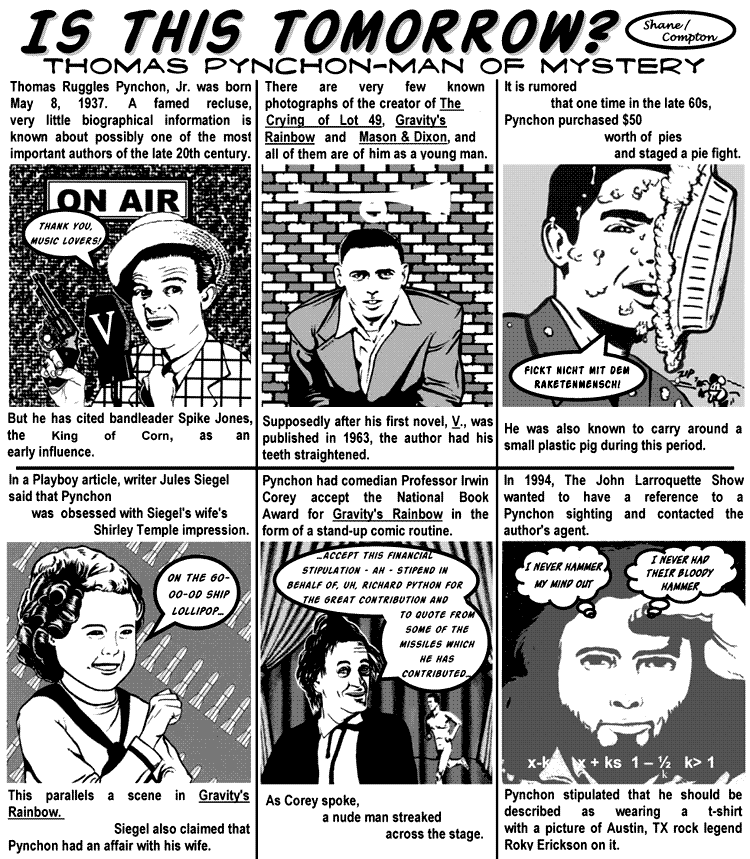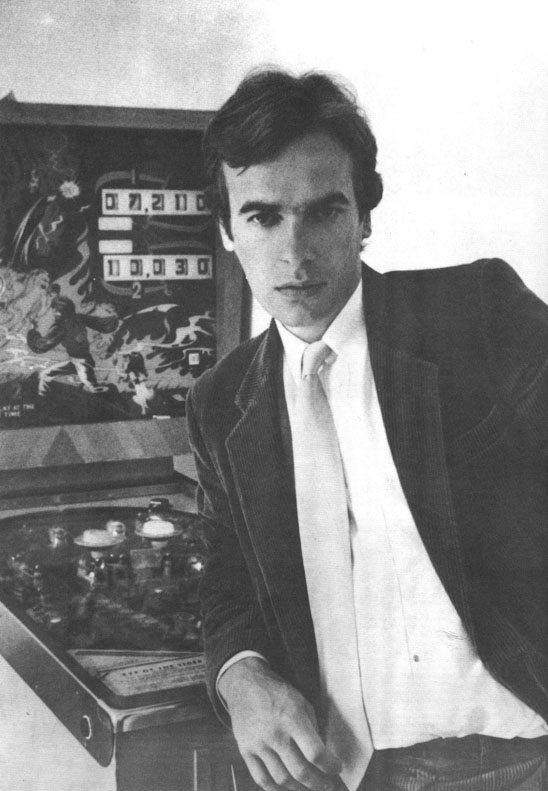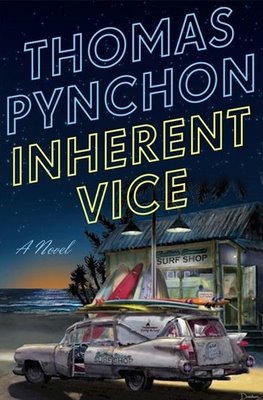
Pynchon narrates trailer for Inherent Vice

Yes, apparently so, according to Penguin.

For my money, better than a photo, hearing the old master’s voice.

Still feels strange to have a trailer for a book.

Inherent Vice, Chapter 1

pynchon

By way of introduction, let me say that my aim here is simply to record the experience of reading IR– the thoughts and associations that occur, and presumptuously, the pleasure of it -not to attempt to deliver any kind of verdict or review (at least not until the end). I’ll be reading each chapter twice, once in a normal fashion, the second time with an eye for things that seem strange/interesting/generally symbolic, my hope being to pull out material to which I shall return. I shall attempt a telegraphic plot summary, but I’m expecting this to fall by the wayside at some point. All page numbers are from the Jonathan Cape UK hardback edition.

So:

‘Inherent Vice’ is a legal tenet referring to a “hidden defect (or the very nature) of a good or property which of itself is the cause of (or contributes to) its deterioration, damage, or wastage. Such characteristics or defects make the item an unacceptable risk to a carrier or insurer. If the characteristic or defect is not visible, and if the carrier or the insurer has not been warned of it, neither of them may be liable for any claim arising solely out of the inherent vice.”

There are number of things this suggests: ‘original sin’, and its implications of humanity being cast out of Eden; that a given decline (or fall) was inevitable; that this or some other defect, being part of our nature,  means that no one is ultimately responsible, save perhaps our manufacturer.

The epigraph, ‘Under the paving-stones, the beach!’ is attributed to Paris, May, 1968, when the stones were lifted and thrown at the police (and by extension, the authorities). For all its apparent exuberance, the suggestions of freedom, nature etc, perhaps this has a more somber implication, because if you lift the paving-stones (whether to throw them or not) there is no beach, just more of the city- hard, unyielding rock.

PLOT

Chapter 1 has the classic noir set up of a private investigator (‘Doc’) being visited by a desirable ex-girlfriend (Shashta) who claims to be in trouble owing to a proposed double cross of her lover Mickey Wolfmann.

Tonight she was all in flatland gear, hair a lot shorter than he remembered, looking just like she swore she’d never look.

We can take this as basic description. But we can also see it as the start of a theme about people (and societies) changing, perhaps inevitably, about the difficulty of maintaining ideals. It continues:

“That you Shasta?”

“Thinks he’s hallucinating.”

“Just the new package I guess.”

And whilst we might still be on the first page, it’s not too early to start asking why Pynchon has made this a psychedelic noir- is it supposed to be a paean for a more liberated time, an apologia for escapism, or a slightly harder view of the many different things we do our ‘best’ to deny?

Pg 4 and 6 have characters distrusting technology, Shasta saying she tries to never use the telephone, then a more substantial passage about Doc’s Aunt Reet who prophesises the coming of search engines that will tell ‘you more than you want to know’ (perhaps a nod to our need for delusion), then speaks of ‘the stories that seldom appeared in deeds and contracts’, the more personal stuff that there will be no record of. This is an old thematic horse of Pynchon’s, previously, most lovably ridden in Gravity’s Rainbow and Mason & Dixon.

Page 5 has Doc being cynical about the idea of ‘free-love’- especially for its “other useful applications, like hustling people into sex activities they might not. given the choice, much care to engage in.” This may be just a chance for Doc to flash his hard-boiled credentials (the world weary P.I.); it is also a means of puncturing the notion (for those who even entertained it) that the 1960s were an idyllic time.

And after all the chatter above, it is worth stating, very loudly, THAT THIS IS ALREADY A VERY FUNNY BOOK. Wollfmann has been described as

technically Jewish, but wants to be a Nazi, becomes exercised often to the point of violence at those who forget to spell his name with two n‘s.

There has also been reference to an ‘overfed leopard’.

The remainder of the chapter is taken up with Doc trying to sort out his hair, the least edible pizza ever made, and another common theme of Pynchon’s, that of dispossession. Tariq Khalil comes to visit Doc, also wanting him to get in touch with Mickey Wolfmann, over a property development in his neighborhood. This culminates in Doc reflecting on

The long, sad history of L.A. land use… Mexican families bounced out of Chavez Ravine to build Dodger Stadium, American Indians, swept out of Bunker Hill for the Music Center, Tariq’s neighborhood bulldozed aside for Channel View Estates.

On the one hand this reminds us what all this swinging hedonism is built on; on the other, it invokes a ‘karmic adjustment’, the debt that needs to be paid (which Pynchon explicitly refers to on page 14, when relating the tale of a black family whose house was burned down after WWII by the Klu Klux Klan. The site, which was left  derelict, became the focus of youthful transgression, much to their parent’s chagrin). The name of the Estates- ‘Channel View- may signal the nature of the karmic punishment- that of televisual enslavement.

So far, so fun… (apart from these summaries I wrote a piece on Pynchon for this book, and an article about going to a Pynchon conference.)

Inherent Vice reviews

pynch

Some early reviews of Pynchon’s new book, most of which applaud its comic elements, though there have been some grumbles (which at times have verged on the pissy) about it lacking the substance of its ancestors. In the next few days, I’m going to start reading and blogging it, probably at the rate of about 25 pages a day (about 2 weeks in all). I do this purely for my own edification, but company, in such surroundings, is always a pleasant surprise.

Golden Hour reading

ghostlogocmyk

I’ll be reading at the Golden Hour, on Wednesday, August 19th (8 p.m. till late) at the Forest Cafe. It will be almost the same line up as on our recent European tour, which some have said was ‘the greatest triumphal procession through Europe’s capitals since Napoleon’s’ (which one, they did not specify). Exit polls for the audience showed that amongst the single people who attended, 63.2% were taken home by someone who cared for them very much.

So if were not there, and were not kissed, please, for your own good, come along.

Readers / Writers:

Jen Hadfield – a remarkably original and inventive poet who recently won the TS Eliot prize.

+

Ryan Van Winkle – poems & stories from the Reader in Residence at the Scottish Poetry Library.

+

Ericka Duffy – hot new prose from her hot new chapbook called The Succubus!

+

Jason Morton – stories that can eat bricks.

+

Jane Flett – seamstress of most fetching stories.

Music / Song Writers:

Billy Liar – Acoustic + infectious punk.

+

Jed Milroy – singer songwriter and hunter finally back from the Woods.

+

Withered Hand – intense, eccentric, bittersweet and very wry original songs.

+

Jonny Berliner – Joyus songs about crustacaens, exhaustion, and gluecose.

+

The Black Diamond Express – a rocking, hell-playing, old time string band.

Visual Amazement:

Paper Cinema and Kora

A cast of hand-drawn marionettes are magically brought to life. This is what happens at the accidental meeting of inkblots, photocopies, cardboard, angle-poise lamps, the occasional table, video technology, a laptop and a banana box.

What Practice Makes

41FburBqfPL._SL500_AA240_

You don’t get published for ages then…

‘What Practice Makes’, one of the first stories I wrote, appears in New Writing Scotland 27- In the Event of Fire. There’s also a good piece by Kirsten Innes, which I heard her give an excellent reading of at The Golden Hour.

The Tree That Bleeds

img045

Luath Press are going to publish The Tree That Bleeds, my book about living in western China, in early 2010.

For more information, click on the tab above.

Yeah, I’m pretty pleased.

A change in habit

Henry James in 1890, aged 47

Henry James in 1890, aged 47

I have recently acquired two new habits in the way I read. The first concerns how I consume prose. It used to be the case that I would, on finishing a book by one author, make sure to shift to one by a very different author. e.g. from E.M. Forster to Henry Miller (or vice versa). If there was anything as developed as a reason for this (which I doubt) it was to avoid being overly influenced by a particular voice.

My new approach is to do the opposite, to read as much by one particular author as is ‘possible’ (which here depends on how many books by a particular author I have, and if it seems worthwhile to try and do so- answers in the negative include Ian McEwan, John Fowles and Herman Hesse). I suppose I began doing this with Faulkner, partly because the first 5 or 6 were so extraordinary, partly because I wanted to see if there was anything he couldn’t do. The benefits of this are that one gets to watch a writer’s style evolve (in some cases, degenerate into mannerism) and that one can identify central preoccupations (or, to put it less grandly, whether he or she is repeating themselves in an increasingly tired manner e.g. Paul Auster). Currently, I am in a Henry James phase, having read The Europeans (very slight), wandered into Colm Toibin’s The Master, then resumed with The Spoils of Poynton. This is from The Master.

Henry studied Gosse and paid attention to his tone. Suddenly, his old friend had become a rabid supporter of the stamping out of indecency. He wished there were someone French in the room to calm Gosse down, his friend having joined forces, apparently, with the English public in one of their moments of self-righteousness. He wanted to warn him that this would not help his prose style.

The second shift concerns poetry, and is, I now realise, the opposite. Where once I would try (and always fail, except with Raymond Carver) to read a poet’s Collected Works, now I either read a single volume, or start with the latest work. Often this latter work seems best, and one does not thus get bogged down in juvenalia or false stylistic turnings. I’m not sure if this is due to the nature of poetry (as opposed- if it is- to prose) or just my own capacity for enjoying it (five or six poems at a time is usually sufficient).

The Road trailer

Worth it for Garret Dillahunt (‘That boy looks hungry’) alone.

***You Tube seems to have stopped allowing me to embed this- you’ll need to click on the screen to watch it.

Stone Voices

Salisbury Crags

Salisbury Craigs

I am continually disgusted by my ignorance of Scottish literature, history, geography, poetry and art. Where once I had purposefully spent hours exploring, going down streets and alleys simply because I had not done so before, now it is a matter of getting to my destination as quickly as possible. The city has plenty of decent museums and galleries, but these days my knowledge of what goes on in them is limited to the posters on walls I glimpse as I cycle by. I have probably not been to an exhibition for almost 2 years.

By no means is this something willful. It is what usually comes of living in the same place for a long period of time (in my case, almost 7  years in Edinburgh). I am aware of this lamentable state of affairs, but it is too comfortable a rut to get out of. Only occasionally do I lift my head and look around and properly comprehend how rich and interesting it is to live here. Usually after I’ve read something like Neal Ascherson’s Stone Voices, which, in its tour through Scottish political history, makes many interesting stops.

For instance, whilst I vaguely knew that Edinburgh had been the site of some serious shifts in geological thinking, I did not realise how profoundly they had altered people’s thinking.

At the end of most streets in Edinburgh’s Old Town rises the crimson wall of Salisbury Craigs, a lesson in the unimaginable force and lapses of time which have gone to shape the world. The Craigs are a basalt intrusion, a fossil tide of volcanic rock which surged through the foundations of a dead volcano some 200 million years ago. Geology and paleontology, with their revelations of deep time and alien life-forms, towered up wherever nineteenth century Scots turned their eyes. The ‘testimony of the rocks’ threatened their moral universe, its narrative incompatible with a creation myth or even with a creator.

Equally powerful testimony exists less than a twenty minute walk from my house, on Blackford Hill, where there is a rock i have passed dozens of times (on which, now I think of it, there is even a plaque). As Ascherson says, “Here, in 1840, the Swiss naturalist and geologist Louis Agassiz arrived in the company of Charles Maclaren, the Scotsman‘s first real editor.” It was his observations of the horizontal scratches on the stone that led him to claim they were the work of stones carried by a moving force, in particular ice masses.

From the Scotsman, the entire British public learned for the first time that there had been an Ice Age in their own land and throughout the northern hemisphere. Conventional religion was faced with proof that much of the world had been overrun, buried and reshaped by an ice-cap and glaciers hundreds of feet thick- and at a relatively recent period. Here was a cataclysm which the Book did not even mention.

As it with the Aggasiz rock, so it is with the shaped stones that constitute the buildings of a city. These too have their plaques that speak of what was done and said within, usually before our time. Perhaps, when we occasionally pause to read them- when the bus is late, when she is late -we find nothing of interest, no connection to the person who lived there or wrote X while doing so. The fault for this is entirely our own. We must unblock our ears.

Too long in the library #2

3614270233_78240b9bee

from Terry Eagleton’s piece in the LRB, 3oth April 2009:

During the Second World War, a woman was interned for five months when the authorities discovered an entry in her diary reading ‘Destroy British Queen. Install Italian Queen.’ She turned out to be a beekeeper.

An opinion

_46025777_007618209-1

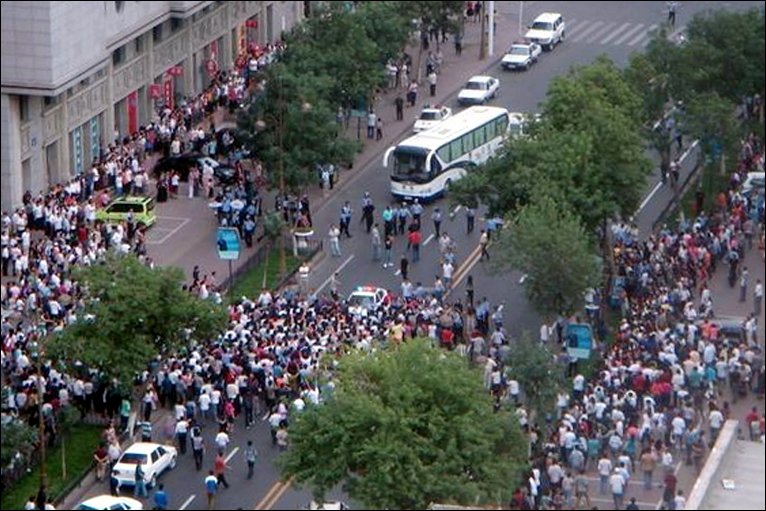
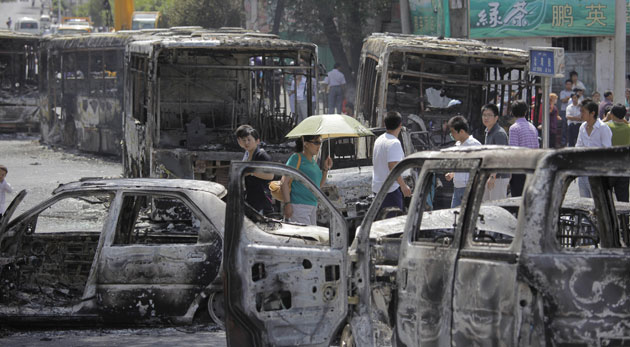
Though there is a long history of protest in Xinjiang (most notably in Baren, in 1990, and Yining, in 1997) the recent unrest in Urumqi differs from previous clashes in two important respects.

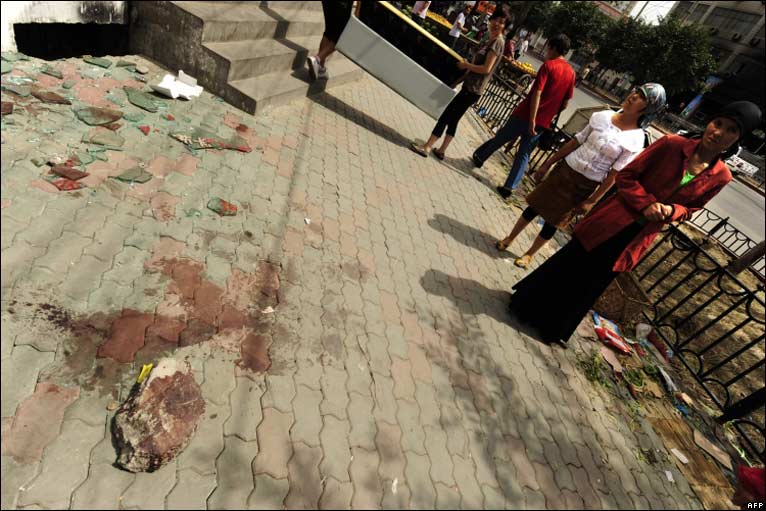
The first is that however the events of July 5th started (whether it was intended as a peaceful protest or not), it definitely ended in violence. Usually this violence has been between Uighur protesters and the army or police (with the protesters on the receiving end). On this occasion, judging by scores of interviews (and the casualty figures, of whom two-thirds were Han) the violence was mostly aimed at Han residents. This, then, is violence on purely ethnic grounds, aimed at other citizens rather than representatives of the government.

The second is the Han response to Sunday’s riots, when they purposefully set out to attack Uighur neighborhoods.This has reinforced the purely ethnic side of the conflict. The role of the police, unusually, has thus been to actually keep the peace.

Whilst the authorities represent a clearly defined entity, about which specific (and verifiable) grievances can be expressed, the same logic cannot apply to other ethnic groups. The fact that most of the police and army (and government) are Han Chinese naturally leads people to conflate the two, but does not, I think, necessitate an automatic hatred for people as individuals. When I lived in Yining in 2001-2, Han and Uighurs were able to co-exist, albeit often in separation (separate schools, neighborhoods, shops and restaurants). Though there was prejudice in abundance, there was rarely any sense that it would escalate to violence.

But even uneasy co-existence seems far off in Urumqi. There will probably be soldiers on the streets for a long time.

‘Martial law in all but name’

_46025780_007618231-1

Yesterday a mob (I think this is a fair way to describe a crowd of people armed with iron bars, meat cleavers and shovels who are shouting angry slogans) of Han Chinese attacked Uighur neighborhoods in Urumqi, in apparent retaliation for Sunday’s violence. Though there were reports of beatings, no casualties have been confirmed (which did not stop the World Uyghur Congress from reporting a long list of atrocities:

A Uighur woman who was carrying a baby in her arms was mutilated along with her infant baby… over 1,000 ethnic Han Chinese armed with knives and machetes marched into Xinjiang Medical University and engaged in a mass killing of the Uighurs… two Uighur female students were beheaded… their heads were placed on a stake on the middle of the street.

This post seems to have since been removed from their site (and it is important to stress that there has been absolutely no indication of any such horrific events), in favour of reports that rely more on the major news providers.

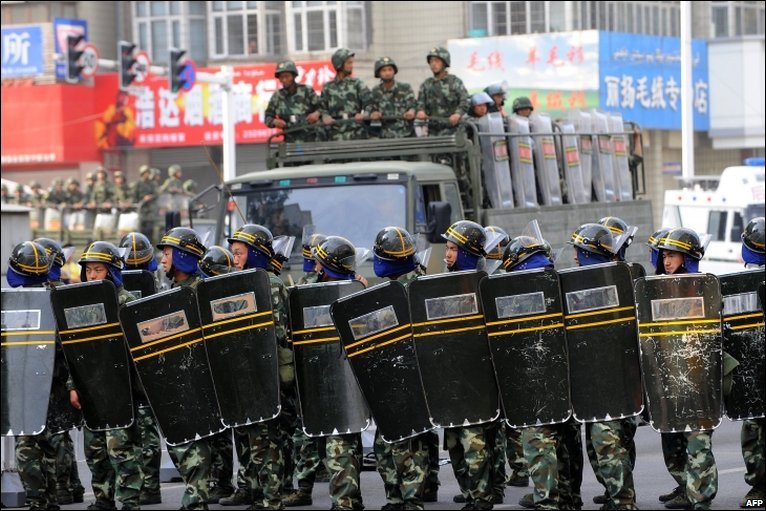
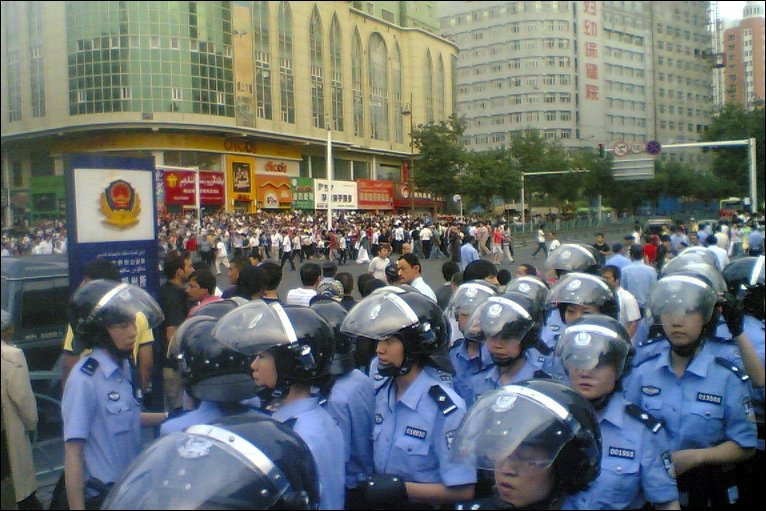
Today, the BBC are reporting a massive troop influx into the city (some estimate 20, 000). They show footage of soldiers marching through the streets; there is talk of it being ‘martial law in all but name’.

Interesting, their footage (which looks to be in a central, Han area) shows people going about their daily business. No doubt the increased troop presence has reassured them there will not be a repeat of Sunday’s violence (a retaliation for their retaliation).

The BBC also have this photo of a Uighur neighborhood, where residents are apparently blocking off a street. Perhaps they are less reassured by the massive influx of troops.

Uighur residents blocking off street

Uighur residents blocking off street

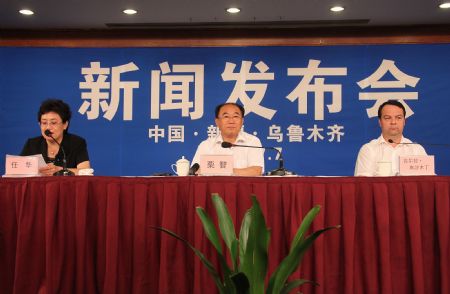
“Ethnic confrontation should be definitely prohibited”

Local government officials hold a press conference

Local government officials hold a press conference

This was the message of Wang Lequan, secretary of the Xinjiang Uygur Autonomous Region Committee of the Communist Party of China (CPC) earlier today, who sounded increasingly worried, and unusually conciliatory.

“Neither the people of Han nor Uygur ethnicalities (sic) are willing to see the Han people being attacked. It is the same the other way around. If the Han people attack the innocent Uygur people, it is also heart-breaking. The family members of those who were involved in the violence are innocent. We should be cool-headed and do not be fooled by the enemies…Our targets should be the hostile forces at both home and abroad and criminals, rather than our own brothers and sisters of different ethnic backgrounds.”

He also announced there will be a curfew in Urumqi (and probably elsewhere).

A less conciliatory note was struck by Foreign Ministry spokesman Qin Gang, who denied that the original protest on Sunday had been intended to be peaceful. He described it as “an evil killing, fire setting and looting… Anybody calling the violence a peaceful protest is to turn black into white in an attempt to mislead the public,” Qin told a press conference.

At present, an estimated 1,400 people have been arrested across the province in connection with Sunday’s protest.

“Now we are going to their area to beat them”

_46019971_hi007610426

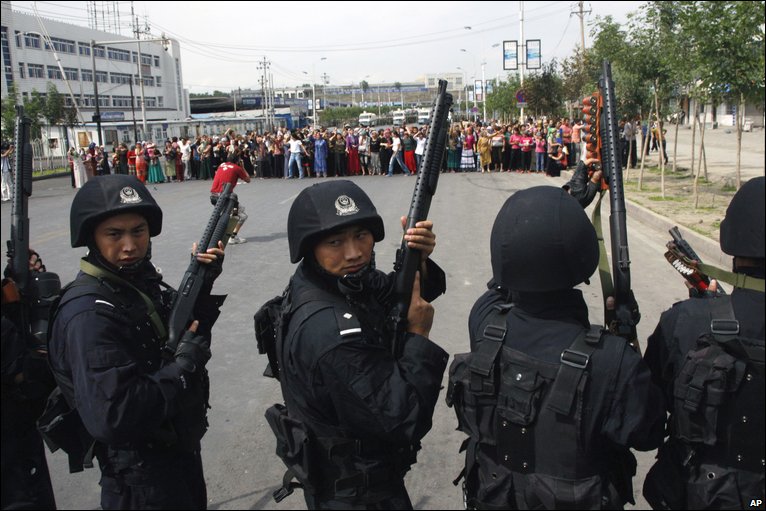
Chinese official sources are reporting what appears to be a counter-protest in Urumqi, this time by Han Chinese. They report that several thousand people

“armed with clubs and knives.. marched along the Youhao Street and Guangming Street toward Erdaoqiao Roadin downtown Urumqi Tuesday afternoon. The protesters, mostly Han Chinese, were shouting “protecting our home, protect our family members”. Police armed with guns and shields guarded intersections. A Xinhua reporter saw a police officer crying while he followed the march.Many of the protesters gathered at the Urumqi South Railway Station, Changjiang Road, Yangzijiang Road and some other places. People ran in panic and roadside shops were shut down. Residents of some community compounds were holding bats for self-defense.”We will not hide up anymore. We will fight back if they (the rioters) come,” said a man standing in front of a building in Shihezi. Crowds of people rushed to the municipal people’s hospital to take shelter. Many nurses were trying to call their relatives to make sure they are safe. An adult who was coughing up blood and a young man whose head was covered in blood were rushed to the hospital for emergency treatment… Someone drove a car into a police wagon during a standoff with police at Tuanjie Road at about 1:30 p.m.. Police have arrested a number of people. The number of arrests in the latest outburst is unknown at this time.

I’m not sure what to make of the tone of the Chinese report. It’s unusual for the Han to be portrayed as being so aggressive. It doesn’t read like a threat, or an act of self-defense. If anything, the report seems almost bewildered by the way in which things seem to be slipping out of the government’s control.

_46020533_-54

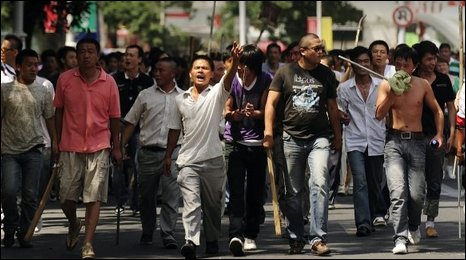
The BBC have since confirmed that a demonstration by Han Chinese took place. Hundreds of Han Chinese marched through the streets of Urumqi smashing shops and stalls belonging to Uighurs. Reuters reported that some Chinese protesters shouted “attack Uighurs” as both sides threw stones at each other. One Chinese protester, clutching a metal bar, told the AFP news agency: “The Uighurs came to our area to smash things, now we are going to their area to beat them.”

Further protests in Urumqi

Uighur people take to the streets in Urumqi. Photograph: Guang Niu/Getty Images

Uighur people take to the streets in Urumqi. Photograph: Guang Niu/Getty Images

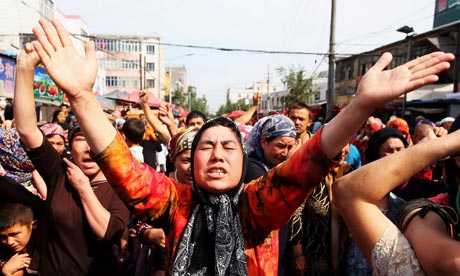
The BBC and The Guardian report that there have been further protests in Urumqi, this time without violence. Incredible footage at http://news.bbc.co.uk/1/hi/world/asia-pacific/8137519.stm

Uighur residents erupted into protests during an official media tour of the riot zone in the face of hundreds of officers… Women in the market place burst into wailing and chanting as foreign reporters arrived, complaining that police had taken away Uighur men. Authorities have arrested 1,434 people in connection with Sunday’s unrest. As they streamed out on to the main street, the crowd swelled to about 200, with Uighur men and more women joining them, shouting and waving their fists… And then a single old woman, propped on a crutch, forced armoured personnel carriers and massed paramilitary ranks into a slow – if temporary – retreat. No one noticed her at first. She emerged from the crowd and moved slowly down the street. A Uighur police officer came forward to escort her away. She could not be persuaded. As older residents stepped forward and attempted to calm the crowd, she advanced steadily towards the line of armoured vehicles. She halted inches in front of one. The driver started its engine. For a long moment they faced each other. Then the carrier slowly began to roll backwards and the line of officers inched away, back down the road. Suddenly, the massed might of the Chinese authorities looked very much like one scared and vulnerable man – like many of the young officers stationed around the city. Officials attempted to remove reporters – telling them that it was not safe and did not fit in with media arrangements – as the stand-off continued. “You see old women and children now. But on Sunday night it was men – you should go to the hospital and see the victims,” said one.

One wonders what the situation would be like if the international media was not present. It could be like after the riots in Yining in 1997, where arrests continued for weeks, followed by executions.

Or perhaps the Chinese authorities have decided that such crackdowns are ultimately counter-productive. That they only exacerbate tensions between Han and Uighurs.

The test is what happens when the media’s attention inevitably shifts.

Unrest spreads to Kashgar

Further pictures of Urumqi from the BBC, who also report that the unrest has spread to Kashgar, in the south of Xinjiang, which has been the focus of many protests in the past. The authorities claim that about 200 people were “trying to gather” at the Id Kah mosque in the centre of Kashgar. They also claimed to have information about plans to organise unrest in Aksu and in Yili prefecture (which was the site of the largest riots to date, in 1997). Given that all of the police and paramailitary troops are likely to be on full alert, it seems unlikely there will be any more large scale disturbances like the one in Urumqi. It is not just the sheer number of police and troops that make this likely- they are also organised in rings that encircle most of the major towns in the province.

_46015540_007602848-2

_46017788_stains_afp

_46015541_007602849-1

Update

Burned-out-buses-after-ye-002

The BBC are reporting that the clash in Guangdong province last month (n the city of Shaoguan) was caused by a man who posted a message on a local website claiming six boys from Xinjiang had “raped two innocent girls”.

Police said the false claim sparked a vicious brawl between Han and Uighur ethnic groups at a factory. Two Uighurs were killed and 118 other people were injured.

As for the riots in Urumqi, Uighur groups are insisting that their protest was peaceful and had fallen victim to state violence, with police firing indiscriminately on protesters in Urumqi.

Dolkun Isa, a spokesman for the World Uyghur Congress (WUC) in Munich, disputed the official figures, saying the protest was 10,000 strong and that 600 people were killed. He rejected official reports on Xinhua that it had instigated the protests.

Riot in Urumqi

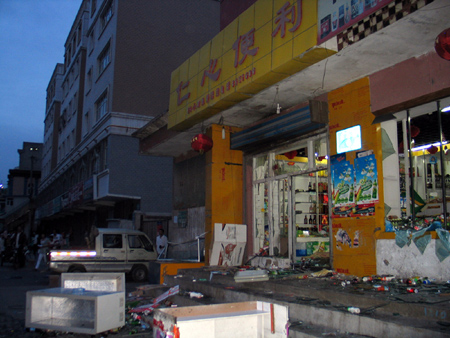
A shop smashed on Tianchi Street in Urumqi

A shop smashed on Tianchi Street in Urumqi

The Guardian reports that there has been widespread violence in Urumqi, the provinical capital of Xinjiang. Official reports place casualties at 140 so far (though this is impossible to verify). The protests were said to have started when several thousand people rallied in the grand bazaar to protest at the death of two Uighur migrants, and injuries suffered by hundreds of others, during an ethnic conflict between workers in a factory in Guangdong, southern China, last month. If this is the case, then it marks a shift from previous protests, most of which have have been at the provincial level (see my article at Eurozine for background and the history of such protests). One would predict an even more intense crackdown than usual from the authorities- nothing disturbs them more than nationally-organised protest.

xin_0620706061121500275224

The official explanation is that “the violence was masterminded by the separatist World Uyghur Congress led by Rebiya Kadeer, according to the regional government. Rebiya Kadeer, a former businesswoman in China, was detained in1999 on charges of harming national security. She was released on bail on March 17, 2005 to seek medical treatment in the United States.”

Whilst there is no evidence of Kadeer ever having done much more than send a few newspapers to her husband (let alone instigating a riot via the internet), it is interesting that the government refuses to mention the political aspect of the riots, so as (in the case of the riots in Yining in 1997) to portray the rioters as apolitical criminals intent on looting and destruction.

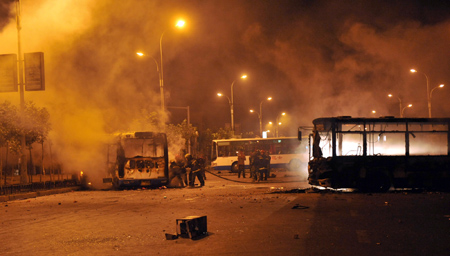
Firemen put out a fire in Dawannanlu Street in Urumqi

Firemen put out a fire in Dawannanlu Street in Urumqi

As for the events in Guandong, the government said “that three forces of terrorism, separatism and extremism made use of a fight between Uygur and Han ethnic workers in a toy factory in Guangdong Province on June 26, in which two Uygur workers died, to creat (sic) chaos.

“Nur Bekri said the bodies of the two Uygur workers in the factory fight have been sent back by plane to Xinjiang for burial. Police in Xinjiang and Guangdong are jointly investigating the incident.

“The government of Shaoguan City, where the toy factory is located, and the factory are trying their best to help Uygur workers go back to work as soon as possible, he added.

“The fight was triggered by the sexual (sic) of a female Han worker assault by a Uygur coworker, he said.”

More on this to follow (not least the dubious implication (as I read it) that it all stems from an attempted rape by a Uighur male.

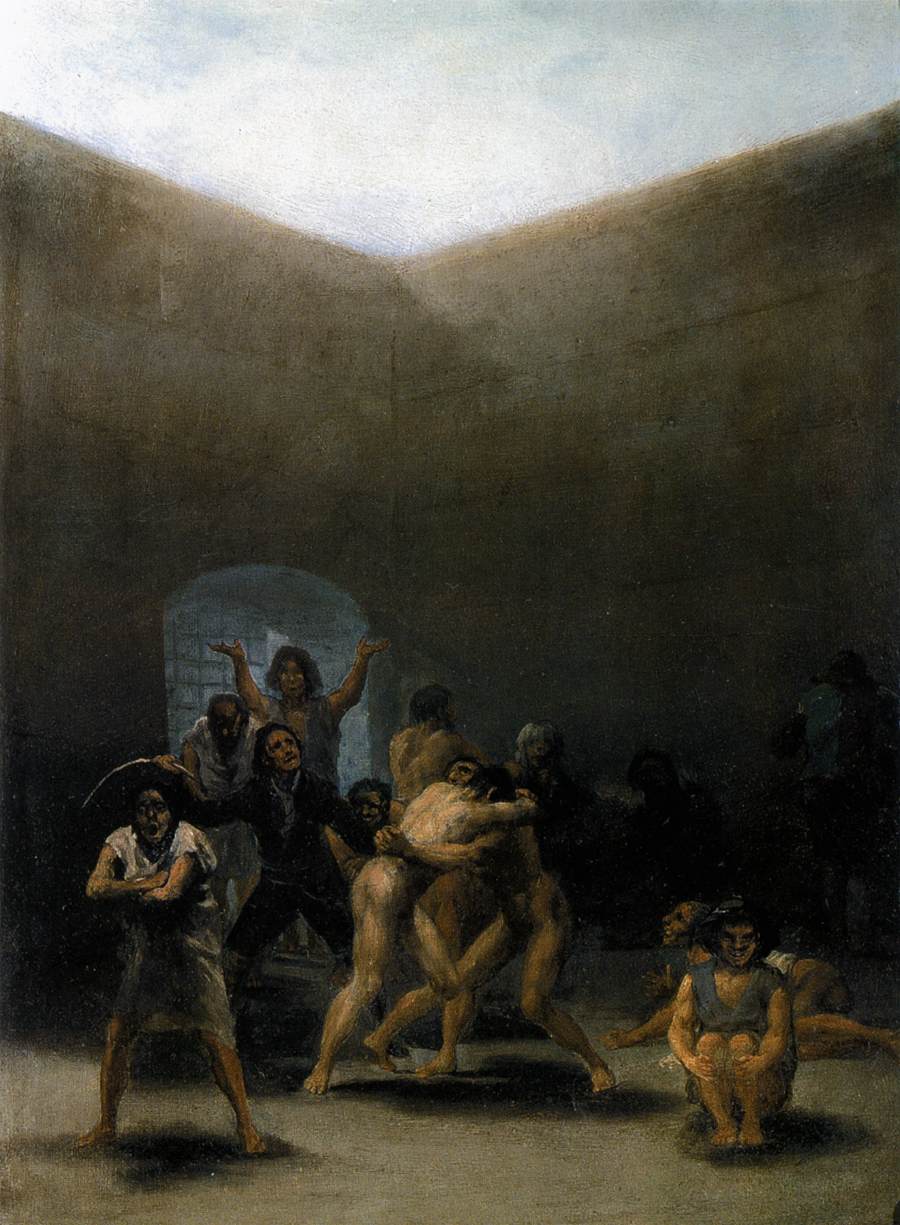
FAO: Lunatics

FranciscoGoya-Courtyard-with-Lunatics-The-Yard-of-a-Madhouse-1793-94

A reasonable request from Alexander Waugh:

To the Editors:

Adam Kirsch’s high-minded and misleading review of my book, The House of Wittgenstein: A Family at War [NYR, June 11], has caused at least one terrorist lunatic to write to me in a threatening manner. I quite understand that reviewers cannot be expected to tailor all their work to the sensibilities of lunatics, but if there happen to be others among your readers who have also interpreted from Mr. Kirsch’s remarks that I am a “Jew-hating British intellectual piece of dog shit” I would advise them, before putting pen to paper, or threatening to “knock me on my ass,” that they read the book itself, which clearly expresses my huge admiration for the Wittgenstein family and acts as a corrective to most of Mr. Kirsch’s somber pensées.

Alexander Waugh
Taunton, England

Age waters the writer down

Martin Amis, 1985

Martin Amis, 1985

I’ve never got much out of Martin Amis’ novels. They seem to want to be both ludicrous (farcical plots; characters called ‘Russia’) and very, very earnest (“She wondered where the end of the world was and what the world ended with- with mists, high barriers, or just the end of everything” Other People, p.56). The only books of his I’ve enjoyed were Experience, a memoir, and The War against Cliche, a collection of reviews and essays, most of which were impressively precise in their attention to language.

I was very snug in this opinion (fiction- no thank you; non-fiction- yes, please) until I read a number of articles in which he expressed opinions on Islam and terrorism that suggested he had lurched to the political right. In October 2006 he told the BBC that we should not feel bad about having “helped Iraq scrape a draw with Iran” in the Iran-Iraq war because a “revolutionary and rampant Iran would have been a much more destabilising presence.” Elsewhere he referred to the “extreme incuriosity of Islamic culture.”

It seemed ill-advised for him to be making high-profile pronouncements on subjects as complex as these. It recalled the rightward shift of Christopher Hitchens (who vigorously defended the Iraq war in the pages of Vanity Fair). And because these views were so in conflict with my own, I accordingly (and very conveniently) wrote him off. It was much simpler than trying to reconcile Amis-as-political-pundit with Amis-as-critic.

But this morning, as I clicked my way through today’s Guardian, I saw he had written a piece on Updike’s last book. It begins with a challenge that is hard to turn down, perfectly pitched as it is to the promise of wisdom and the reader’s ego.

The following wedge of prose has two things wrong with it: one big thing and one little thing – one infelicity and one howler. Read it with attention. If you can spot both, then you have what is called a literary ear.

… Craig Martin took an interest in the traces left by prior owners of his land. In the prime of his life, when he worked every weekday and socialised all weekend, he had pretty much ignored his land.

From there it takes sentence after sentence apart, chiding them for repetition and poor word choice (I wonder if he would fail the sentence from Other People quoted above on the same grounds).  As Amis himself concedes, it is the kind of demolition that “would have gone unwritten if its subject were still alive”.

But this destruction is wreaked in the most loving, respectful fashion (for Updike’s place in Amis’ canon is almost as assured as that of Saul Bellow), as if by highlighting the flaws of this last book, he means to underscore the quality of all that came before. It is a fine review. It makes me think that his students at Manchester University are very fortunate. They cannot be complacent.

Alas, poor Kodachrome

UmeEQ2M5kp2gdd521Yatplsko1_r1_500

Two Gentlemen 1951

This week Kodak announced that they would no longer be manufacturing Kodachrome film. Even someone like myself who has little interest in taking photos (though always interest in looking at them), feels a degree of sadnes at this news, which is all the more acute on looking at Margaret Strickland’s pictures, taken by her grandfather during the Korean war, and in Valdosta, Georgia (which I found via the excellent new Oxford American art blog).

It is, of course, quite typical, that the one picture of hers that I was able to paste in is the least colour saturated. You’ll need to go the immense trouble of clicking to see what I mean.

That Incredible Music Again

31A82TZBYpL._SS500_

The New York Observer reports that there are two biographies of David Foster Wallace being offered to publishers. One is by D.T. Max (who wrote the excellent New Yorker piece) and has already sold. The other, by David Lipsky, is perhaps not quite a biography, apparently more a sketch based on a series of interviews he did for Rolling Stone in the mid-90s (which never got published).

Max’s biography is due to come out no earlier than 2011. He aims to examine the sociological factors that shaped D.F.W’s writing (this for some reason depresses me).

“The reason I wanted to go longer on him is that most writers live and die in a room writing, and Wallace definitely did that, but he also lived and died out on the street. He was in the world in a way that most writers are not. Because of his peculiar openness to the world and his peculiar kind of sensitivity, everything that happened in this country affected him and entered his fiction in a way that I don’t think is true of other writers.”

He added: “We don’t know the book where the author is a child in the ’70s … where he first becomes a writer in the Reagan era, attacking when everyone else is retreating. And where he keeps trying to produce during the profound blandness of the Clinton years. … That’s not on the bookshelf yet. Because the writers who’ve gone through this experience are just too young—they’re in mid-career; much of their work is ahead of them,” Mr. Max said. “So in the tragedy of Wallace’s early death, I see an opportunity, a chance to write down a story so recent, it’s strange.”

Much as I admired Max’s piece, I would prefer to hear more from D.F.W., rather than someone else’s take on him. Let’s hope the Lipsky book finds a home.

Christian the lion

liontv_468x649

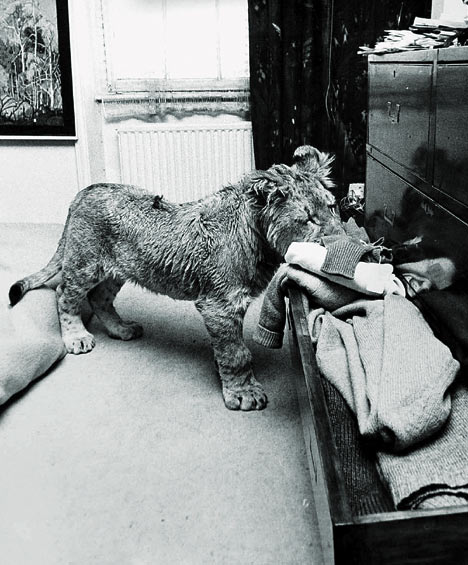
“Sometimes, he’d see people staring at him through the back window of the car, keep very still on purpose – and then, just when they were convinced he was a stuffed toy, he would very slowly turn his head and freak them out.”

This lion was bought (as a cub) from Harrods, then lived in a London flat in the Sixties. Eventually its owners had him released in Africa, and were then, even more improbably, reunited with him years later. If this all seems horribly cute, I’m sorry, it is Friday. Further details here.

Also, here is the sickeningly happy video when they are all reunited.

liondraw_468xx565

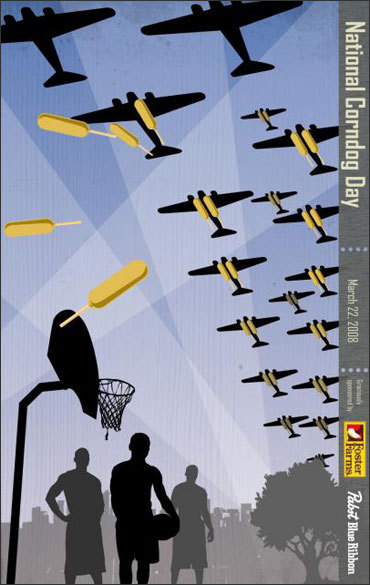
A screaming comes across the sky

corndog

Consider this your advance warning.

From September, I shall be doing a PhD on Thomas Pynchon at the University of Edinburgh.  Some, or even much of it, may take place in this column. Look forward to half-baked statements, scraps of literary theory, tedious unpickings of sentences, obscure allusions, deployment of dodgy terminology, some of it made-up (for example, yesterday, whilst semi-drunk, I hatched the phrases ‘bathetic inversion’ and ‘bathetic mimesis’).

My ‘proposal’ follows below. It is what I think I will be doing, until I start doing it. Then, after an indeterminate period- months, years -I will have a moment of panicked horror when I realise I have been doing something completely different, most likely very far from Pynchon. It will be like wandering in an unfamiliar city where every scrap of wall and face seems delightful till you realise that night is close and you are lost and a figure is coming towards you.

Proposal

As a symbolic structure, the historical novel does not reproduce the events it describes; it tells us in what direction to think about the events (White:1978 cited in Huthceon:1988).

The novels of Thomas Pynchon are dense, encyclopedic narratives, rich in allusion and context. Most, if not all, can be considered ‘historical’, in the sense that the majority of their action takes place in the past, ranging from the mid-18th Century setting of Mason & Dixon, up to a period that resembles (whilst not quite being) the 1980s of Vineland. As many have argued, most recently Smith (2005) and Thomas (2007), Pynchon uses these different historical contexts as a way of challenging received interpretations of history, so as to shift the focus from a unitary, cohesive narrative of progress, to one that emphasises plurality, injustice, and the structures of authority (including those of ‘narrative’ and ‘historiography’) that promote inequality. My proposed course of research is to analyse the means by which this project is continued, and extended, in Pynchon’s most recent novel Against the Day (2006), with the aim of understanding its significance in the context of his previous work.

The novel’s framing narrative is the Boys-Own style adventures of ‘The Chums of Chance’, which span the chronology of the book, from the late 19th Century to the start of the First World War. These ‘Chums’ travel round the world in hot air balloons, at the behest of semi-mysterious figures, accompanied by a dog with a penchant for the novels of Henry James. This comic pastiche is another example of Pynchon’s ‘serious unseriousness’ (Tanner: 2000). As in V. and Mason & Dixon, the presence of absurd elements (songs, fantastical creatures, elements from popular culture) is used to satirise the naïvete and self-delusion of many of those involved in the business of Empire (and indeed, many of the ‘Chums’, by the end of the book, do question their service of the imperial powers).

However, it seems likely that Pynchon’s intends to do more than simply undermine the rhetoric of imperial duty. The notion of an air-borne set of global agents is strongly reminiscent of the science fiction writing of the period (Jules Verne, H.G. Wells et al). By merging this fantastical strand with well-documented historical events, Pynchon (as in his previous work) calls into question the veracity of all presented historical events. This, of course, is what we would expect from any self-respecting (and self-regarding) piece of historiographic metafiction (Hutcheon:1988). Pynchon’s specific purpose may be to interrogate these visions of technological progress, in particular the arguments that such technical advancements would be socially beneficial (see Lindqvist: 2001). In his previous novels, most notably in Gravity’s Rainbow, scientific and technological ‘progress’ has been closely equated with dehumanisation and destruction (Smith: 2005). There are also a number of scenes in the novel where the future literally encroaches on the present, in the form of ghosts from the approaching First World War, and of “Trespassers” from “the end of the capitalistic experiment” (Against the Day: 467). One potential course of inquiry is thus to examine how Pynchon, by embedding ‘science fiction’ within received history, undermines our narratives not only of the past, but of the future as well. My discussion of Pynchon’s use of genre-elements is likely to be informed not only with reference to his previous work, but also by his forthcoming novel, Inherent Vice (2009), which promises to be “part-noir, part-psychedelic romp”.

As in many of Pynchon’s previous works, Against the Day utilises recurring symbolic tropes (Smith: 2005). Whilst it will require close reading to unpick these elements in Against the Day, a first reading of the novel suggests that light— its refraction, reflection, its ordering and disruption —is a leitmotif throughout the novel, perhaps representing some of the different uses to which versions of the past, or visions of the future, may be employed by those who possess (or lack) power.

In terms of methodology, my approach will be to try and embed the kind of micro-textual analysis performed by Thomas (2007) within the type of framework Smith (2005) utilises. Whilst both approaches have much to recommend them (Thomas’s focus at the level of the sentence; Smith’s sense of the novels’ grand thematic arcs), singly they possesses methodological weaknesses: on occasion, Thomas is forced to rely on rhetoric to bridge the logical gaps in his arguments for the great significance of a single phrase; whilst Smith sometimes try to second-guess Pynchon’s intentions without anchoring such supposition in the text . By combining these two approaches, I hope to complement their respective strengths whilst balancing their shortcomings.
In order to provide a theoretical context for my analysis, my research will also include a discussion of the debates regarding the value of metafictional historiography, such as whether or not, in a form so imbued with irony, one can determine the “boundary between parody and mimetic representation” (Witzling: 2007). Or, to put it more crudely, How can one be sure of the political stance of any given text?, assuming as White (1978) perhaps does, that a (postmodern) text can have anything so coherent and knowable.

Bibliography

Hutcheon, L. (1988) A Poetics of Postmodernism, Routledge: London.
Lindqvist, S. (2001) A History of Bombing, Granta: London.
Pynchon, T. (2006) Against the Day, Vintage: London.
Smith, S. (2005) Pynchon and History, Routledge: London.
Tanner, T. (2000) The American Mystery: Essays on American Literature from Emerson to DeLillo, Cambridge University Press: Cambridge.
Thomas, S. (2007) Pynchon and the Political, Routledge: London
Witzling, D. (2007) Everybody’s America: Thomas Pynchon, Race, and the Cultures of Postmodernism, Routledge: London.

Brief Interviews with Hideous Men trailer and clips

brief_interviews_with_hideous_men_movie_image_julianne_nicholson

Well, it’s not quite a full trailer, and not great quality. But it gives an encouraging glimpse of how Jon Krasinski has tried to translate DFW’s monologues into film.

For the ‘trailer’ click here

**There are also some actual scenes at Collider.com

*** Apple now has the official trailer

Granta, Burnside, Gregerson

1242299192932

Somehow, without quite meaning to, I have been leaving my room. Last night I went to a poetry reading by John Burnside and Linda Gregerson, both of whom, despite my misgivings about readings, spoke (and read) very well. Many of her poems had that longed-for (though not predictable) shift in tone or subject that, when it works, is like the shift from cold to warm when stood beneath a shower. Her most recent collection is Magnetic North.

41yt0cW1ujL._SL500_AA240_

I only know Burnside’s work through his considerable reputation, as both a novelist and poet. The poems he read (including a long narrative poem about hunting a deer that made me recall, in a pleasurable fashion, Faulkner’s story ‘The Bear’) were mostly from his forthcoming collection, The Hunt in the Forest. In all of them the language seemed vital, rooted in landscape and its traditions (not least those of how we represent and imagine it).

31lcmnTUGAL._SL500_AA240_

Were this not enough, I also attended the launch of the Edinburgh International Book Festival this morning, held amidst the grandiosity of the Signet Library.

signet-library

Champagne was consumed. Some items were received. One of which was the new Granta (106), which continues to improve under the editorship of John Freeman (by which I mean that it features more interesting writers, as well as being willing to print work like Chris Ware’s (you will want to zoom in on this:

warenyr061127-05

Issue 107 also promises to be good, with pieces by Kenzaburo Oe and (gasp) William T. Vollmann.

Now it is the afternoon; the fizz has consented to fade. It was very nice to go out. Shall try it again next year.